TRANSMISSION // 2611.34521v1
PURA lets video AI prune across space and time
Source published
A training-free method weighs spatial and temporal redundancy together to shorten video-token sequences, with benchmark tests reporting an accuracy–efficiency trade-off.
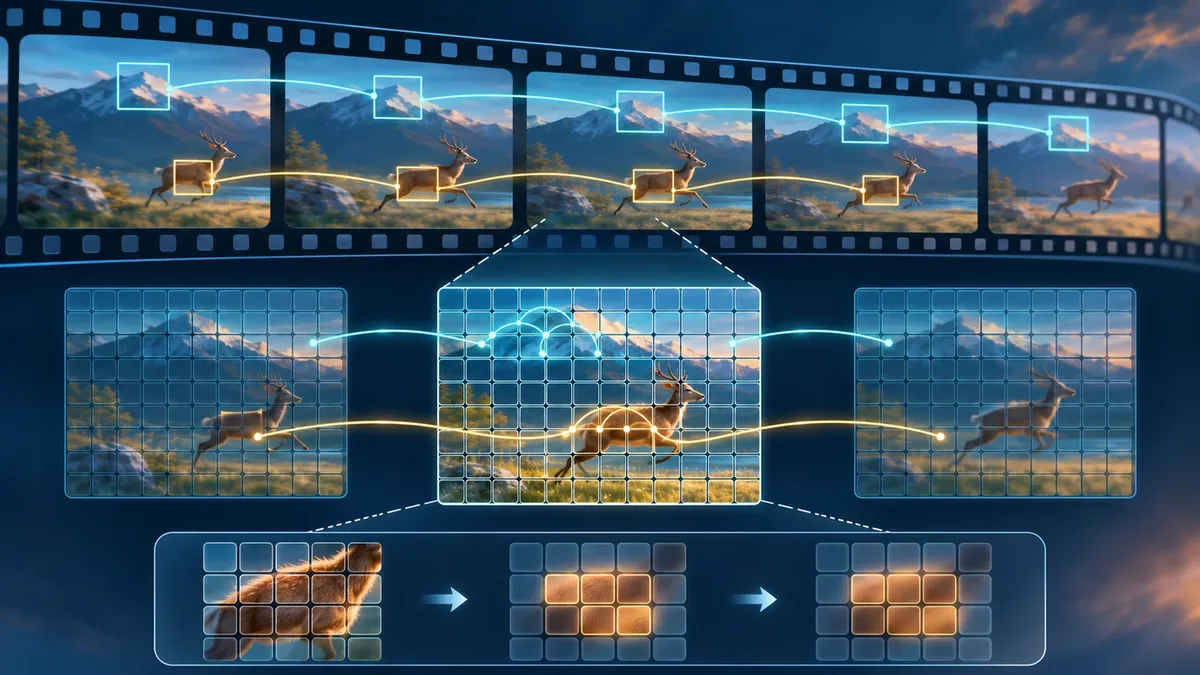
Video models can spend substantial computing effort processing repeated or similar visual details. PURA, a proposed training-free pruning method, assesses redundancy within frames and across time to decide which visual tokens to remove.
Why video tokens are a bottleneck
When a video large language model (VideoLLM) processes a clip, its vision system turns images into visual tokens—compact representations of patches or regions. More frames and higher-resolution images can mean more tokens for the language model to handle, increasing inference time and memory use.
Some tokens represent repeated content: a background may stay similar across frames, or regions within one frame may contain similar information. Compression methods remove or combine tokens while trying to preserve enough evidence for the model to answer questions.
The authors of PURA argue that many existing methods prescribe how compression proceeds—for example, handling within-frame and across-frame redundancy in a fixed order, or assigning them fixed shares of a budget. PURA asks whether the balance can instead adapt to the redundancy in each video.
Choosing what to keep
PURA is described as training-free: it does not require additional model training. For each token, it creates candidate references in two ways. Spatial candidates are other tokens in the same frame. For temporal candidates, the method links tokens between adjacent frames within video segments, matching within a local spatial neighborhood, then traces those links backward.
PURA chooses the most similar available candidate across the spatial and temporal options. The feature difference between a token and its chosen reference estimates representation error. The method combines that error with token importance, measured using attention in the vision encoder, to calculate a removal cost. During pruning, accumulated importance is also transferred to retained references, so the cost reflects the contribution of tokens already represented by them. This cost helps guide which tokens are removed; it is not simply a ranking by similarity alone.
Removing tokens one at a time requires repeated ranking and updates. PURA’s second component, Coordinated Pruning, groups compatible low-cost candidates for batch removal. Its checks are designed to prevent one removal from invalidating another token’s reference in the same batch. After each batch, the method updates affected matches and costs, then continues until it reaches the target token budget. Finally, it refines retained representations by averaging in features from removed tokens that are sufficiently similar.
What the tests report
The paper evaluates PURA with three VideoLLMs—Qwen3-VL-8B-Instruct, InternVL3.5-8B, and LLaVA-Video-7B—on five video-understanding benchmarks: EgoSchema, LongVideoBench, MLVU, MVBench, and VideoMME. The authors compare it with five token-compression methods. On Qwen3-VL with 64 input frames, PURA has the highest reported average score among the compared methods at each of four tested retention levels: 20%, 10%, 5%, and 1%. These are averages across benchmarks; individual benchmark scores do not show PURA winning every comparison. The paper also reports the highest average scores for the other two models at their tested retention levels.
In a latency test on VideoMME using Qwen3-VL and one NVIDIA RTX 5090 GPU, PURA retained 10% of visual tokens and recorded an end-to-end speedup of 2.53× over the uncompressed model. At 5% retention, the reported speedup was 2.71×. These results describe the paper’s particular setup, not guaranteed gains on other hardware or workloads.
The authors also report that Coordinated Pruning reduced mean compression time from 2,435.5 milliseconds to 21.8 milliseconds across five benchmarks at 5% retention, using the paper’s coordinated-pruning configuration. This measures the compression procedure, not the entire model inference process.
The paper tests whether saved token capacity can accommodate more frames. With Qwen3-VL, PURA’s reported average score reached 105.7% of the 64-frame uncompressed baseline when processing 512 frames at 12.5% retention. This is a result for that benchmark configuration, not evidence that pruning generally improves understanding. Component tests also report gains as the authors add attention-based importance, importance transfer, feature merging, and temporal pruning to a spatial-only baseline.
What remains uncertain
The results support PURA on the models, benchmarks, retention settings, and hardware reported in the paper. They do not establish performance on every video, model architecture, or real-world task. Pruning can remove details that matter, and benchmark averages may hide differences among clips or question types. The method also uses specified segmentation thresholds and local matching settings; their effects beyond the tested experiments remain uncertain.
The source is an arXiv preprint. The findings here are the authors’ reported experimental results, and broader evaluation would help establish how well the accuracy–efficiency trade-off carries over to other settings.
- video large language models
- visual token pruning
- video understanding
- inference efficiency
- spatiotemporal redundancy
Reviewed cross-references
These connections were reviewed by a model, not independently fact-checked by a human. Similarity does not imply agreement; consult the original papers and the evidence below.
A Tokenizer-Aware Approach to Faster Video AI
Supporting evidence: Both papers report that training-free video-token reduction can improve inference efficiency while retaining task performance in their tested settings: PURA reports end-to-end speedups with 10% or 5% retention, while ESSENCE reports near-full-model accuracy at about 2× faster time to first token on sparse videos. This is compatible evidence, not a head-to-head comparison; the methods, models, benchmarks, and efficiency measures differ.
Model review: · openai-codex/gpt-6-luna
Evidence and provenance
Selected excerpts, not complete papers. PDF extraction can omit figures or damage equations, tables and reading order; sources may be preprints.
2611.34521v1 — Original paper
Excerpt reference:
static/papers/2611.34521v1.md:243-303
Basis: Paper text
Source SHA-256:5025ebe83e2efb955028936048b18b50528d7fe53ff6bc2fc81545f264a549542611.26933v1 — Original paper
Excerpt reference:
static/papers/2611.26933v1.md:237-303
Basis: Paper text
Source SHA-256:87b76a1c6896a86b96790f7f0adf4232a6ada5b647f54d6e2144bfc9039abf3d
Related reading
Automatically matched by shared topic keywords. These links do not imply that the sources agree or establish a consensus.
FP-Prune: Choosing Visual Tokens by What They Add
Source published
Shared keywords: visual token pruning
Teaching robot models which visual details to keep
Source published
Shared keywords: visual token pruning
AVIS Lets Vision-Language Models Spend Effort Where It May Help
Source published
Shared keywords: visual token pruning
When Video AI Sees the Impossible
Source published
Shared keywords: video understanding
Why Video AI Misses Brief, Crucial Moments
Source published
Shared keywords: video understanding