TRANSMISSION // 2611.34512v1
A genetic search maps possible gravity behind dark energy
Source published
A genetic algorithm searched for scalar–tensor gravity models that fit several cosmological datasets. Its best candidate improves the fit over ΛCDM in the authors’ analysis, but this exploratory preprint does not show that the theory describes the universe.
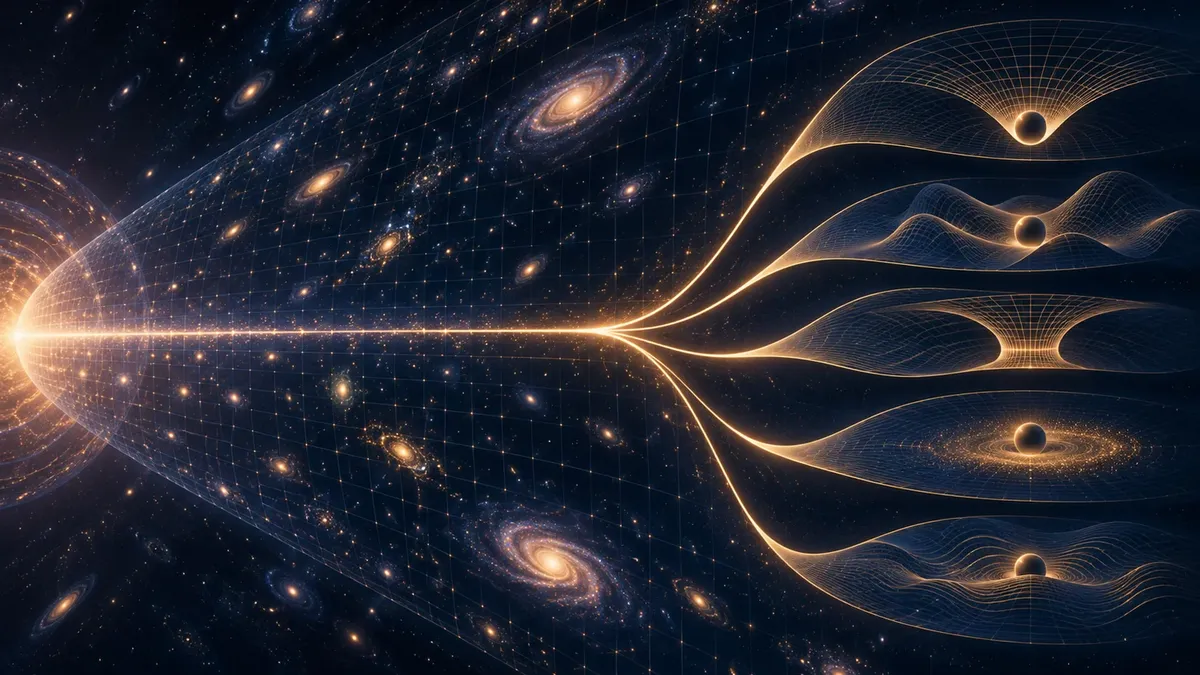
Could gravity itself help explain why some cosmological data have been interpreted as favoring dark energy that changes over time? Mikel Artola and colleagues use a genetic algorithm to search for scalar–tensor theories that can reproduce observations while meeting selected local-gravity and early-universe constraints.
The question: can gravity accommodate an apparent crossing?
The standard cosmological model, ΛCDM, treats dark energy as a cosmological constant. Some combinations of observations—particularly baryon acoustic oscillation (BAO) measurements from DESI with cosmic microwave background (CMB) and supernova data—have been interpreted as favoring an evolving dark-energy equation of state. In some descriptions, it crosses the value (w=-1), known as the phantom divide.
A minimally coupled scalar field cannot cross that divide smoothly, according to the paper’s framing. Scalar–tensor theories offer another possibility: a scalar field is connected to gravity through a nonminimal coupling, allowing the effective gravitational coupling to evolve. The authors ask whether observations can guide the construction of such a theory, rather than requiring researchers to choose its mathematical form in advance.
Searching over equations
The team uses a genetic algorithm, a computational method that evolves candidate solutions. It searches symbolic expressions for two ingredients: the nonminimal coupling (F(\varphi)) and the scalar potential (U(\varphi)).
Each candidate is assessed with a forward model. The researchers calculate the expansion history, effective gravitational coupling and growth of cosmic structure predicted by a proposed theory, then compare them with observations. The joint likelihood combines DESI DR2 BAO, Pantheon+ supernovae calibrated with SH0ES Cepheids, compressed CMB distance information, and redshift-space distortion measurements of structure growth, summarized as (f\sigma_8).
The analysis also imposes theoretical and observational constraints. It restricts the search to the unscreened branch and applies Solar System limits involving the post-Newtonian parameter (\gamma) and changes in the gravitational coupling over time. It also includes a bound on that coupling’s evolution from Big Bang nucleosynthesis. These conditions narrow the models considered; they are not direct observations of the proposed scalar field.
What the search found
Across 64 independent runs, the best reconstruction had a lower chi-squared than the ΛCDM fit by 16.6 units (reported as (\Delta\chi^2=-16.6)). The authors report a smaller improvement, (\Delta\chi^2=-10.6), for the CPL parametrization of evolving dark energy. These figures describe fit differences within this analysis. On their own, they do not prove that the reconstructed theory is true or that the data establish a particular physical cause.
The preferred coupling is described as well approximated by (F(\varphi)=c_1\varphi^2+e^{\varphi}(1-c_2\varphi)), where (c_1) and (c_2) are parameters. In this reconstructed model, the effective equation of state is in the phantom regime at redshifts around and above 0.5, while remaining close to (w=-1) at lower redshift. This is the behavior of the model produced by the search, not a direct measurement of the underlying field or coupling.
What remains uncertain
A good fit to selected observations does not establish that nature uses the equations that produced it. The result is conditional on the datasets, likelihood and theoretical restrictions used. More generally, conclusions from a flexible model search can be sensitive to modeling choices; the abstract alone does not provide enough information to evaluate the full statistical uncertainties or robustness of this reconstruction.
There is also a distinction between data being interpreted as favoring evolving dark energy and evidence for this particular modified-gravity explanation. The paper reports how well its tested model fits selected observations under specified assumptions; it does not show that scalar–tensor gravity has been detected.
This account is based on the paper’s abstract, not a full-text assessment. The source is an arXiv version 1 preprint, and the supplied information does not establish whether it has undergone peer review. Details needed to evaluate the complete statistical analysis and theoretical consistency cannot be checked here. The reconstruction is a data-driven candidate for further scrutiny, not a settled explanation of dark energy.
- scalar–tensor gravity
- dark energy
- genetic algorithm
- DESI
- cosmology
- modified gravity
Related reading
Automatically matched by shared topic keywords. These links do not imply that the sources agree or establish a consensus.
A proposed safety barrier for modified-gravity futures
Source published
Shared keywords: dark energy, modified gravity
One simulation, many dark-energy histories
Source published
Shared keywords: dark energy
Could a quantum horizon timescale shape cosmic expansion?
Source published
Shared keywords: dark energy
Can dark matter and dark energy share an origin? A new cosmology test keeps the idea in contention
Source published
Shared keywords: dark energy
Can cosmic structure mimic changing dark energy?
Source published
Shared keywords: dark energy