TRANSMISSION // 2611.34496v1
Why Do Some Black Hole Jets Bend?
Source published
A survey of radio images finds 586 active galaxies with strongly curved parsec-scale jets. The shapes fit several possible explanations, but the data do not yet identify a winner.
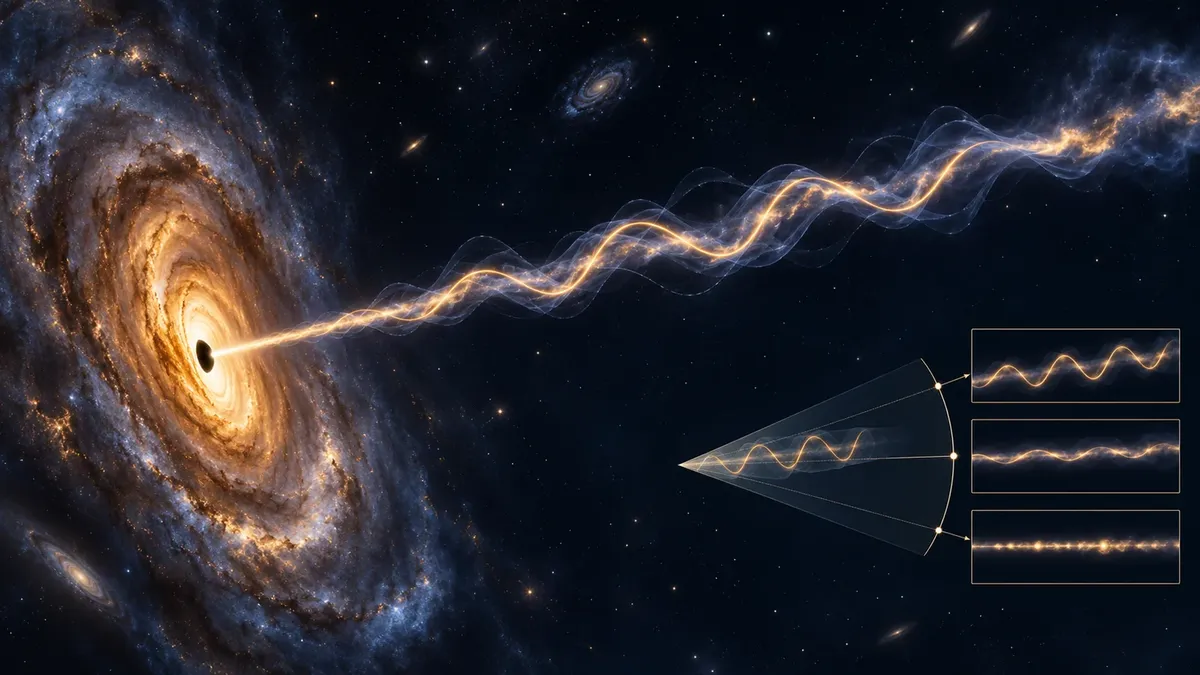
The jets launched by active galaxies can look sharply bent even close to their central black holes. A large study of radio-telescope images searches for these curves and tests whether they might reflect a wobbling jet base or an instability within the flowing plasma.
A bend in the jet—or a trick of perspective?
Active galaxies can launch narrow, fast-moving jets of plasma from the region around a supermassive black hole. On scales of a few parsecs—tiny by galactic standards—some jets appear to curve or twist. But an image shows only a two-dimensional projection of a three-dimensional structure. A jet aimed nearly toward Earth can therefore look more dramatically bent than it really is.
A new study asks two related questions: how often do strongly curved jets show up in a large collection of radio observations, and can their shapes point to what bends them? The authors consider two broad possibilities. The jet’s direction might change over time, tracing a helix as material streams outward; or a wave-like instability in the plasma could distort the jet as it travels.
Building a sample from many radio images
The researchers searched the public Astrogeo database, which contains 123,456 very long baseline interferometry (VLBI) images of 17,478 compact radio sources. VLBI combines radio telescopes to achieve fine angular resolution. The images span frequencies from 1.2 to 86 gigahertz, and sources were observed at different times and, often, at multiple frequencies.
First, the team filtered for images that showed extended structure rather than an unresolved point. They then traced each jet’s ridge line: a curve marking its central path in the image. After an automated search for substantial changes in direction, researchers inspected candidate sources by hand to remove cases where noise or poor-quality maps might mimic a bend.
The team identified 586 sources with robustly curved jets, representing 7.4% of sources with resolved jets in their sample. Another 768 showed signs of curvature but did not meet the study’s quality or data-quantity requirements for the robust group. That distinction matters: the headline fraction is not a count of every curved jet in the universe, but of clear cases in this particular set of resolved VLBI sources.
What the shapes suggest
The study reports that bending rates tend to be higher at higher observing frequencies. Since these observations generally probe closer to the jet’s core, this points to especially strong changes in direction in the inner regions. Multiple frequencies also help reveal bends that can be missed in an individual image: different bands may show different portions of a jet, with different apparent directions.
The authors fitted the traced paths with helical models. One family describes material following a helix because the jet’s launch direction precesses, or slowly changes orientation. Another represents a resonant Kelvin–Helmholtz instability, a disturbance that can grow where fast-moving jet plasma meets its surroundings. The researchers also used Monte Carlo simulations—repeated calculations with sampled input values—to estimate what precession periods could fit the observed curvature. Under the precession interpretation, those estimates range from about 10 to 10,000 years, with a logarithmic mean near 219 years.
Several physical scenarios can produce periods in the inferred range. Precession of an accretion disc in a supermassive black-hole binary is broadly compatible with the estimates. Geodetic precession of a black hole’s spin would require very compact binaries with nearly equal-mass black holes. Lense–Thirring precession, a relativistic effect involving a tilted disc and a spinning black hole, also remains viable in the authors’ modelling. The Kelvin–Helmholtz explanation is another possibility.
A shortlist, not a verdict
The study does not determine which mechanism causes the bend in each source. The authors say that their statistical model comparisons cannot reliably distinguish precession from instability across the sample. In particular, some fitted models could not be identified well enough to include in the final comparisons, and the selected model counts were too small for a firm physical conclusion. The instability model was not subjected to a detailed, uniform sample-wide analysis.
Other limitations affect how the patterns should be read. The sample includes only jets whose extended radio structure could be resolved and detected. The researchers note that their selection method can miss jets with wiggles that average out to little net bend, or with curvature confined to small scales. Sources farther away may be observed with poorer resolution in physical distance, while viewing angle can amplify apparent curvature. The observed redshift pattern—curved jets were less common at low redshifts—may therefore reflect selection effects rather than an underlying difference in jet physics. Optical classifications are also incomplete, with different coverage for curved and other extended sources.
To tell whether a particular jet’s components move along a changing, corkscrew-like path or follow a changing launch direction, astronomers need more than a static shape. The authors point to time-resolved studies of jet motion, velocity measurements and viewing-angle constraints as important next steps.
This account is based on a manuscript posted to arXiv, rather than an independent assessment of the result. Although the paper describes comments from an anonymous referee, the supplied source does not establish the manuscript’s publication or review status. The findings should therefore be read as the authors’ analysis, with its stated uncertainties, rather than as settled evidence for one explanation.
- active galaxies
- black hole jets
- VLBI
- radio astronomy
- jet precession
- Kelvin–Helmholtz instability
Reviewed cross-references
These connections were reviewed by a model, not independently fact-checked by a human. Similarity does not imply agreement; consult the original papers and the evidence below.
A faint feature near 3C 84 brightens and fades without clear outward motion
Shared method: Both studies use multi-epoch VLBI observations to examine parsec-scale jet structure: Makeev et al. stack ridge lines across epochs and frequencies to characterize curvature, while Iinuma et al. track the N1 component’s position and brightness over time. The measured features and analyses differ, so the latter study does not directly test the curvature models.
Model review: · openai-codex/gpt-6-luna
Evidence and provenance
Selected excerpts, not complete papers. PDF extraction can omit figures or damage equations, tables and reading order; sources may be preprints.
2611.34496v1 — Original paper
Excerpt reference:
static/papers/2611.34496v1.md:16-66
Basis: Paper text
Source SHA-256:b3baf9c217b02ccdca5096bbd49e1c93f44becb81168e9988b681fc6bcc27dbd2611.07782v1 — Original paper
Excerpt reference:
static/papers/2611.07782v1.md:236-304
Basis: Paper text
Source SHA-256:15dc6afde73e54e653744589a62c92c088d1faaba489d0148bba2d3c8b4446ea
Related reading
Automatically matched by shared topic keywords. These links do not imply that the sources agree or establish a consensus.
Radio galaxies masquerade as tiny gravitational lenses
Source published
Shared keywords: active galaxies, radio astronomy
Quieter satellites could protect radio astronomy and Earth-rotation measurements
Source published
Shared keywords: radio astronomy
Could quantum computers help correlate radio telescope data?
Source published
Shared keywords: radio astronomy
Radio galaxies vary—and geodesy needs to keep up
Source published
Shared keywords: radio astronomy
Using Scintillation to Study the Double Pulsar
Source published
Shared keywords: radio astronomy