TRANSMISSION // 2611.34475v1
How Neutrino Energy Could Separate Solar Temperatures—in Theory
Source published
A theoretical model finds that different neutrino energies can help distinguish temperatures in two solar zones. But its estimated signal is tiny and based on a heuristic plasma model—not a practical measurement forecast.
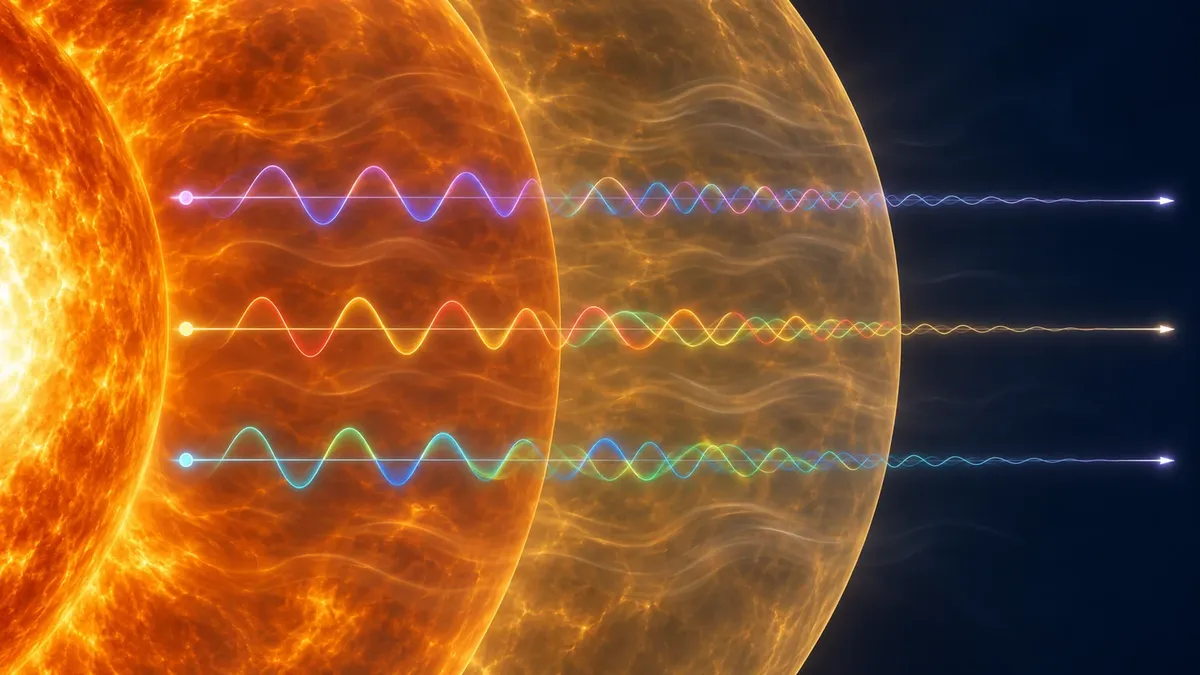
Could neutrinos reveal the temperatures of the regions they pass through? A theoretical study explores that question with quantum-information tools. Its central result is conditional: energy diversity can resolve an ambiguity in a simplified model, but the solar signal estimate is extremely small and depends on a heuristic plasma approximation.
The question: can neutrinos carry temperature information?
Neutrinos change flavor as they travel through matter. The Mikheyev–Smirnov–Wolfenstein (MSW) effect describes how surrounding electrons alter that evolution. But the mean electron density does not, by itself, tell us the temperature. In this study’s framework, temperature enters through fluctuations in electron density, which can reduce the neutrino state’s quantum coherence—a process called dephasing.
The authors ask whether neutrino observations could, in principle, distinguish temperatures in different regions of the Sun. They also examine a separate two-probe model and estimate the scale of a possible solar signal. This is a theoretical analysis, not a report of neutrino-based temperature measurements.
Why one energy can leave temperatures tangled
The main calculation uses a two-flavor neutrino model and an illustrative Sun divided into two zones. Each zone has a fixed mean electron density, while its temperature is treated as unknown. In the restricted case considered, temperature affects the propagated state only through one accumulated dephasing quantity.
That creates an identification problem. At one neutrino energy, the model’s quantum Fisher information matrix—a measure of how much information a quantum state carries about parameters—has rank at most one. Put simply, the state responds to only one combination of the two temperatures. Collecting more samples at that same energy cannot, within this model, separate both temperatures on its own.
The authors then consider independent samples at different energies. Matter mixing varies with energy and density, so different energies can weight the two zones differently. If the resulting temperature-sensitivity directions are not parallel, combining the samples can make the two temperatures locally distinguishable in the model. The key is not simply collecting more events: the energy samples must contribute genuinely different information.
The two-zone example is a theoretical benchmark, not a fit to the Sun’s full structure. Some energy pairs give a well-conditioned separation of the temperature parameters; others provide nearly redundant information. These are measures of the model’s information geometry, not predicted experimental errors. The authors also note practical obstacles: useful energy combinations may lie near or below relevant detection thresholds, and solar-neutrino energies are not necessarily reconstructed event by event.
Other information channels—and an important distinction
A separate theoretical benchmark considers two probes exposed to noise that may be local or spatially correlated. Different Bell-state sectors respond to common and differential fluctuations; in principle, this can help distinguish temperature from a noise-correlation length. This is an information-theory example, not a proposed solar-neutrino experiment: the authors say that prepared Bell pairs of solar neutrinos are not a realistic resource.
It is also important to distinguish information encoded in a quantum state from information an actual detector can access. Quantum Fisher information gives a state-level precision benchmark; it does not show that a practical flavor measurement can reach that benchmark. In the study’s restricted longitudinal-dephasing model, complete phase averaging removes temperature information carried solely by coherence damping. The authors say that possible sensitivity from other effects—such as transitions, temperature-dependent refraction, or neutrino production—requires separate calculations.
A very small, conditional solar benchmark
To estimate an absolute scale, the authors use an electron-only Debye-cell model of plasma fluctuations. For a hypothetical coherent neutrino state at 10 MeV crossing a uniform central-density medium over one solar radius, they report a conditional quantum signal-to-noise ratio of about 3.1 × 10⁻¹³. Under the same idealized assumptions, their calculation implies roughly 3.3 × 10¹⁴ independent events for 10% relative precision, before detector limitations and other complications are included.
These figures are neither a detector forecast nor a general limit on solar neutrino thermometry. The Debye-cell estimate is heuristic: it omits effects including ionic screening, collisional corrections, and the neutrino wave-packet form factor. It is not a controlled microscopic calculation or an established upper bound. The benchmark assumes a coherent state, whereas solar neutrinos reaching a detector are described in the paper as effectively incoherent. In the specified longitudinal-only model, complete phase averaging removes the operational temperature information. The paper also notes that collisional damping is larger than the estimated dephasing rate, but does not calculate its thermometric contribution.
What the result does—and does not—show
The main result concerns identifiability within a defined model: one scalar dephasing channel cannot independently reveal two temperatures, while multiple energies can help if they probe different temperature combinations. Whether that information could be measured is a separate question; the solar benchmark does not establish a viable measurement.
The analysis uses a two-flavor approximation, simplified zones, and assumptions that temperature does not affect other parts of the neutrino state. A realistic solar inference would require a radial density and temperature profile, a microscopic plasma-response calculation, transverse transitions, source and detector averaging, energy resolution, and treatment of nuisance parameters. This article is based on an arXiv preprint, so its theoretical results should not be read as an established observational finding.
- neutrinos
- solar neutrinos
- MSW effect
- quantum thermometry
- quantum Fisher information
- plasma fluctuations
Reviewed cross-references
These connections were reviewed by a model, not independently fact-checked by a human. Similarity does not imply agreement; consult the original papers and the evidence below.
How precisely can neutrino oscillations be measured?
Shared method: Both studies use quantum Fisher information matrices to analyze multiparameter estimation: the origin examines identifiability of two zone temperatures in a conditional dephasing model, while Huang et al. analyze oscillation parameters in vacuum neutrino states. This is a shared estimation framework, not evidence that their model-specific conclusions transfer; the parameters, states and assumptions differ.
Model review: · openai-codex/gpt-6-luna
Evidence and provenance
Selected excerpts, not complete papers. PDF extraction can omit figures or damage equations, tables and reading order; sources may be preprints.
2611.34475v1 — Original paper
Excerpt reference:
static/papers/2611.34475v1.md:1745-1787
Basis: Paper text
Source SHA-256:1459c47b10c41d0832b077433f5652e50c456b93405e79d65a5108286553916c2606.28275v2 — Original paper
Excerpt reference:
static/papers/2606.28275v2.md:387-521
Basis: Paper text
Source SHA-256:e5a987f3c4cbeaa3d0cb8508fba968941abc96a3c182666ee00311573fbceb1f
Related reading
Automatically matched by shared topic keywords. These links do not imply that the sources agree or establish a consensus.
A quantum computer tests a different kind of thermal state
Source published
Shared keywords: quantum fisher information, quantum thermometry
How energy levels set the limits of quantum thermometers
Source published
Shared keywords: quantum fisher information, quantum thermometry
How precisely can neutrino oscillations be measured?
Source published
Shared keywords: quantum fisher information
A single atom as a thermometer for an ultracold gas
Source published
Shared keywords: quantum thermometry
Could a quantum chip’s defects become its thermometers?
Source published
Shared keywords: quantum thermometry