TRANSMISSION // 2611.34474v1
A Noise Boundary for Quantum-Memory Learning
Source published
A preprint studies how Pauli noise affects quantum memory in a specific learning task. It proves a boundary for entangled probes, conjectures a broader one, and reports processor tests of Bell pairs and a three-qubit code.
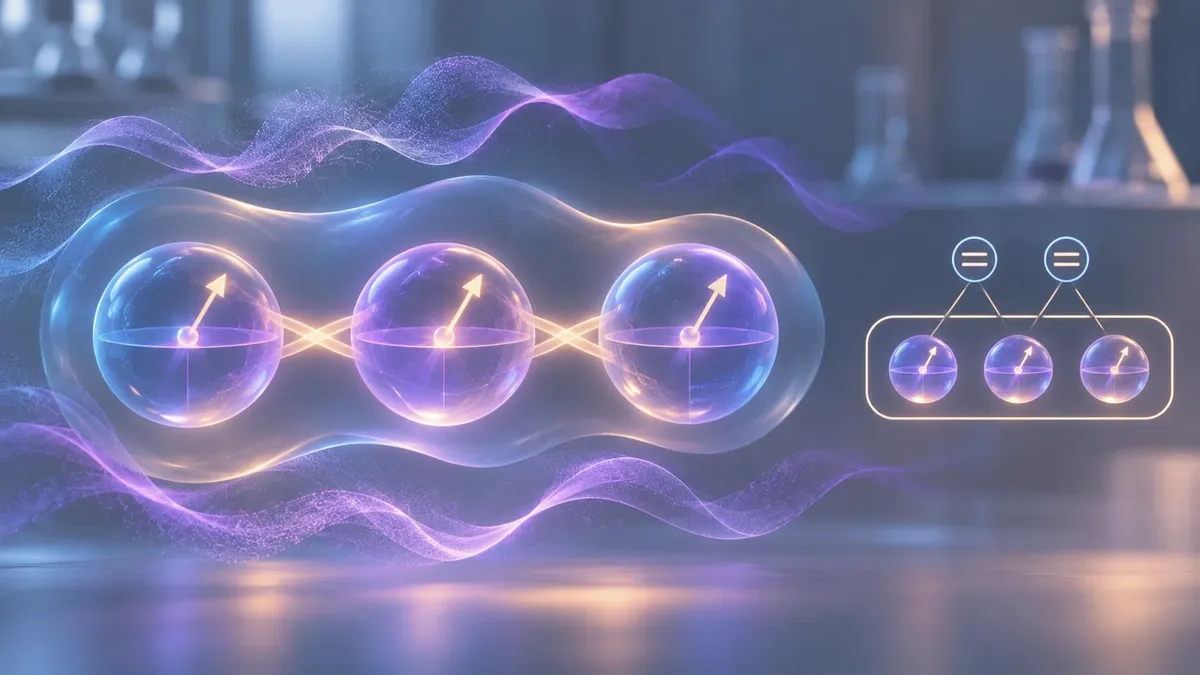
Quantum memory can reduce the experiments needed to learn a physical process, but noise weakens the information it stores. A new preprint examines this trade-off for a particular Pauli-learning task—and tests whether error correction can help.
Quantum memory can let an experimenter keep quantum information while a probe passes through an unknown process, then measure the two together. In some learning tasks, that approach can sharply reduce the number of experiments. But noise in the memory blurs the correlations the method relies on. How does that noise affect the advantage, and can coding help preserve it?
Miaojiang Chen and colleagues study a specific task: identifying a uniformly chosen unknown Pauli operator from uses of a defined channel. Pauli operators are combinations of basic quantum operations such as bit and phase flips; the task channel is distinct from the Pauli noise applied to the memory. Each round may adapt to earlier measurement outcomes, but quantum data are not carried from one round to the next. The authors model memory noise with a Pauli channel whose parameters, λX, λY and λZ, describe how it affects different kinds of quantum information.
Their key boundary involves the sum λX² + λY² + λZ². They prove that when this sum is at most one, entangled-probe protocols cannot obtain an advantage that grows exponentially with system size, in the setting where quantum data are not retained across uses of the unknown process. The result does not cover protocols that preserve quantum data between uses. Extending the converse to those protocols is identified as future work.
The authors conjecture that the same boundary applies to all protocols in the task. This broader claim is not proved: it rests on a proposed additivity property of a Rényi-2 information measure. Numerical optimization for memories up to four qubits and tests of random stabilizer codes up to seven qubits provide evidence, but do not establish the conjecture. Above the boundary, an exponential advantage may be possible; crossing it does not guarantee that any particular strategy achieves one.
The paper compares Bell sampling with encoded-memory strategies. In Bell sampling, a probe is entangled with a memory qubit, sent through the task channel, and measured jointly with the retained qubit. Its performance depends on the geometric mean of four per-site factors for the task’s possible Pauli letters—identity, X, Y and Z. The bound for entangled probes instead involves the arithmetic mean of those factors. Because the means can differ, Bell sampling may lose its growing advantage while a different strategy could still work; that possibility is not itself a guarantee of success.
The authors evaluate stabilizer codes, which distribute information across qubits and use measured error syndromes to help decode it. Under the depolarizing-noise conditions they evaluate, the [[32,20,4]] code has a reported threshold of η = 0.580, close to the theoretical boundary of 1/√3, or about 0.577. The authors describe this as within 1% of the boundary. This is a result for that code and those modeled conditions, not proof that codes generally reach the limit.
For hardware tests, nine Bell pairs were operated simultaneously on the Wukong 180 superconducting processor. The team injected controlled memory noise and measured the learning advantage as the number of sites increased. Depending on the noise setting, the advantage grew or shrank exponentially with system size. A model predicted the reversal point using measured noiseless single-site factors and a specified scaling assumption; it was not a prediction independent of calibration data. The measurements included processor effects. For the nine-pair analysis, the authors used raw counts to avoid spurious correlations associated with the processor’s built-in readout correction.
A separate experiment on one four-qubit chain compared an unencoded pair with a three-qubit phase-flip repetition code under dephasing noise. The paper reports end-to-end results from raw counts, including processor and readout errors, as well as a separately mitigated memory-level analysis. In the end-to-end data, the code’s fitted crossing occurs at a lower noise parameter than the unencoded pair’s, creating an interval between the crossings where the coded advantage is predicted to grow with size while the unencoded advantage shrinks. One fitted crossing lies just above the largest noise value tested in that run, so the interval should not be read as direct observation across every tested point.
At the memory level, across twelve measured settings with a ≤ 0.64 in three sessions, the coded memory performed better per site than ideal Bell sampling in its best memory frame; the difference was statistically significant at eight settings. The reported coding gain also depends on how strongly the noise is biased toward errors the code is designed to detect.
These results concern a specific Pauli-learning task, Pauli memory noise and the tested processor conditions; the experiments do not establish a general noise boundary. The theoretical converse does not cover protocols that retain quantum data across uses, non-Pauli noise such as amplitude damping, or learning tasks beyond Pauli channels. This work is an arXiv preprint, not a peer-reviewed publication in the evidence available here. Its contribution is a proved limit within a defined protocol setting, a wider conjecture, and experiments showing how coding affected performance in particular conditions.
- quantum memory
- quantum learning
- Pauli noise
- quantum error correction
- Bell sampling
- superconducting processor
Related reading
Automatically matched by shared topic keywords. These links do not imply that the sources agree or establish a consensus.
Why bigger quantum systems can need fewer samples
Source published
Shared keywords: quantum learning
When the Most Likely Error Is Not the Best Correction
Source published
Shared keywords: quantum error correction
How the shape of a quantum-code region determines what it reveals
Source published
Shared keywords: quantum error correction
When quantum memory becomes undecidable
Source published
Shared keywords: quantum error correction, quantum memory
A small memory makes quantum measurement records predictable
Source published
Shared keywords: quantum memory