TRANSMISSION // 2611.34458v1
Neural emulators speed up detailed maps of the Sun
Source published
A neural-network surrogate helps researchers fit polarized sunlight across large solar images, while retaining a physics-based model—and clear limits.
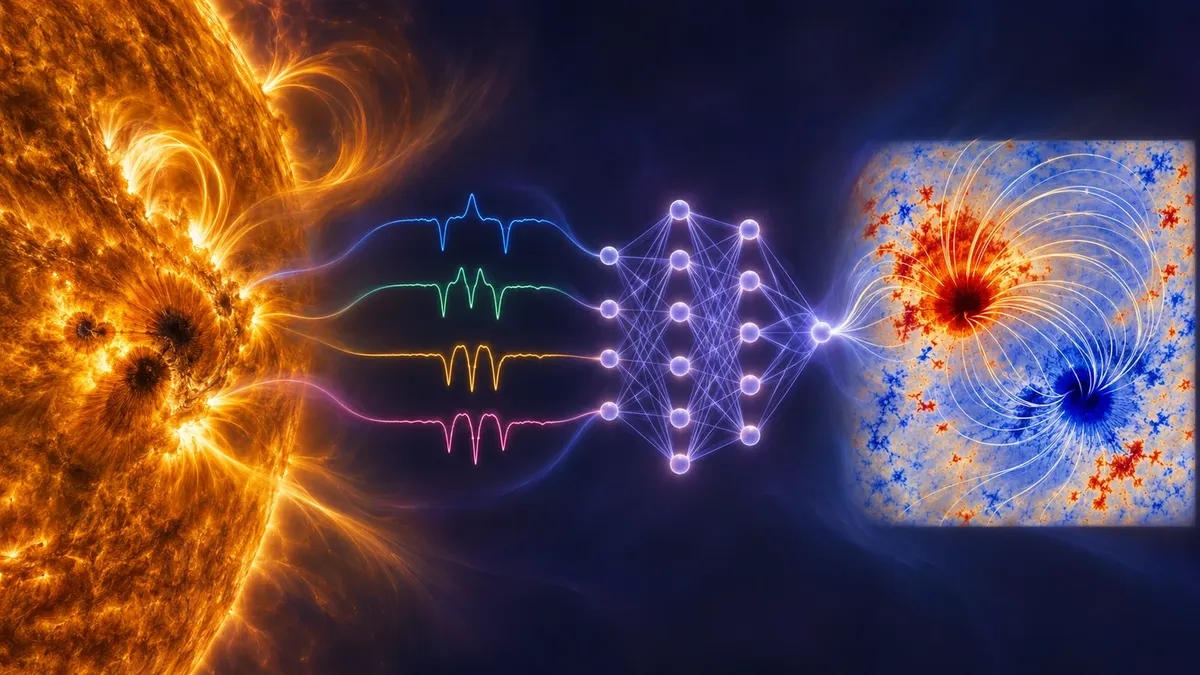
The Sun’s magnetic atmosphere leaves clues in polarized light, but interpreting those clues pixel by pixel can be slow. A new method uses neural networks to speed up the calculations behind those interpretations, while still fitting the observed spectra with a physical model.
Turning sunlight into maps
Solar telescopes measure more than brightness. They also record how light is polarized at different wavelengths. These measurements, described by four Stokes parameters, carry information about conditions in the Sun’s atmosphere, including magnetic fields and motion. To infer those conditions, researchers compare observed spectra with spectra calculated from models—a process called inversion.
The challenge is scale and detail. A large image contains many pixels, and each pixel’s spectrum may require repeated, computationally expensive calculations. Treating pixels together can help account for the fact that nearby parts of the Sun are connected and that a telescope’s optics blur light across neighboring pixels. But that makes the fitting problem larger still.
In this study, A. Asensio Ramos and colleagues tested whether neural-network “emulators” could make those calculations fast enough for spatially regularized inversions of whole fields of view. An emulator approximates the output of a more computationally demanding model. Here, it predicts polarized spectra from atmospheric parameters, allowing the researchers to optimize maps of those parameters without repeatedly running the original synthesis calculations.
A shortcut inside a physics-based fit
The team trained emulators on synthetic spectra generated from model atmospheres. They covered several solar spectral regions: the photospheric iron lines near 6302 angstroms; silicon and helium lines near 10830 angstroms; and the calcium line at 8542 angstroms. The models included quantities such as temperature, velocity and magnetic field. For the calcium line, the training calculations accounted for non-local thermodynamic equilibrium, a more involved description of how radiation and matter interact.
The inversion fits all pixels together, with regularization terms that encourage selected spatial patterns—for example, smoother maps or maps with sparse features. The researchers also implemented an option to account for the telescope’s point-spread function, which describes how the instrument spreads light across the image. The emulator is not itself asked to guess the final map directly: it supplies fast synthetic spectra within an iterative, physics-based fit to the observations.
The authors tested the emulators against synthetic profiles set aside from training, then demonstrated the inversion on three solar data sets. These included a Hinode map of an active region, observations around the silicon and helium lines, and a large calcium-line map from the Swedish 1-m Solar Telescope.
Fast calculations, with boundaries
On an off-the-shelf NVIDIA 4090 GPU, the authors report that the calcium-line example—a 1300-by-900-pixel field—took about 15 minutes to invert. The paper also reports large-field inversions in minutes for its examples. These are demonstrations on particular data and hardware, not a guarantee that every data set or model will run at the same speed.
On a separate test set of 2,000 synthetic profiles, the emulator’s average differences from the original synthetic calculations were small. The paper reports that, in most cases, emulator errors in the polarization profiles were comparable to or below the noise in current observations. The authors also found larger residuals for the more complex calcium line than for the iron lines. These tests assess the emulator against its training-generation model; they do not establish that the inferred solar atmosphere is uniquely correct.
The main limitation is that an emulator should not be trusted beyond the conditions represented in its training data. In the active-region example, some very strong magnetic fields lay at or beyond the emulator’s training range and produced artifacts. The coolest sunspot regions also contained molecular lines absent from the synthesis model, so those spectra could not be reproduced well. In the helium observations, weak Stokes Q and U signals meant the azimuth—the direction of the magnetic field across the line of sight—was not well constrained. The authors caution that this inferred direction should be treated carefully; they report that the line-of-sight magnetic-field component is better constrained by the Stokes V signal.
The team argues that these shortcomings can be addressed by extending training to more extreme conditions or adding missing physics, but that requires retraining. The method’s speed therefore does not remove the need to check whether the model and training set suit the observations.
This is a research manuscript posted as a preprint; the supplied paper text has no acceptance date. Its results should be read as a reported method and set of demonstrations, rather than as an independently established performance guarantee. The authors say their code is publicly available. The broader promise is practical: faster fitting could let solar researchers explore model choices and analyze large maps sooner, provided the emulator remains within its tested domain.
- solar physics
- solar magnetic fields
- spectropolarimetry
- neural emulators
- Stokes profiles
- solar atmosphere
Related reading
Automatically matched by shared topic keywords. These links do not imply that the sources agree or establish a consensus.
A solar magnetic-field shortcut has stricter limits than it seems
Source published
Shared keywords: solar atmosphere, solar magnetic fields
What polarized hydrogen light can reveal about the Sun’s magnetic atmosphere
Source published
Shared keywords: solar magnetic fields
A magnetic-field puzzle in the Sun’s quiet photosphere
Source published
Shared keywords: solar magnetic fields
Solar spectra put atomic line data to the test
Source published
Shared keywords: solar atmosphere
Could traveling waves help launch solar spicules?
Source published
Shared keywords: solar physics