TRANSMISSION // 2611.34450v1
How Solar Flare X-rays Trace a Heating Pattern
Source published
A study reports strong links between hard and soft X-rays in selected Aditya-L1 flares, and tests a model that reconstructs much of the softer signal from individual bursts.
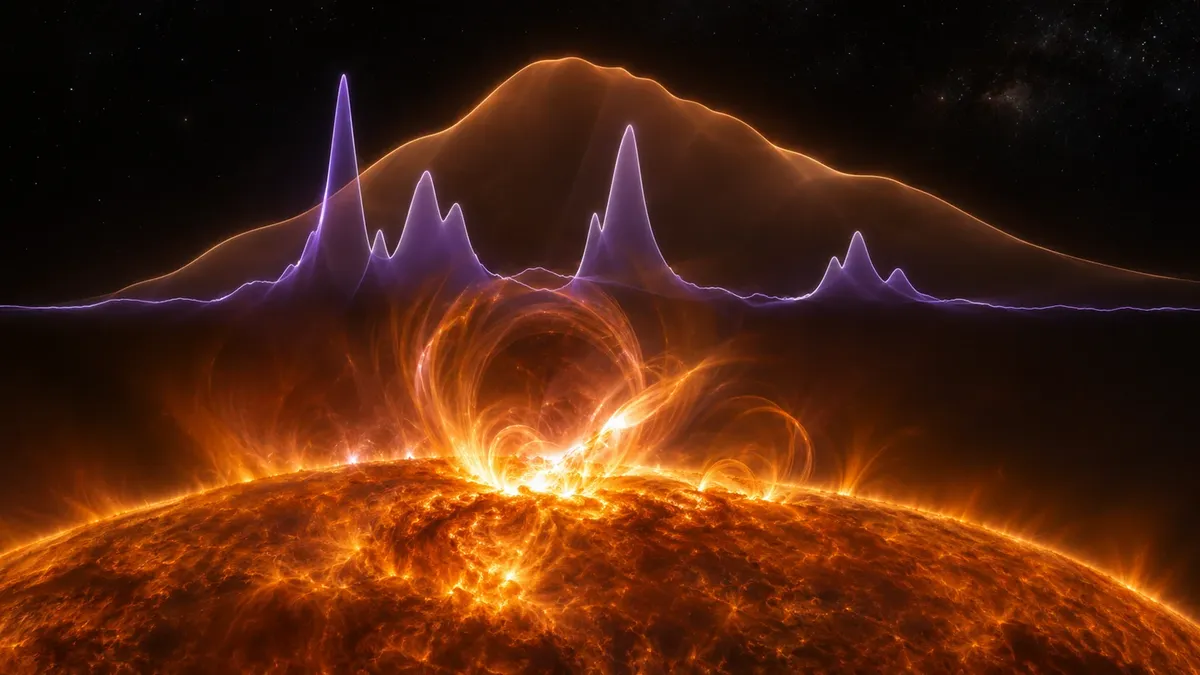
Solar flares produce hard X-rays in bursts and softer X-rays from hot plasma. A study using Aditya-L1 observations examines how these signals track one another—and whether a model based on burst timing can reproduce the softer glow.
Solar flares release energy in the Sun’s atmosphere. They produce hard X-rays associated with accelerated electrons, as well as softer X-rays from heated plasma. The Neupert effect describes a pattern in which the soft X-ray signal follows the accumulated hard X-ray emission: as hard X-ray bursts build up, the softer glow often rises.
That relationship need not be exact. Plasma loses energy through processes such as radiation and conduction, and heating may continue after the most obvious bursts. The study asks how consistently the pattern appears in flares observed by Aditya-L1, and whether the sequence of hard X-ray bursts can be used to reconstruct the changing soft X-ray signal.
Comparing flare signals
According to the authors’ manuscript, the team analysed observations from HEL1OS, a hard X-ray spectrometer aboard India’s Aditya-L1 solar observatory. They selected 312 flares observed between November 2023 and May 2026. The selected events had significant signals in both detector systems; some events affected by impulsive particle backgrounds were excluded.
For a population-level test, the researchers compared lower-energy emission treated as predominantly thermal with accumulated higher-energy emission treated as predominantly non-thermal. They also examined correlations across energy bands. For a more detailed analysis, they fitted thermal and non-thermal components in spectra and used a boundary between them that could vary from flare to flare.
To model the changing thermal signal, the researchers used a signal-processing technique to help locate individual bursts in the hard X-ray record. They fitted burst profiles to the measured light curve, then convolved each profile with an exponential response. This empirical response represents a lingering signal after a burst; it is not a direct measurement of one specific cooling process. The researchers compared the summed model responses with the observed thermal-dominated light curve.
A close relationship, with exceptions
The manuscript reports a median correlation of 0.984 between thermal emission and accumulated non-thermal emission across the selected sample. Correlations remained high across the energy-band combinations examined, though they generally weakened at higher hard X-ray energies. The authors suggest that weaker signals and greater difficulty distinguishing flare emission from background could contribute to this trend.
In representative flares, the pulse-based model reproduced much of the thermal evolution, including cases with one main burst, irregular multiple bursts, and visibly modulated sequences. The authors describe some sequences as quasi-periodically modulated in appearance, but clarify that these categories are based on their shape, not formal detections of quasi-periodic pulsations. Overall, the thermal signal was smoother and longer-lived than the hard X-ray bursts.
The match was not equally good throughout the flares. Differences appeared especially near the beginning and during late decay. An early thermal signal not accounted for by the measured hard X-rays could reflect heating the instrument’s non-thermal signal does not capture, including energy from lower-energy electrons; the authors also discuss other possibilities. A lingering soft X-ray signal may be consistent with continued heating, but an unresolved light curve cannot show why it persists. These are interpretations, not mechanisms established by the model.
What the study can—and cannot—tell us
The reported results support a close association between measured non-thermal emission and thermal X-ray evolution in this selected set of flares. The modelling approach also retains the timing of individual bursts, information that a simple cumulative comparison leaves out.
But correlation does not show that measured hard X-rays account for all the energy heating the plasma. Thermal and non-thermal components can overlap, and the boundary used to separate them changes during a flare. The model’s fitted response times are effective parameters, not direct measurements of a particular physical cooling time. And because HEL1OS measures the Sun as a whole, these light curves do not reveal the flare’s spatial structure. The authors point to spatially resolved ultraviolet and extreme-ultraviolet observations, combined with physical plasma models, as ways to investigate the residuals.
This account is based on the November 2026 arXiv manuscript supplied for this article. The retrieval excerpts available alongside it concern unrelated research and do not independently verify this study’s methods or findings. The results described here are therefore the authors’ reported findings in that manuscript, not an independent assessment. An arXiv preprint is a public research manuscript; its posting alone does not establish that it has completed peer review.
- solar flares
- Neupert effect
- Aditya-L1
- HEL1OS
- hard X-rays
- plasma heating
- solar physics
Related reading
Automatically matched by shared topic keywords. These links do not imply that the sources agree or establish a consensus.
How FOXSI’s X-ray optics handle off-center views
Source published
Shared keywords: solar flares
How energetic particles behave ahead of space shocks
Source published
Shared keywords: aditya l1
How Magnetic Reconnection May Heat Ions Behind Shock Waves
Source published
Shared keywords: plasma heating
How Ultraviolet Observations Illuminate Solar Activity
Source published
Shared keywords: solar flares
Could axions reshape magnetic turbulence? A theoretical study links field-line geometry to energy spectra
Source published
Shared keywords: solar physics