TRANSMISSION // 2611.34439v1
Can a cosmic ‘inverted pendulum’ steady an axion?
Source published
A theoretical study tests whether rapid oscillations can hold cosmological axions near an unstable potential peak. The effect works temporarily, but the authors find it does not generally remove the need for finely chosen initial conditions.
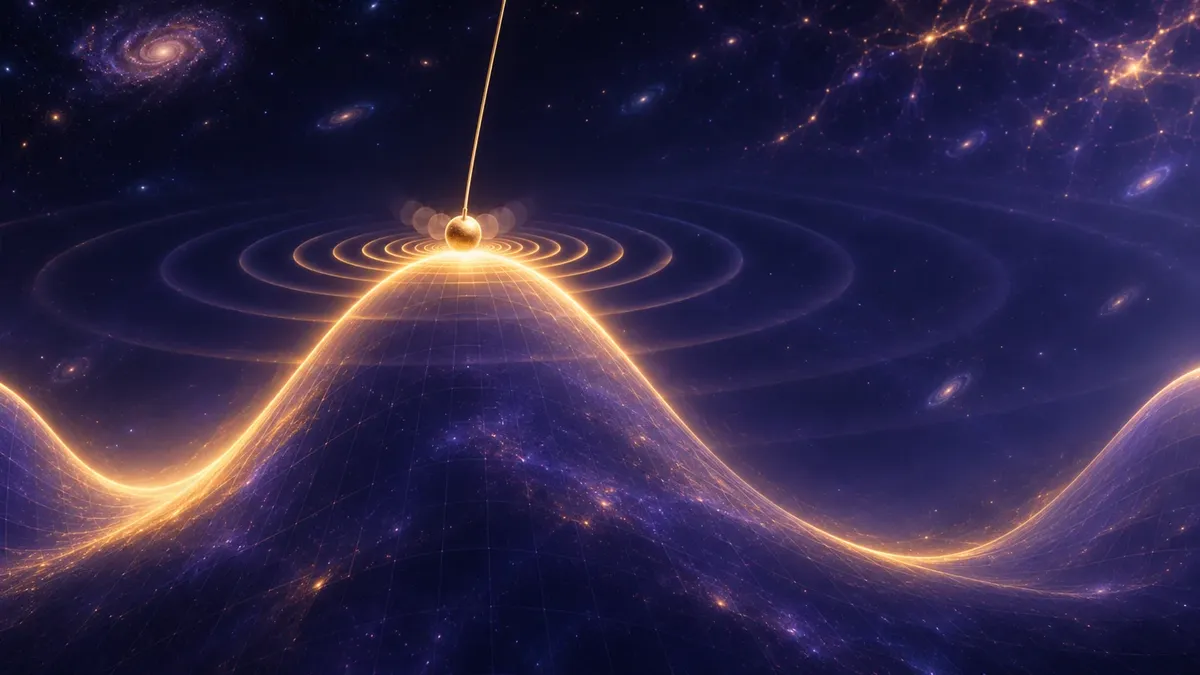
A field poised near the top of a hill usually rolls away. Could a rapid cosmic rhythm keep it there, like a vibrating support that steadies an upside-down pendulum? A theoretical study applies Floquet analysis to this idea for axions and finds that expansion of the Universe sharply limits its usefulness.
A cosmic version of a balancing trick
Axions are hypothetical fields that appear in several ideas about the early Universe and dark matter. Like a ball near the crest of a hill, an axion field near the maximum of its potential is unstable: a small displacement can grow and send it rolling. In some cosmological scenarios, the field needs to begin extremely close to that peak, making its initial conditions finely tuned.
Tokiro Numasawa and Masahito Yamazaki ask whether a rapidly changing influence could steady the field. The analogy is the Kapitza pendulum: an upside-down pendulum can be stabilized when its pivot vibrates quickly enough. The key question is not just whether an axion hilltop can be stabilized in principle, but whether that stabilization can last and draw the field toward the peak in an expanding Universe.
From periodic motion to stability
The authors use Floquet theory, a mathematical framework for systems whose properties repeat in time. They study how small disturbances around the axion hilltop behave when the field is subject to a periodic drive. In the simplest setup, rapid oscillations modify the field’s effective potential; within a range of drive parameters, the normally unstable peak becomes stable against small disturbances.
They then examine several ways to supply the oscillation: an explicitly varying coupling, a second field that spins or oscillates, and a gyroscopic analogue of a spinning top. The latter is modeled with a nonlinear sigma model whose field space is a squashed three-sphere. The paper combines analytic stability conditions and scaling arguments with numerical solutions of the model equations. It also considers whether the oscillations can excite other, spatially varying modes rather than merely affecting the uniform field.
A crucial distinction is between stability and capture. A field can remain near the peak if it is already within a limited region of suitable starting positions and velocities. That does not mean the mechanism will bring arbitrary starting conditions to the hilltop. The paper explicitly finds a finite basin of attraction, so linear stability alone does not solve the initial-condition problem.
Expansion puts a clock on the effect
In an expanding Universe, the source of the rapid motion loses strength as space expands. The stabilized period therefore ends. In the realizations studied, its duration in e-folds—the logarithmic measure of cosmic expansion—is logarithmic in the hierarchy between relevant scales and does not depend on whether the background is radiation-, matter-, or inflation-dominated. The same number of e-folds can correspond to different amounts of ordinary elapsed time in different cosmic eras.
The authors classify the mechanisms according to how their effective restoring frequency changes with expansion. Their central result is restrictive: in the radiation- and matter-dominated eras, the studied mechanisms cannot both draw the field toward the hilltop and leave it frozen there by Hubble friction. During inflation, attraction is possible in some circumstances, but Hubble friction and the energy available to the stabilizing field limit how close the axion can be brought to the peak.
So the paper’s main conclusion is not that oscillations generically erase hilltop fine-tuning. Rather, these simple mechanisms do not do so. The authors identify a possible exception in a scaling analysis involving a stabilizing field whose mass grows slowly over time, but say they are unaware of a natural realization and note that it would require further conditions to hold.
A different possible role: delaying the roll
Even if stabilization does not generally solve the initial-condition problem, it may postpone when the axion begins oscillating. In radiation domination, the paper derives a relic-abundance enhancement proportional to ((\tilde m/H_c)^{3/2}) in the delayed-release regime, where (\tilde m) is an effective mass scale and (H_c) is the expansion rate when stabilization ends. This is a model-dependent theoretical scaling, not an observation or a universal prediction for axion dark matter.
The authors also flag limits to their analysis. Much of the cosmological discussion follows a spatially homogeneous field, while inhomogeneous modes can undergo parametric resonance. They estimate energy transfer into a resonance band for a particular benchmark, but emphasize that this estimate does not track the full fluctuation spectrum or nonlinear evolution. Fragmentation and the formation of localized structures are not captured by the homogeneous treatment; the paper calls for further study, including lattice simulations. A dedicated analysis is also left for the QCD axion’s temperature-dependent mass.
The work is a theoretical preprint, not evidence that this stabilization occurs in nature. Its conclusions depend on the chosen models, approximations, and cosmological assumptions. The authors report that numerical codes are publicly available, but the analysis does not establish a natural mechanism that removes the hilltop tuning across the scenarios considered.
- axions
- cosmology
- Floquet theory
- Kapitza pendulum
- dark matter
- early Universe
Related reading
Automatically matched by shared topic keywords. These links do not imply that the sources agree or establish a consensus.
Can primordial magnetic fields dissolve cosmic domain walls?
Source published
Shared keywords: dark matter, early universe
Could self-interacting ultralight dark matter ease the Hubble tension?
Source published
Shared keywords: early universe
Can a cosmic bounce create the right primordial pattern?
Source published
Shared keywords: early universe
Runaway bubble collisions could make superheavy dark matter
Source published
Shared keywords: dark matter, early universe
A Python tool traces possible signals from the early universe
Source published
Shared keywords: dark matter