TRANSMISSION // 2611.34435v1
A video model learns to predict what robot actions do
Source published
Dianjing adapts a pretrained video generator to predict robot-action outcomes, using limited robot footage and a small trainable portion of the model. Its benchmark results are promising, but long-horizon consistency remains a challenge.
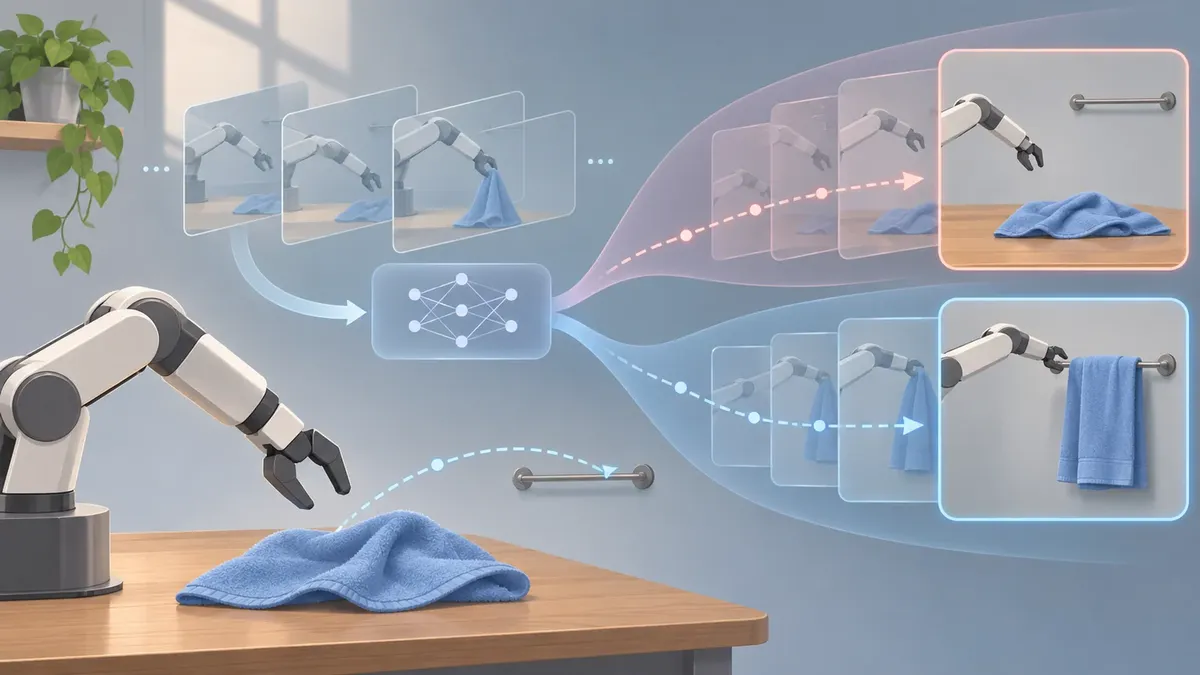
A video can look convincing without showing what a robot’s action would really cause. A new preprint tests whether a powerful video generator can be adapted to make more action-faithful predictions—with comparatively little extra training.
A robot’s predicted future is useful only if it reflects the action it actually takes. A video generator might show a plausible-looking object interaction while getting the important consequence wrong: a gripper moves toward a towel, for example, but the towel stays on the table. That gap matters if generated videos are used to evaluate robot policies or plan actions.
In this study, researchers introduce Dianjing, a method for adapting a pretrained video model into an action-conditioned world model. The central question is how much a strong video generator needs to change before it can predict the consequences of specific robot commands—not just produce plausible scenes.
Adapting a video prior
Dianjing is built on MiniMax H3, a video foundation model with 33 billion parameters. The researchers freeze its pretrained backbone and train a small set of additional parameters—about 0.34% of the model—using roughly 65 hours of robot video from two embodiments, AgiBot G2 and YAM. They report no additional robot-specific pretraining or camera calibration.
The method has three main parts. First, it translates the robots’ commands into a shared representation of end-effector motion: how the robot’s working ends move and operate their grippers. This gives the model a common way to receive physical actions across the two robot types. Second, training puts greater emphasis on high-noise stages of video generation. The authors’ rationale is that coarse motion and scene layout are established early in generation, so this is where learning the consequences of an action may be particularly useful. Third, Dianjing carries information from one video segment into the next using the pretrained model’s existing reference mechanism, rather than adding a separate memory module.
The researchers evaluate predictions on WorldOracle, a benchmark that compares generated videos with paired recordings of real robot executions. Its five tracks cover two robot embodiments and different kinds of rollouts, including longer sequences and actions from a robot policy. The reported score combines measures of physical-state correctness, fidelity around key interaction areas, and spatial alignment.
What the tests found
On the benchmark’s official test results, Dianjing received the highest reported score on four of the five tracks and ranked second on AgiBot-Long. The authors also tested design choices on a fixed validation set. In those experiments, adding action inputs improved the average score beyond visual-only adaptation, and shifting training toward high-noise levels improved it further. Their controlled comparisons suggest that this allocation of training effort mattered more than trying alternative ways of feeding actions into the model.
The paper illustrates the distinction between motion and consequence with a towel-hanging example. In a validation clip, the model reproduced two successive hanging events, while a comparison system moved its arms but left the first towel on the table. This is a useful example, not proof that the model will handle every task reliably. The authors say that Dianjing still makes errors in object positions, orientations and fine-grained physical states.
Longer predictions are a particular weakness. Scores on the long-rollout tracks were lower than on corresponding core tracks, and the paper reports that errors can build up as the model generates successive video chunks. Passing the final latent representations from one chunk into the next helped in the authors’ tests, but did not eliminate the problem. Their conclusion is therefore about competitive benchmark performance, not a fully reliable simulator.
What remains uncertain
The results apply to the model, data and tasks tested. Training used robot videos from two embodiments, and the benchmark’s paired executions offer a specific way to assess prediction quality; they do not establish performance across all robots, environments or uses. Even a strong score on a benchmark cannot by itself show that predictions are safe or dependable enough for real-world deployment. The study also reports discrepancies in predicted object states, especially over extended rollouts.
The paper is an arXiv preprint, a research manuscript shared before the usual journal or conference review process; its claims should be treated as provisional. The authors’ broader suggestion—that video generators already contain much of what is needed for robot world modeling—is an interpretation of these experiments, not a general result proven for every video model. The practical takeaway is narrower: in this setup, a frozen video backbone paired with explicit robot actions and carefully allocated training produced promising predictions with limited robot-video data, while long-term consistency remains unresolved.
- robotics
- video generation
- world models
- robot learning
- action-conditioned prediction
- Dianjing
Reviewed cross-references
These connections were reviewed by a model, not independently fact-checked by a human. Similarity does not imply agreement; consult the original papers and the evidence below.
Teaching robot video models to focus on what moves
Supporting evidence: Both papers report improvements from adding physical guidance to video-based prediction in their tested settings: Dianjing reports gains from explicit action conditioning, while MoReWorld reports stronger interaction-dynamics scores with motion-region guidance. This supports the limited point that physical guidance can improve action-conditioned prediction; their benchmarks and outcomes differ, so the results are not directly comparable.
Model review: · openai-codex/gpt-6-luna
Evidence and provenance
Selected excerpts, not complete papers. PDF extraction can omit figures or damage equations, tables and reading order; sources may be preprints.
2611.34435v1 — Original paper
Excerpt reference:
static/papers/2611.34435v1.md:125-188
Basis: Paper text
Source SHA-256:255340c6eaadc21d1f83f31e08cc85443d7fdf5967951c7fb155e3ca43c542432611.27344v1 — Original paper
Excerpt reference:
static/papers/2611.27344v1.md:950-1051
Basis: Paper text
Source SHA-256:15519900f5bbf63f29419fea3708e0d6a4212b324271c72091d55f5a3b021b43
Robots learn from the grasp that goes wrong
Supporting evidence: Both studies report improved prediction of physical interaction outcomes using physical grounding: Dianjing finds gains from conditioning on robot actions, while WorldReforge reports reduced object-motion error after training with simulated failures and physical labels. This is bounded support for grounding predictions in interaction data, not a direct comparison, since the training signals, models, and evaluations differ.
Model review: · openai-codex/gpt-6-luna
Evidence and provenance
Selected excerpts, not complete papers. PDF extraction can omit figures or damage equations, tables and reading order; sources may be preprints.
2611.34435v1 — Original paper
Excerpt reference:
static/papers/2611.34435v1.md:125-188
Basis: Paper text
Source SHA-256:255340c6eaadc21d1f83f31e08cc85443d7fdf5967951c7fb155e3ca43c542432611.33925v1 — Original paper
Excerpt reference:
static/papers/2611.33925v1.md:207-277
Basis: Paper text
Source SHA-256:f32db6d041c01c57577832fd034bea63e3e87973f787521d62e16f04fc605977
Related reading
Automatically matched by shared topic keywords. These links do not imply that the sources agree or establish a consensus.
A robot's-eye view, generated from outside video
Source published
Shared keywords: robot learning, world models
WorldPhy Tests Robot World Models’ Physics
Source published
Shared keywords: video generation, world models
Teaching robot video models to focus on what moves
Source published
Shared keywords: video generation, world models
WorldFlow predicts motion in both pixels and 3D
Source published
Shared keywords: video generation, world models
How a Robot Can Predict a Moving Target
Source published
Shared keywords: robot learning, world models