TRANSMISSION // 2611.34430v1
One vision model, two ways to ask what changed
Source published
OVTSID3 uses a shared visual representation to find changes in satellite and aerial images, guided either by text or by a masked visual example.
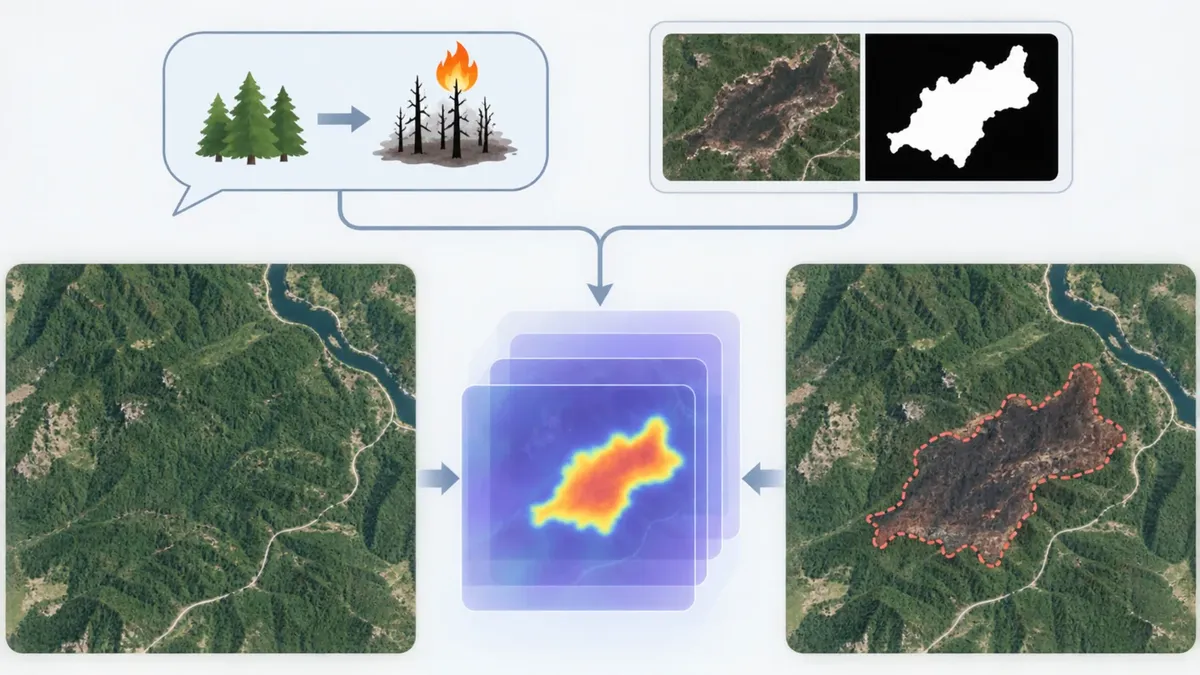
A change-detection system is only useful if it can find the kind of change a person cares about. A new preprint introduces a training-free method that lets users specify that target with words—or with an example image and mask.
Finding changes by describing or showing them
Imagine comparing satellite images of a region before and after a wildfire. A basic change detector might flag every difference, while a more targeted system would identify the burn scar. But some features are easier to show than to name: a landslide, for instance, may not match a vision model’s understanding of the word “landslide.”
That is the problem addressed by open-vocabulary change detection (OVCD). Rather than being limited to categories fixed during task-specific training, an OVCD system aims to locate changes selected at inference time. In a new arXiv preprint, Blaž Rolih and colleagues present OVTSID3, a method that accepts either a text query or a visual example to define the target.
The method’s central idea is to use one shared visual representation for three jobs: grouping similar image regions, deciding which regions match the requested concept, and estimating what changed between two dates. The authors say this avoids the chain of separate models used in many earlier systems, where errors in region proposals or semantic recognition can carry through to the final change map.
How text and visual prompts work
OVTSID3 processes a pair of co-registered images—that is, images of the same area aligned with one another—using a frozen DINOv3 vision backbone. “Frozen” means its learned weights are not updated for this task. The system extracts features from each image and groups similar locations into clusters. It also reduces a positional bias in the features, which matters for overhead imagery because a location’s position in an image should not determine what it depicts.
For a text prompt, the method compares image features with descriptions of both the target and background. The authors used multiple descriptions, such as variations on “building,” rather than relying on one label. For a visual prompt, a user supplies a reference image pair and a mask marking the concept of interest. The system builds a visual prototype from the marked area and uses it to seek similar features in the images being compared. This route needs one annotated example, but not model fine-tuning.
The two routes then share the same steps. OVTSID3 combines a concept mask with a separate, concept-agnostic estimate of image change. In effect, a region must both differ between dates and match the requested concept. The paper also extends the framework to semantic change detection, which assigns land-cover categories to changed areas.
What the tests found
The authors evaluated binary change detection on four datasets: two focused on building changes, one on landslides, and one on wildfire-related changes. They report that text prompts worked better for the building categories, while visual examples helped with concepts that were harder to capture in language. With text prompts, OVTSID3’s average F1 score across the four datasets was 8.9 percentage points higher than OmniOVCD’s, the comparison described in the paper. F1 is a measure that balances finding relevant pixels against avoiding false detections.
For the visual-prompt tests, the system used one masked reference pair. On the landslide and wildfire datasets, the authors report F1 scores of 55.3 and 73.4, respectively. The visual prompt was not uniformly best: on building changes, the paper reports stronger results for text prompting than for its visual-prompt route. This supports the authors’ case for offering both ways to specify a target, rather than assuming one prompt type suits every concept.
On the SECOND dataset, used for semantic change detection, OVTSID3 achieved a mean intersection-over-union of 30.2% and a mean F1 of 45.1%. The authors report these as the highest results among the methods they evaluated for that task. These are benchmark results, not evidence that the system is ready to make operational decisions about disasters or land use.
What remains uncertain
The approach still depends on the prompt. The authors note that an unrepresentative visual example can transfer poorly to other appearances. Their failure analysis includes a landslide detected only in part because it differed visually from the reference, and wildfire examples where a reference led to over-segmentation. The semantic results also leave ambiguity among some land-cover categories, including trees and low vegetation.
The evidence comes from selected public benchmarks, and one wildfire dataset was split by the researchers because it had no public train/test split. Performance on these tests cannot establish how well the method will work across other sensors, locations, image conditions, or real-world workflows. The paper is an arXiv preprint, so its claims should be treated as provisional rather than as peer-reviewed consensus. The manuscript lists the code as “TBA,” which also limits independent reproduction based on the information available there.
The practical contribution is a flexible design: users can name a change when language works, or point to an example when it does not. Whether that flexibility holds up beyond the reported benchmarks remains an open question.
- open-vocabulary change detection
- remote sensing
- satellite imagery
- DINOv3
- computer vision
- disaster mapping
Related reading
Automatically matched by shared topic keywords. These links do not imply that the sources agree or establish a consensus.
A satellite-image AI uses memory to spot change
Source published
Shared keywords: computer vision, remote sensing, satellite imagery
How SRCWDNet links landscape features and labels
Source published
Shared keywords: remote sensing, satellite imagery
Can an AI disaster report show its evidence?
Source published
Shared keywords: remote sensing, satellite imagery
AI satellite analysts struggle to separate land change from sensor change
Source published
Shared keywords: remote sensing, satellite imagery
Can satellite AI explain what it sees?
Source published
Shared keywords: remote sensing, satellite imagery