TRANSMISSION // 2611.34416v1
How Robot Curiosity Can Lead to New Skills
Source published
CHASE links robot investigation with learning missing operations and checking both actions and evidence. Tests report promising results in selected simulated and real-robot tasks, with important limits.
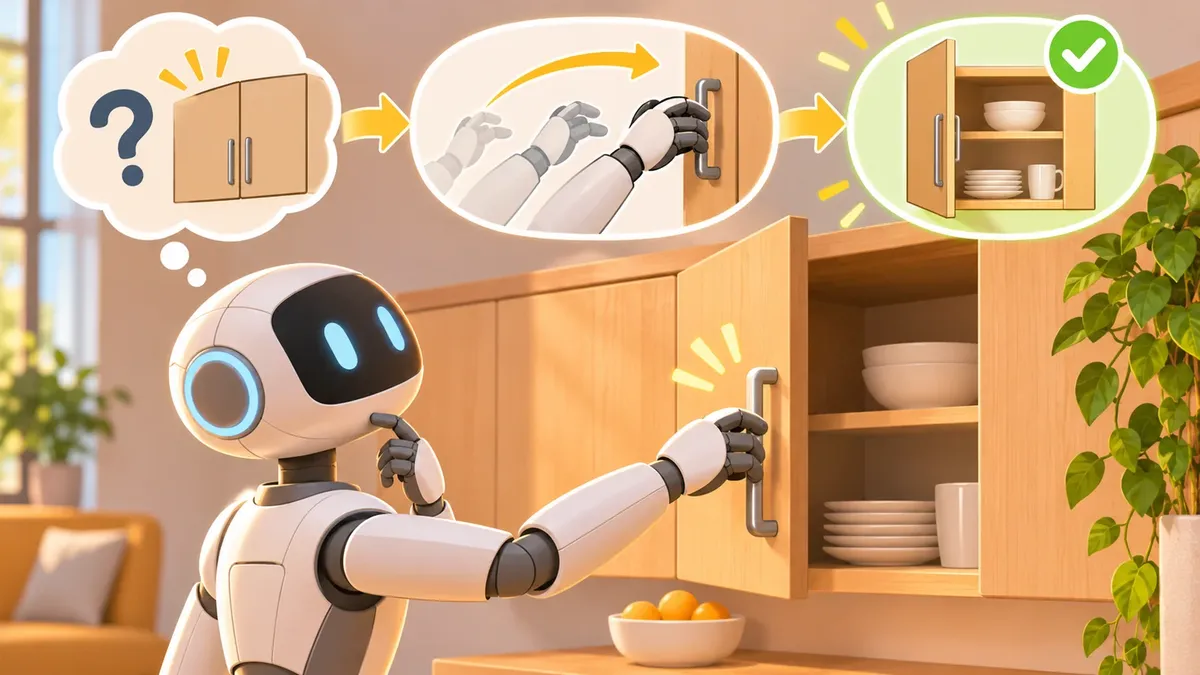
A robot may know what it needs to find but lack either the information or the skill to proceed. CHASE is designed to address both gaps in one loop: investigate, learn an operation if needed, then verify what happened. Its reported results are promising within a limited set of simulated and physical-robot tasks, but do not establish broad, reliable autonomy.
A robot asked to fetch a mug might not know which cupboard contains it. Even if it does, it may not know how to open the cupboard. A system that can only act on what it currently sees, using a fixed set of skills, can get stuck at either obstacle.
A November 2026 technical report introduces CHASE, a system that treats these as linked problems. Its central idea is that a robot should plan not only what to do, but what it needs to find out—and whether it must acquire a missing operation to investigate. The authors test the approach in simulation and on a physical robot. Their results suggest it can help with selected search, inspection and retrieval tasks, but do not show that robots can generally learn new skills and handle unfamiliar environments reliably.
One loop for questions and capabilities
CHASE combines four functions: maintaining an updated representation of the scene; planning investigations around unanswered questions; acquiring skills when an operation is missing; and composing skills while checking the result.
For example, a robot might consider whether an object is inside a drawer. It can plan to inspect the drawer, but if it has no way to open it, that operation becomes a capability gap. CHASE can make bounded attempts using a general-purpose robot policy, learn a separate skill from segments whose physical outcomes have been verified, and admit that skill only after testing it on held-out configurations. A successful attempt by the general-purpose policy is not itself proof that a reusable skill has been learned.
The planner weighs three considerations: how much an investigation might reduce uncertainty, how many pending tasks a newly acquired skill might enable, and the costs of acting, exploring and learning. That skill value is an estimate of potential usefulness—not proof that the skill will work in every setting. The system also distinguishes physical outcomes from information outcomes. Opening a drawer does not answer what is inside if the contents remain hidden; likewise, a failed grasp does not necessarily invalidate a well-supported observation about an object’s location.
What the tests report
In simulation, the researchers varied whether the robot lacked information, a required operation, or both. They report 50–80% task success for full CHASE when both information and capability gaps were present, alongside 70–90% resolution of evidence questions. These are ranges across evaluated scenes or configurations, not a single pooled success rate. In the same combined-gap setting, a version with search and skill acquisition but without the planner’s capability-value ranking reported 45–70% success. This comparison suggests the ranking component may help in these tests; it does not establish that it will help across other tasks or robots.
For three acquired operations—opening drawers or cabinets, lifting and restoring an occluder, and removing and returning a lid—the report gives held-out reuse success lower bounds of 70% to 75%, depending on the operation. Acquisition was costly: the reported upper bounds were 30 minutes for opening and lid handling, and 40 minutes for occluder handling. Those costs matter when judging whether learning a skill is worthwhile, especially for a task the robot encounters only once.
The physical-robot experiments used an AgileX Split Aloha platform for hard-drive search, office-object search and container-interior inspection. CHASE’s reported success ranges were 60–85%, 55–80% and 55–85%, respectively. These are task-specific results in clutter, not evidence of broad manipulation competence. Real-robot execution-time figures exclude training and skill admission, so they do not represent the full cost of a first task that requires learning.
What remains uncertain
The source identifies the work as a technical report and an arXiv preprint. Experiments cover six simulated scene instances, a limited set of acquired operations and three kinds of physical-robot task. The report identifies broader testing across objects and environments, incomplete visibility, and acquisition cost as remaining challenges. The findings therefore support a bounded claim: in the tested settings, CHASE reports the stated performance while combining investigation, skill acquisition and separate verification checks. They do not establish that curiosity itself causes better performance in general, or that acquired skills transfer safely beyond their validated scope.
Separating what a robot physically did from what it learned about its surroundings is a useful design principle. Whether CHASE scales to longer, less structured tasks remains open. Read the CHASE preprint.
- robotics
- embodied AI
- robot learning
- active perception
- skill acquisition
- robot manipulation
Reviewed cross-references
These connections were reviewed by a model, not independently fact-checked by a human. Similarity does not imply agreement; consult the original papers and the evidence below.
How Robot Memory Can Guide the Next Move
Supporting evidence: In their respective evaluations, both papers report evidence consistent with experience-based adaptation helping task execution: CHASE reports higher success with acquisition enabled than with fixed skills under capability gaps, while MXI-MemICL reports success gains over its base policy using retrieved interaction experience. The methods and tasks differ, so this is not a direct comparison or evidence of a general effect. Both are arXiv v1 papers, CHASE identifies itself as a technical report, and these conclusions are limited to the supplied excerpts and possible extraction errors.
Model review: · openai-codex/gpt-6-luna
Evidence and provenance
Selected excerpts, not complete papers. PDF extraction can omit figures or damage equations, tables and reading order; sources may be preprints.
2611.34416v1 — Original paper
Excerpt reference:
static/papers/2611.34416v1.md:666-772
Basis: Paper text
Source SHA-256:30724834257a80cf4518918198963c0c8eb4cac879b6ae2c756cc904b13ec4832611.34416v1 — Original paper
Excerpt reference:
static/papers/2611.34416v1.md:1011-1068
Basis: Paper text
Source SHA-256:30724834257a80cf4518918198963c0c8eb4cac879b6ae2c756cc904b13ec4832611.32564v1 — Original paper
Excerpt reference:
static/papers/2611.32564v1.md:153-209
Basis: Paper text
Source SHA-256:6c155b5dcc81e46dcac8c6c6638a3716f7d4428ac197b75400e8045bdc0b6caf
Related reading
Automatically matched by shared topic keywords. These links do not imply that the sources agree or establish a consensus.
AI coding agents build a robotics simulation benchmark
Source published
Shared keywords: embodied ai, robot learning
Robots Learn From Teachers, Then From Failure
Source published
Shared keywords: embodied ai, robot learning
When Reflections Challenge Robot Policies
Source published
Shared keywords: embodied ai, robot manipulation
Why computer-savvy AI struggles with a real keyboard
Source published
Shared keywords: embodied ai, robot manipulation
Can a general AI model control a robot arm?
Source published
Shared keywords: robot learning, robot manipulation