TRANSMISSION // 2611.34414v1
Giving 3D-modeling agents a spatial blueprint
Source published
SemProxy lets people guide coding agents with labeled 3D boxes. Tests found better model matches, but results rely partly on idealized boxes and leave shape and style to other inputs.
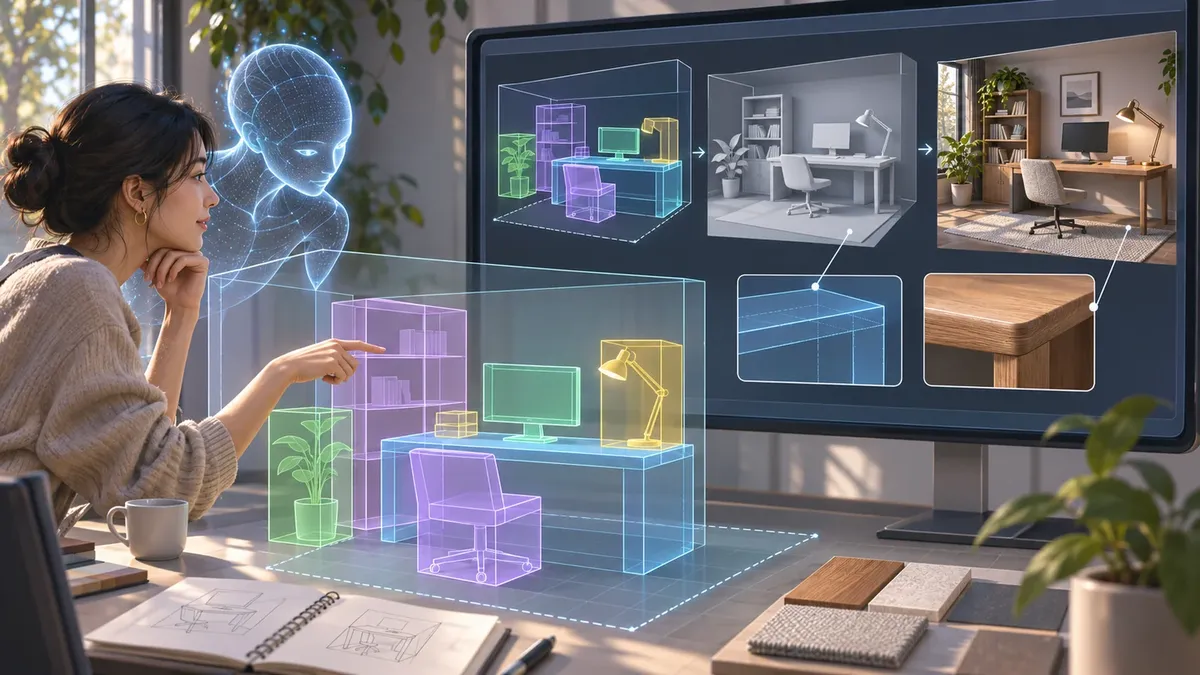
Text and pictures can leave room for guesswork when an AI agent builds a 3D model. SemProxy adds an editable spatial guide: labeled boxes that show where parts go and how large they should be. In tests, this approach improved model matches, though the strongest comparisons used carefully prepared boxes rather than ordinary user-made ones.
A more direct way to describe a 3D idea
A text prompt can name the parts of a model, and reference images can show its appearance. But neither necessarily says exactly where parts sit in three-dimensional space or how large they are. That can leave a coding agent to guess—and a user to correct the result through more prompts.
SemProxy, a system introduced by Shuyuan Zhang and Changjian Li of the University of Edinburgh, offers another kind of input: labeled 3D bounding boxes. A user can place, move, rotate, or resize a box for a part such as a monitor riser, or for an object in a room. The boxes communicate approximate position and scale, while the agent remains responsible for creating the detailed geometry.
The idea is to keep the guide simple enough for people to edit and structured enough for existing coding agents to read. SemProxy stores boxes as structured text and as a 3D scene that can also be rendered as images. The authors built ProxyStudio, an interface combining box editing with text prompts and reference images. An agent can also draft boxes from text and images for the user to review.
Testing boxes as an extra input
The researchers tested three coding agents using Blender’s Python interface. Their test collection included 40 objects, split between easier and more complex examples, and 20 furnished indoor scenes. For each sample, they compared modeling from text and reference images with modeling from those same inputs plus boxes.
The main comparison used boxes fitted to the reference models, rather than boxes independently drawn by users. This made it possible to test the effect of spatial guidance under controlled conditions, but it also means the boxes were unusually informative. The team measured geometric similarity to the reference meshes and used two additional scores for visual and shape similarity. They also ran tests with agent-drafted boxes, deliberately perturbed boxes, and alternative ways of encoding box information.
Across the tested agents and task types, adding the prepared boxes generally improved the scores and reduced modeling time and output-token use. Averaged across the reported task levels and agents, the authors report a 47% reduction in Chamfer distance, a measure of geometric mismatch. The two similarity scores also rose, by 2% and 1.5% on average. These are results on the study’s selected examples and metrics, not a guarantee that every model or user task will improve.
In a separate online preference survey, 32 participants compared paired models. Among the 535 responses that expressed a preference, 67.5% favored the model made with the boxes. Responses without a clear preference were excluded from that percentage. A smaller hands-on study involved seven participants using ProxyStudio; the authors report that participants generally felt in control, but this study is too small to establish how users broadly would experience the tool.
Useful guidance has limits
The tests also show why the quality and meaning of the boxes matter. When an agent first drafted boxes from text and images, the results generally fell short of using the prepared boxes and often stayed closer to the no-box baseline. The authors suggest that image ambiguity and occlusion can prevent an agent from recovering spatial information that was never clearly supplied.
Small amounts of added noise to prepared boxes retained much of their benefit in the tested setup. But performance declined as the boxes became more inaccurate; at the highest noise level, some visual similarity scores fell below the text-and-image baseline. Agents also differed in how they resolved conflicts between boxes and images. So a box guide can steer a model, but conflicting inputs may leave the agent’s choice unpredictable.
Boxes describe location, size, and orientation—not surface texture, material, visual style, or a part’s exact curved shape. The paper’s user study includes examples where curved components needed further correction. Text and images remain important for those details, and the authors suggest that sketch-based or richer spatial inputs could help in future systems.
What the evidence can—and cannot—show
The evaluation is useful evidence that explicit spatial structure can help coding agents reproduce reference models in these particular object and room tasks. But the most controlled comparison relies on reference-derived boxes, because the authors say no large dataset of user-placed boxes was available. Creative work often has no reference mesh against which to score a result, making the study’s main quantitative metrics harder to apply. The hands-on evidence comes from only seven participants, and the tested agents, software setup, and selected tasks do not represent every modeling workflow.
SemProxy is best understood as a proposed interface for sharing spatial intent, not an autonomous modeling breakthrough or a replacement for human judgment. The paper is an arXiv preprint; the supplied source does not establish that it has been peer reviewed. Its results are promising within the reported experiments, while broader usability and performance remain open questions.
- 3D modeling
- AI coding agents
- human–AI interaction
- spatial interfaces
- bounding boxes
- SemProxy
Reviewed cross-references
These connections were reviewed by a model, not independently fact-checked by a human. Similarity does not imply agreement; consult the original papers and the evidence below.
Why 3D reconstruction needs more than a close fit
Shared method: Both studies use coding agents to create 3D models through modeling software: SemProxy supplies labeled proxies to agents modeling through Blender, while S2Bench lets agents measure scans and iteratively build components in a CAD/BIM kernel. This is a bounded methodological overlap, not evidence that the systems or tasks are equivalent: SemProxy studies user control of object and scene modeling, whereas S2Bench evaluates reconstruction from scans.
Model review: · openai-codex/gpt-6-luna
Evidence and provenance
Selected excerpts, not complete papers. PDF extraction can omit figures or damage equations, tables and reading order; sources may be preprints.
2611.34414v1 — Original paper
Excerpt reference:
static/papers/2611.34414v1.md:140-195
Basis: Paper text
Source SHA-256:7ac505938aa0466ad660212c4c39af4cbda17075956510ad4dba46a03044b50d2611.28197v1 — Original paper
Excerpt reference:
static/papers/2611.28197v1.md:101-176
Basis: Paper text
Source SHA-256:76446043de9e610f6feb55260e542e28af0ec95d3b14deec0ae7ebebf8ba2769
Related reading
Automatically matched by shared topic keywords. These links do not imply that the sources agree or establish a consensus.
What Does an AI Think You Want?
Source published
Shared keywords: human ai interaction
What Your Typing Can—and Can’t—Reveal When Prompting AI
Source published
Shared keywords: human ai interaction
Can a few smart questions help an AI learn what you prefer?
Source published
Shared keywords: human ai interaction
A Better Paper Trail for Updating AI Skills
Source published
Shared keywords: human ai interaction
The bargaining penalty of being labeled AI
Source published
Shared keywords: human ai interaction