TRANSMISSION // 2611.34401v1
When Strong Coupling Changes the Quantum Thermalization Clock
Source published
A theoretical study derives a lower bound on how quickly strongly coupled open quantum systems can thermalize. The bound can be calculated from equilibrium properties, but it depends on what information about the system’s Hamiltonian survives in its equilibrium state.
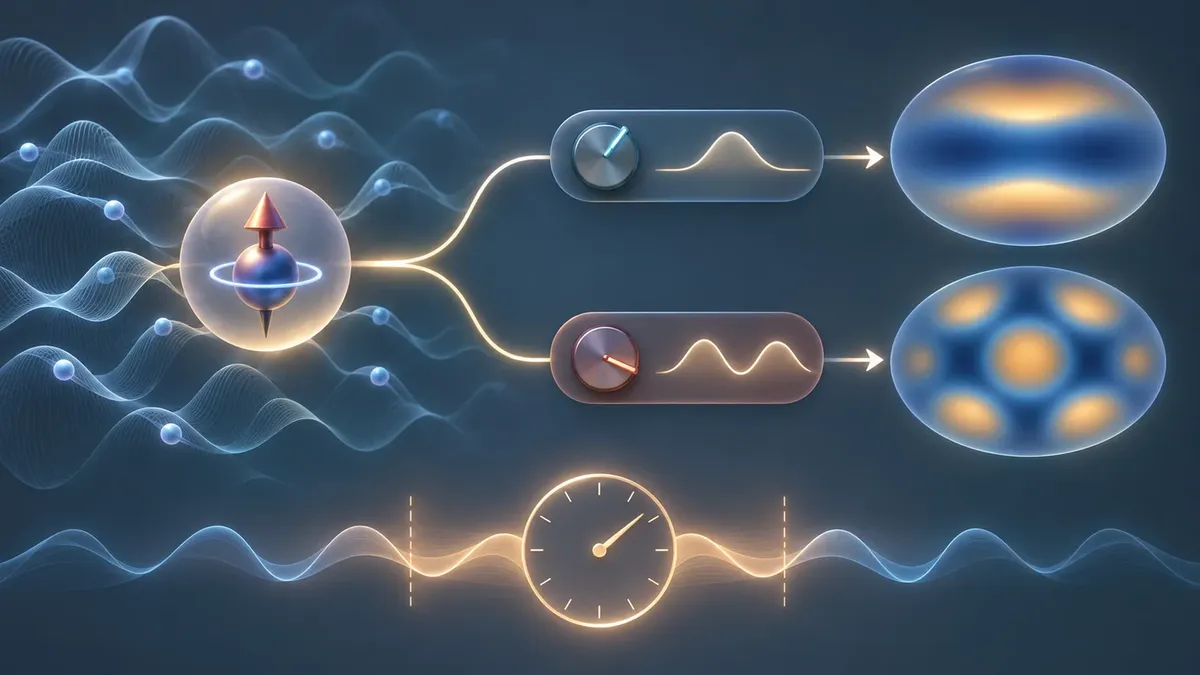
Can quantum systems be forced to take a minimum time to settle into thermal equilibrium? A new theoretical study argues that, even when a system is strongly coupled to its environment, a useful lower bound can be found by comparing the equilibrium states associated with nearby versions of the system. The result is not a universal stopwatch: strong coupling can weaken the bound when equilibrium carries little information about the system’s Hamiltonian.
Thermalization is often described as a system settling into a state set by its temperature. But for a quantum system strongly coupled to its surroundings, the equilibrium state may not be the familiar Gibbs state of the system alone. The environment’s influence matters, and the appropriate state is called the mean-force Gibbs state.
A paper by Jesús Jiménez-Rodríguez, John Calsamiglia and Martí Perarnau-Llobet asks whether the time needed to reach this kind of equilibrium is limited by a fundamental quantum timescale: the Planckian time, written as ℏ/(kB T). Here ℏ is the reduced Planck constant, kB is Boltzmann’s constant and T is temperature. The authors’ answer is conditional: they derive a lower bound, but whether it enforces a Planckian-scale limit depends on how much information about the system’s Hamiltonian is retained in the equilibrium state.
Comparing nearby systems
The central idea is to ask whether the same physical process can thermalize a family of systems whose Hamiltonians differ only slightly. A Hamiltonian is the mathematical description of a system’s energy and dynamics. If changing it slightly also changes the corresponding equilibrium state in a distinguishable way, the process must acquire information about that change as it thermalizes.
The authors derive a lower bound on the time for this process. According to the abstract, the bound does not depend on the detailed system–environment dynamics. Instead, it depends on how distinguishable the equilibrium states are. That makes it possible, in principle, to calculate the bound using equilibrium properties rather than a full account of the route to equilibrium.
In a simpler form, the calculation requires a static susceptibility and an equilibrium variance of a system observable. Put informally, susceptibility describes how a system responds to a small change in a parameter, while variance describes how much an observable fluctuates in equilibrium. These quantities help indicate whether the equilibrium state contains a detectable imprint of a change in the Hamiltonian.
What the models show
The researchers examine exactly solvable fermionic models, the spin-boson model and a spin coupled to a two-dimensional Heisenberg antiferromagnet. These are theoretical models used to explore different forms of system–environment coupling; the abstract does not describe experiments.
Across the models studied, strong coupling can lift the Planckian constraint when the mean-force Gibbs state retains little information about the system Hamiltonian. In other cases, the constraint persists: the abstract associates this with information carried by system observables that have substantial equilibrium fluctuations at frequencies below kB T/ℏ.
The proposed bound is therefore not a claim that all strongly coupled quantum systems must thermalize within one fixed range of times. Rather, it links the strength of a time constraint to how visibly a small change in the system’s Hamiltonian alters its equilibrium state.
A different kind of speed limit
The authors describe their result as complementary to open-system speed limits. Those limits concern how quickly a system can be prepared in a target state. This bound instead concerns the acquisition of information about which nearby Hamiltonian is present. The distinction matters: a restriction on how quickly a process can learn about a change is not identical to a restriction on how quickly it can prepare a particular state.
The abstract also says the bound can remain informative at strong coupling even when other speed-limit bounds become trivial. That is a claim about the framework and the models examined, not evidence that it applies usefully to every real-world open quantum system.
What remains uncertain
This account is based on the paper’s abstract, not a full examination of its derivations, assumptions, numerical details or supplementary material. The abstract names several models but gives no quantitative results, so it does not support a numerical estimate of thermalization times or a ranking of the models. Nor does it establish experimental confirmation or a universal law for all forms of coupling.
The work is listed as an arXiv preprint. A preprint is a publicly shared research manuscript; its presence on arXiv alone does not establish that it has passed peer review. The authors’ conclusion is best read as a theoretical result whose reach and practical usefulness require assessment from the full paper and further research.
- quantum thermalization
- open quantum systems
- strong coupling
- Planckian time
- mean-force Gibbs state
- quantum speed limits
Related reading
Automatically matched by shared topic keywords. These links do not imply that the sources agree or establish a consensus.
A Quantum Thermalization ‘Burst’ Can Be Built to Order
Source published
Shared keywords: quantum thermalization
How a tiny gauge-theory ladder approaches thermal equilibrium
Source published
Shared keywords: quantum thermalization
How a frequency comb could shape photon emission
Source published
Shared keywords: strong coupling
How quantum systems behave over the long run
Source published
Shared keywords: open quantum systems
How Gaussian wave packets trace quantum motion in open systems
Source published
Shared keywords: open quantum systems