TRANSMISSION // 2611.34399v1
Could clouds create near-horizon radio backgrounds?
Source published
A simplified model suggests cloud reflections might contribute to confusing near-horizon radio signals, but the proposed effect has not been confirmed by measurements.
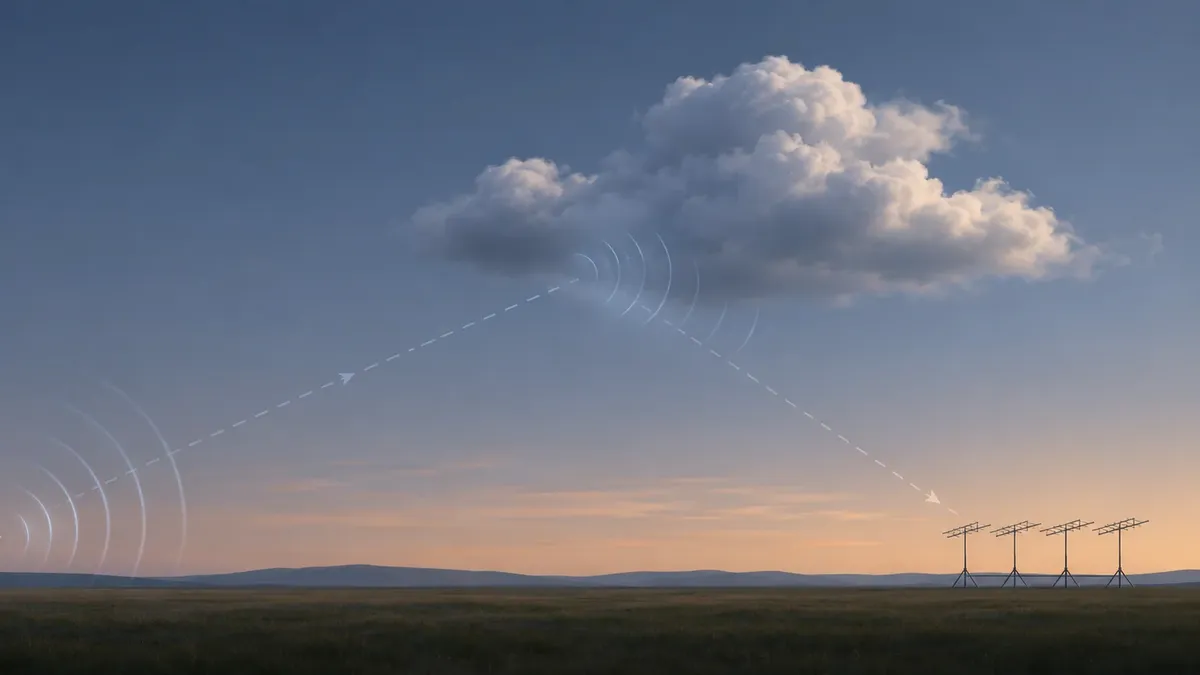
Self-triggered radio detectors studying air showers must contend with changing human-made radio interference. A new preprint asks whether clouds could redirect some transmissions into apparent near-horizon signals—a possibility that remains untested.
An unexplained patch near the horizon
Radio antennas can detect brief emissions from air showers: cascades of particles produced when cosmic rays enter the atmosphere. In self-triggered experiments, the antennas decide when to record signals, so radio-frequency interference (RFI) can generate unwanted triggers and strain data-taking systems. Signals around the horizon are especially challenging. The paper says this region—defined there as a couple of degrees above the physical horizon—is often excluded from triggers or analysis.
That exclusion is not an easy option for every search. Experiments looking for radio signals from showers produced by Earth-skimming neutrinos may need to distinguish signals from below the horizon from backgrounds at or above it. The new preprint by Enrique Huesca Santiago, Giulia Cantarini and Anna Nelles explores whether clouds might reflect terrestrial transmissions into directions that appear above the horizon.
The authors draw motivation from reports of unexplained events near the horizon in several experiments, including AERA, OVRO-LWA and BEACON. The reports are not a uniform dataset: some describe time-variable backgrounds, and the experiments used different triggers and reconstruction methods. The authors caution that publicly available information is incomplete and does not allow a precise, direct comparison. These observations motivate the hypothesis; they do not show that clouds caused any particular event.
A first estimate of cloud scattering
The team estimated whether clouds could scatter radio waves in the MHz frequency range used by air-shower experiments. They adapted a radar-scattering simulation method, representing a cloud as a collection of smaller modeled volumes, or cells. The calculation assumes liquid-water droplets, with idealized configurations including rain-like, stratus-like and fog-like cases. Some configurations use droplets of a single size, rather than representing the full complexity of real clouds.
The researchers combined the modeled scattering with basic geometry and estimates of transmitter power, travel distances and detector sensitivity. These assumptions matter: whether a reflected signal would be detectable depends on the source, the distances involved, the receiver and its sensitivity. The geometry calculations also examine whether a reflection from a cloud at atmospheric altitude could be consistent with a signal reconstructed near the horizon.
What the model indicates
For some modeled cloud configurations, the estimated radar cross section—the measure of how strongly a target scatters radio energy—was compatible with detection under the study’s assumptions. The model found enhanced scattering in forward-scatter geometries, where the transmitter and receiver lie in nearly the same direction as viewed from the cloud. For the modeled stratus configuration, the calculated radar cross section rose strongly at low elevation angles.
These results make cloud reflections a physically plausible possibility in the authors’ calculations; they do not establish that clouds have produced the reported near-horizon events. The hypothesis is that a cloud could redirect a transmission, so the signal’s apparent direction might not point to the transmitter. The study does not identify a cloud as the source of any observed signal or demonstrate a specific reflection path.
What remains uncertain
The authors describe their calculation as a first-order feasibility estimate. Real clouds are more complex than the idealized droplet arrangements used in the model, and the authors note that modeling cloud structure is difficult. The paper also says that no experiment publishes fully raw data before cuts, while only a few publish related event distributions. That limits outside researchers’ ability to examine waveform details and trigger behavior for the reported events.
Testing the idea will require both experimental investigation and further modeling. The authors propose examining possible connections between weather and near-horizon events, and say future work should include full waveforms, multiple propagation paths and detector-trigger details. Other atmospheric phenomena may also merit study. They explicitly hope experiments can test—and potentially reject—the cloud-reflection explanation.
This is a preprint, so its claims are preliminary and have not necessarily been peer reviewed. Its main result is a model-based argument that cloud reflections cannot yet be ruled out under certain assumptions—not a confirmed explanation for radio backgrounds, nor evidence that the proposed effect occurs in a particular detector.
- radio detection
- cosmic-ray air showers
- radio interference
- cloud scattering
- near-horizon backgrounds
- neutrino detection
Related reading
Automatically matched by shared topic keywords. These links do not imply that the sources agree or establish a consensus.
Using Greenland’s radio background to calibrate detector signal chains
Source published
Shared keywords: neutrino detection
A Decade of Antarctic Radio Data Tightens the Search for Extreme Neutrinos
Source published
Shared keywords: neutrino detection
A small radio array listens for solar outbursts
Source published
Shared keywords: radio interference
South Pole radio array sets new limits on extreme-energy neutrinos
Source published
Shared keywords: radio detection