TRANSMISSION // 2611.34365v1
Magnetic features reveal solar flows near the poles
Source published
Tracking magnetic features in SDO images, researchers map solar inertial modes to higher latitudes than granule tracking reliably reaches. They report a new mode whose physical identity remains uncertain.
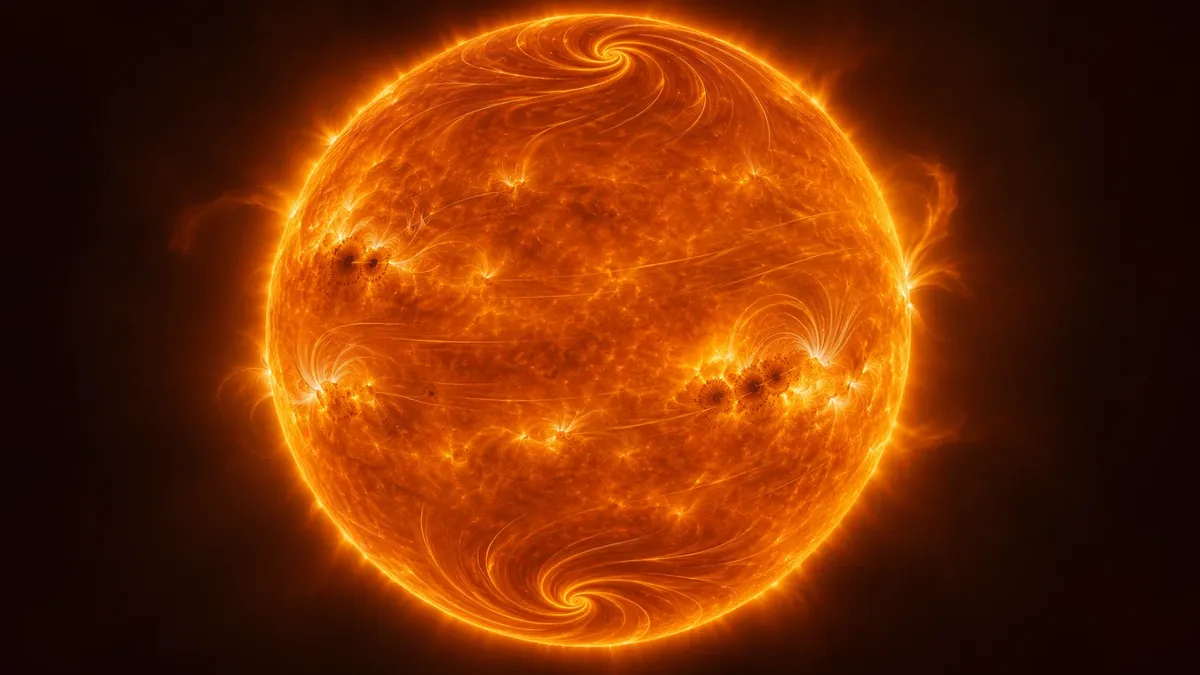
The Sun’s slow, large-scale motions can offer clues about its deep convection zone. A study uses magnetic patterns on the solar surface to trace these flows toward the poles and reports a previously unreported oscillation. Its signal is identified in the data, but its physical identity is not settled.
The Sun’s outer layers move in broad, repeating patterns as well as shining. Among these motions are inertial modes: oscillations shaped by the Coriolis force associated with solar rotation. Their properties can help researchers investigate conditions in the convection zone, but the signals are faint, and measurements become difficult at high latitudes.
Neelanchal Joshi and colleagues tested whether small magnetic features could help trace these flows closer to the poles. They analyzed observations from the Helioseismic and Magnetic Imager aboard NASA’s Solar Dynamics Observatory, spanning May 2010 to December 2024. Their method, local correlation tracking, estimates motion by comparing image patches at different times: the displacement of a recognizable pattern provides an estimate of horizontal surface flow.
The team tracked magnetic features in magnetograms, comparing image pairs one hour apart. For comparison, they tracked granules—the small, changing patterns seen in continuum-intensity images—using pairs 45 seconds apart. Both approaches produced flow maps at six-hour intervals. The researchers also compared their results with ring-diagram analysis, a helioseismic method applied to Doppler measurements, which provided maps about every nine hours.
Before searching for modes, the researchers removed large-scale systematic patterns and long-term variations that could obscure the signals. They analyzed how the flows changed over time and longitude, then isolated frequency ranges associated with modes. To estimate each mode’s shape across latitude, they used singular value decomposition, a mathematical technique for extracting a dominant shared pattern from a dataset.
Magnetic-feature tracking, which the paper calls LCTMag, provided reliable measurements to about 85 degrees latitude. Granule tracking became unreliable above roughly 65 degrees, where granules are harder to resolve at steep viewing angles. Ring-diagram measurements reached about 80 degrees in this comparison. Below 65 degrees, the mode shapes from magnetic-feature and granule tracking were broadly consistent. The authors also report that the power-spectrum noise background was about 80% lower for LCTMag than for granule tracking. This describes the methods and data analyzed here; it does not establish that magnetic tracking is better for every purpose.
Using LCTMag, the researchers report a previously unreported retrograde mode with longitudinal wavenumber m = 3 and frequency −192 nanohertz in the Carrington frame, which rotates with the Sun. The signal appears across latitudes, and its flow pattern has a pronounced spiral shape above 65 degrees. The authors estimate a maximum velocity amplitude of 1 metre per second near 70 degrees.
The reported signal and its proposed physical explanation are separate questions. The authors suggest a possible identification with a mode from a linear model, but do not present that identification as definitive: the observed and modeled patterns differ, and they describe mode identification as a continuing challenge. The study therefore reports a new mode in the measurements while leaving its physical interpretation open.
In this analysis, the broader latitude coverage and lower noise in magnetic-feature tracking helped the researchers examine mode patterns, including those at high latitudes. These are measurements of near-surface horizontal flows, however—not direct maps of motion throughout the convection zone. The authors also found no clear evidence in their data for certain prograde thermal Rossby signals reported in earlier work. That is a non-detection in this analysis, not evidence that such signals do not exist.
The supplied source is an Astronomy & Astrophysics manuscript labeled as proofs, and its receipt and acceptance dates remain placeholders. The source provided here does not establish the manuscript’s final publication or peer-review status. Its findings should be read with that limitation in mind.
- solar inertial modes
- solar convection zone
- magnetic feature tracking
- SDO/HMI
- solar oscillations
- helioseismology
Reviewed cross-references
These connections were reviewed by a model, not independently fact-checked by a human. Similarity does not imply agreement; consult the original papers and the evidence below.
How a different view changes the Sun’s magnetic map
Supporting evidence: Both studies indicate that viewing geometry affects solar magnetic observations: Joshi et al. note foreshortening-related gradients in tracked magnetic features at high latitudes, while Sinjan et al. find viewing-angle and resolution effects in inferred active-region flux. This is a limited methodological caution, not a direct comparison: the studies examine different targets and quantities, and do not establish that the same biases affect both measurements.
Model review: · openai-codex/gpt-6-luna
Evidence and provenance
Selected excerpts, not complete papers. PDF extraction can omit figures or damage equations, tables and reading order; sources may be preprints.
2611.34365v1 — Original paper
Excerpt reference:
static/papers/2611.34365v1.md:1758-1794
Basis: Paper text
Source SHA-256:ae8e7dd8f9fbf646b6395af83b90ea8345099e72fceb76e00f2eafbcfef866442611.31704v1 — Original paper
Excerpt reference:
static/papers/2611.31704v1.md:525-600
Basis: Paper text
Source SHA-256:a311b1a08ac0fc64a94fa200f002f551383df8283781703cc6e3bd95f6f93be9
Related reading
Automatically matched by shared topic keywords. These links do not imply that the sources agree or establish a consensus.