TRANSMISSION // 2611.34364v1
A new pipeline cleans up CHASE observations of the Sun
Source published
The open-source enCHASE pipeline corrects several instrumental effects in CHASE solar spectra. Tested on six solar features, it improves image alignment, wavelength stability and intensity calibration, with important limits to its stray-light correction.
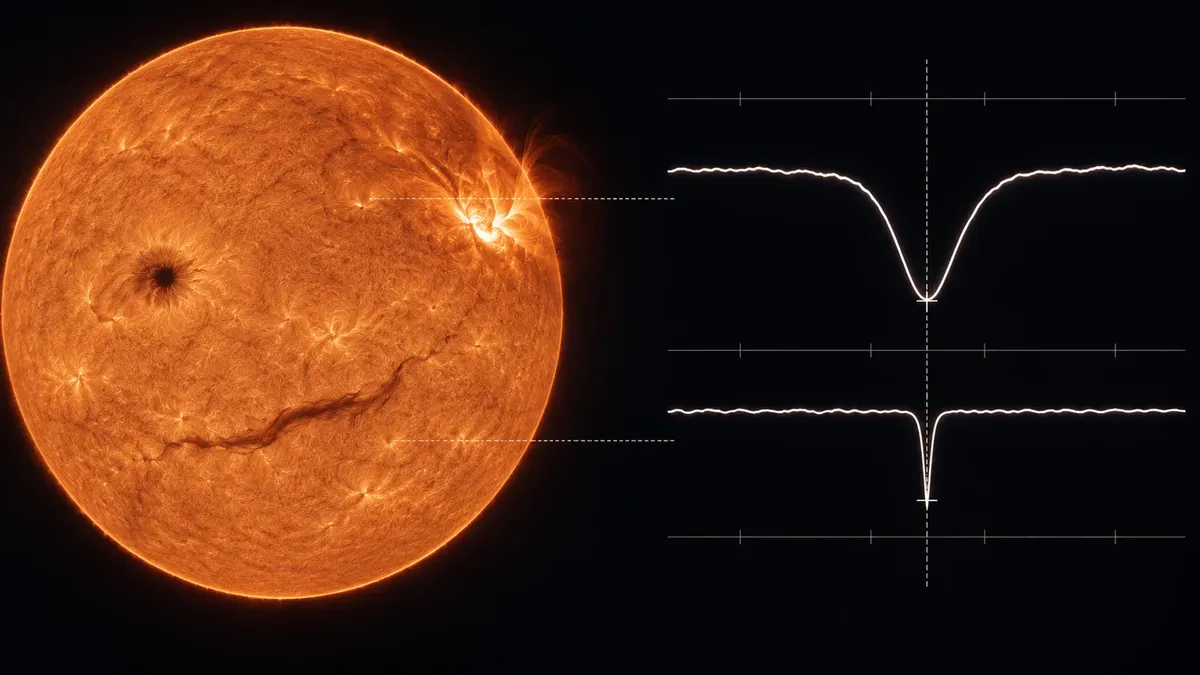
Solar spectra can reveal activity from quiet regions to flares, but instrumental shifts and distortions can blur the picture. Researchers introduce enCHASE, an open-source tool for correcting and calibrating observations from China’s CHASE solar mission.
Making solar spectra easier to trust
The Sun is not a static disk. Its atmosphere contains quiet regions, sunspots, filaments and explosive flares, and researchers use light from different parts of the Sun to study how those features change. But before small changes in a spectrum can be interpreted as solar activity, scientists need to distinguish them from shifts and distortions introduced by the instrument.
The Chinese Hα Solar Explorer, or CHASE, records spectra across the full solar disk. Its publicly available Level-1 data already receive standard corrections, but residual effects can remain, including pointing shifts, wavelength offsets, intensity variations and stray light. The authors present enCHASE, an open-source, documented workflow for correcting these effects and preparing data for analysis.
A series of calibration steps
The pipeline registers full-disk images by locating the Sun’s edge, recentering each frame and using the instrument’s INST_ROT header angle to derotate frames to solar north. For smaller regions, it tracks features between scans using image correlation. It also applies optical flow—a method that estimates local image motion—to correct smaller distortions the authors consider likely related to telescope vibrations during scanning.
Next, enCHASE aligns the wavelength scales of different scans and calibrates intensity against a high-resolution reference spectrum, or atlas. For intensity calibration, it fits the mean Fe I spectrum in a 100-by-100-pixel box at disk centre to the atlas; the box can be moved manually to avoid active regions. Finally, the pipeline estimates and corrects for stray light, which fills in spectral line cores.
The team demonstrated the workflow on one full-disk time series containing six types of solar region: quiet Sun, a filament, a sunspot, plage, a prominence and an X1.2-class flare. The series included 25 scans over about 29 minutes. It was selected to include a range of features and instrumental effects; analysing the solar regions themselves was outside the paper’s scope.
What improved—and what did not
In tracked sub-fields, residual pointing error fell from 10.5 arcseconds RMS in the original data to 0.43 arcseconds after correlation tracking and 0.06 arcseconds after optical flow. The authors describe the final error as well below one pixel. After wavelength resampling, scan-to-scan scatter in the line-core position was reduced to 0.9 milliångströms for Hα and 1.2 milliångströms for Fe I. The abstract summarizes wavelength zero-point stability as 1.2 milliångströms, or about 0.05 kilometres per second.
For the Fe I atlas fit, the authors report a residual of 0.95% of the continuum in the line wings, with a largest residual of 2.4%. After calibration, the quiet Sun, filament, sunspot and plage were broadly stable at about the 1% level in the study’s contrast measure. The flare still showed line-core brightening. The prominence retained stripes that alternated with scan direction because the tracking method could not lock onto the off-limb region.
These results show that the pipeline reduced several instrumental patterns in the tested data. They do not establish that every remaining variation is solar, or that the same performance will hold for all observations.
Limits matter
The stray-light correction relies on an important simplifying assumption: stray light is constant across the field of view. The authors warn that this can overestimate stray light near or beyond the solar limb, and say the correction should not be applied to off-limb features such as prominences. The pipeline also cannot correct light scattered between nearby image pixels because a spatial point-spread function for CHASE has not been published. Its narrow instrumental profile is not deconvolved.
The demonstration uses one time series, so it is an example rather than a broad validation across dates and observing conditions. The authors note that data uploaded after July 18, 2023, already have corrections for many of the residual issues described for earlier data. Users should therefore consider which data version they are processing. They recommend using both Hα and Fe I in the reduction, since Hα-only calibration has slightly higher uncertainties.
The manuscript is available as an arXiv preprint; the supplied record does not establish its peer-review status. The authors report that enCHASE is open source under the MIT license and available through PyPI. Its accessibility makes the workflow available for testing, but the reported performance remains tied to the demonstration and assumptions described in the paper.
- enCHASE
- CHASE solar mission
- solar spectroscopy
- H-alpha
- Fe I
- instrument calibration
- solar flares
Related reading
Automatically matched by shared topic keywords. These links do not imply that the sources agree or establish a consensus.
Solar spectra put atomic line data to the test
Source published
Shared keywords: solar spectroscopy
Testing IXPE background signatures with cobalt-60
Source published
Shared keywords: instrument calibration
How FOXSI’s X-ray optics handle off-center views
Source published
Shared keywords: solar flares
Cleaning the View of Earth’s Faint Ultraviolet Halo
Source published
Shared keywords: instrument calibration
How Solar Flare X-rays Trace a Heating Pattern
Source published
Shared keywords: solar flares