TRANSMISSION // 2611.34350v1
Quasar pairs offer a way to map young galaxy clusters
Source published
DESI’s first data release reveals tens of thousands of nearby-in-redshift quasar pairs. Their clustering suggests many mark the environments of forming galaxy clusters, though the evidence is statistical.
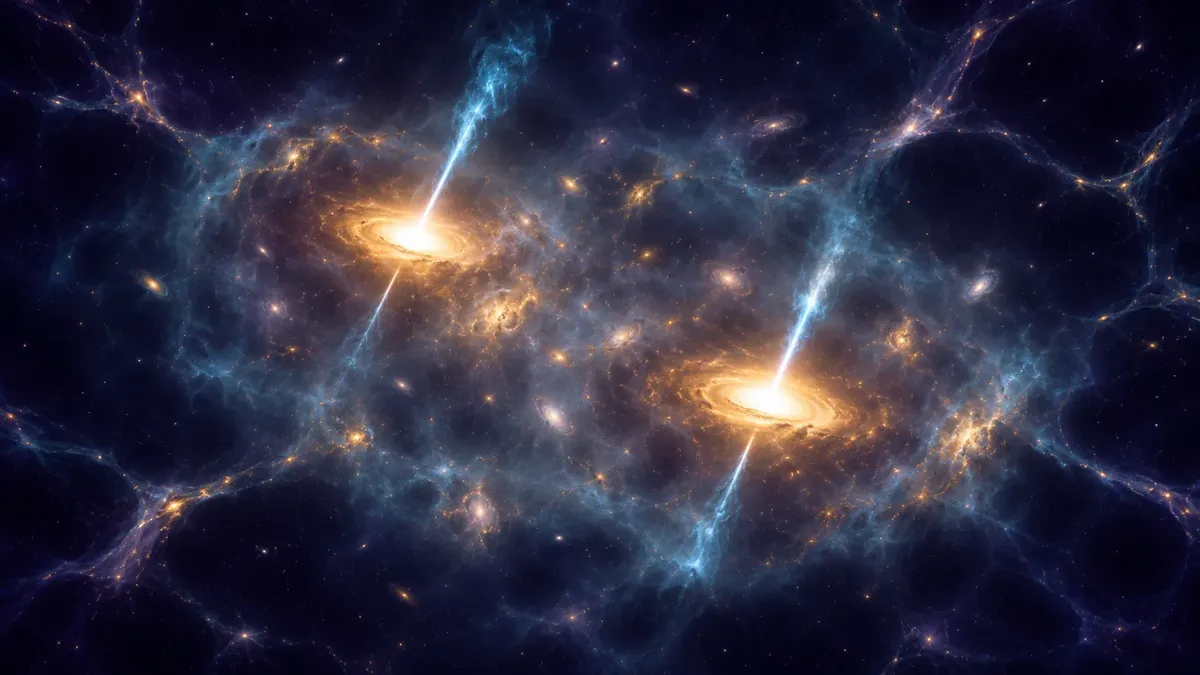
Galaxy clusters grow over vast regions in the early universe. A new study uses pairs of quasars—bright, distant beacons powered by feeding black holes—to identify places where such clusters may be forming. The result is a promising statistical tracer, not confirmation of the surroundings of every pair.
Galaxy clusters have ancestors called protoclusters: extended regions that have not yet settled into mature clusters and whose galaxies can occupy several dark-matter haloes. Finding them is difficult, so astronomers seek tracers that can be identified in large numbers and linked to dense environments.
A study by Martín G. Richarte and Diego G. Lambas asks whether pairs of quasars can serve this purpose. Quasars are bright galactic cores powered by matter falling onto supermassive black holes. Two quasars close together on the sky and at similar distances may indicate a region rich in massive haloes. But apparent closeness can also be a coincidence. The researchers therefore estimate how often selected pairs are likely to be physically associated and test whether their members occupy unusually clustered environments.
Selecting pairs and testing the signal
The team searched the first data release of the Dark Energy Spectroscopic Instrument (DESI), selecting quasars with redshifts between 1.2 and 2.8. Candidate pairs had a rest-frame velocity difference no greater than 900 kilometres per second and a projected physical separation of at most 4 megaparsecs. A megaparsec is about 3.26 million light-years.
To estimate how many apparent pairs could occur by chance, the researchers shuffled quasar redshifts while keeping sky positions fixed. At separations of 2–2.5 megaparsecs, estimated purity was about 53%; at 3–4 megaparsecs, it was 43%. They chose 2.5 megaparsecs as the main sample’s outer limit, where roughly half the pairs are estimated to be chance alignments.
DESI’s fibre system cannot observe two very close targets in a single pass. The team restricted its main analysis to regions observed on at least two overlapping tiles and corrected pair counts using measured fibre-assignment completeness. They also removed identified lens candidates and inspected images and spectra for 90 randomly selected pairs. They report that 89 were two distinct quasars; the remaining pair included a galaxy classified as a quasar.
Next, they compared the clustering of pair members with that of all DESI quasars. As a control, they examined “chance pairs” with much larger redshift separations, which are not expected to be physically close along the line of sight. They also compared their results with ten AbacusSummit simulations designed to represent DESI quasar observations in a standard cosmological model.
What the measurements show
The main sample contains 40,626 pairs with projected separations up to 2.5 megaparsecs. Members of pairs separated by up to 1 megaparsec were 1.69 times as strongly clustered as all DESI quasars, with an uncertainty of 0.14. For pairs separated by 1–2.5 megaparsecs, the factor was 1.78, with an uncertainty of 0.09. The 2.5–4 megaparsec test bin showed a factor of 2.01, with an uncertainty of 0.06, although it is less pure and lies beyond the main sample limit.
The chance-pair control showed little excess clustering: its measured factor was 1.08, with an uncertainty of 0.05. This contrast supports the interpretation that physical quasar pairs select unusually clustered environments, rather than merely reflecting the clustering of quasars overall.
Using a model that relates clustering strength to dark-matter halo mass, the authors estimate environmental masses of about 1.4–2.2 × 10¹³ times the Sun’s mass, in units that include the conventional cosmological parameter h. These are model-based estimates for the environments, not direct weighings of individual structures or proof that every pair sits inside one bound object. The simulations reproduce the measured clustering within the reported uncertainties, consistent with the study’s interpretation under the standard cosmological model.
A useful tracer, with limits
The evidence is statistical. The 2.5-megaparsec boundary is not a sharp physical edge: estimated purity there is only about 50%, so chance projections remain. The mass estimates depend on a model linking clustering to halo mass. Fibre completeness is another limitation: pairs in regions observed only once are not included in the main analysis because weighting cannot reliably recover the very low completeness there.
The paper is an arXiv preprint presented as an Astronomy & Astrophysics manuscript. Its results should be treated as the authors’ reported analysis, not as a substitute for independent assessment. The authors say the catalogue and analysis materials will be made available upon publication. A proposed future measurement using cosmic microwave background lensing could offer an additional test of the inferred environments.
The study covers a broad span of cosmic history, from redshift 1.2 to 2.8, rather than a single moment in the universe’s past. It suggests that quasar pairs can help build a statistical census of protocluster-scale environments across this era, often called cosmic noon. The full DESI survey could expand the sample; further observations will be needed to establish the properties of individual structures.
- quasar pairs
- DESI
- protoclusters
- cosmic noon
- large-scale structure
- dark matter haloes
Reviewed cross-references
These connections were reviewed by a model, not independently fact-checked by a human. Similarity does not imply agreement; consult the original papers and the evidence below.
A CMB lensing signal reveals mass around Planck candidates
Supporting evidence: In separate preprint analyses, Richarte and Lambas report that DESI physical-quasar-pair members are more clustered than quasars overall and interpret pairs within 2.5 Mpc as protocluster tracers; Dusserre et al. report a significant stacked ACT lensing signal at Planck candidate positions and conclude the candidates are correlated with high-redshift mass and likely include protoclusters. This is complementary evidence, not direct cross-validation: the samples and methods differ, and Dusserre et al. estimate mass from a stack rather than from the quasar pairs.
Model review: · openai-codex/gpt-6-luna
Evidence and provenance
Selected excerpts, not complete papers. PDF extraction can omit figures or damage equations, tables and reading order; sources may be preprints.
2611.34350v1 — Original paper
Excerpt reference:
static/papers/2611.34350v1.md:654-707
Basis: Paper text
Source SHA-256:fe5f17ba0248d767f9b6df3b13455602876b5c82901e240fae940a84a7afa7642611.32282v1 — Original paper
Excerpt reference:
static/papers/2611.32282v1.md:543-592
Basis: Paper text
Source SHA-256:65fb285f1f481b8b1e2b746c6b73b989751679856c9d55fcefcdd74836b54c67
Related reading
Automatically matched by shared topic keywords. These links do not imply that the sources agree or establish a consensus.
Combining Cosmic Probes to Test Dark Energy
Source published
Shared keywords: large scale structure
One simulation, many dark-energy histories
Source published
Shared keywords: large scale structure
Could Cosmic Structure Help Explain Acceleration?
Source published
Shared keywords: large scale structure
A softly broken symmetry offers a route across the phantom divide
Source published
Shared keywords: large scale structure
Little Red Dots at Cosmic Noon: What Spectra Reveal
Source published
Shared keywords: cosmic noon