TRANSMISSION // 2611.34343v1
Shaping an optical lattice may help atoms stay squeezed
Source published
Numerical simulations suggest that a weak, higher-frequency lattice component can slow the early loss of motional squeezing by bringing key vibrational energy spacings closer together.
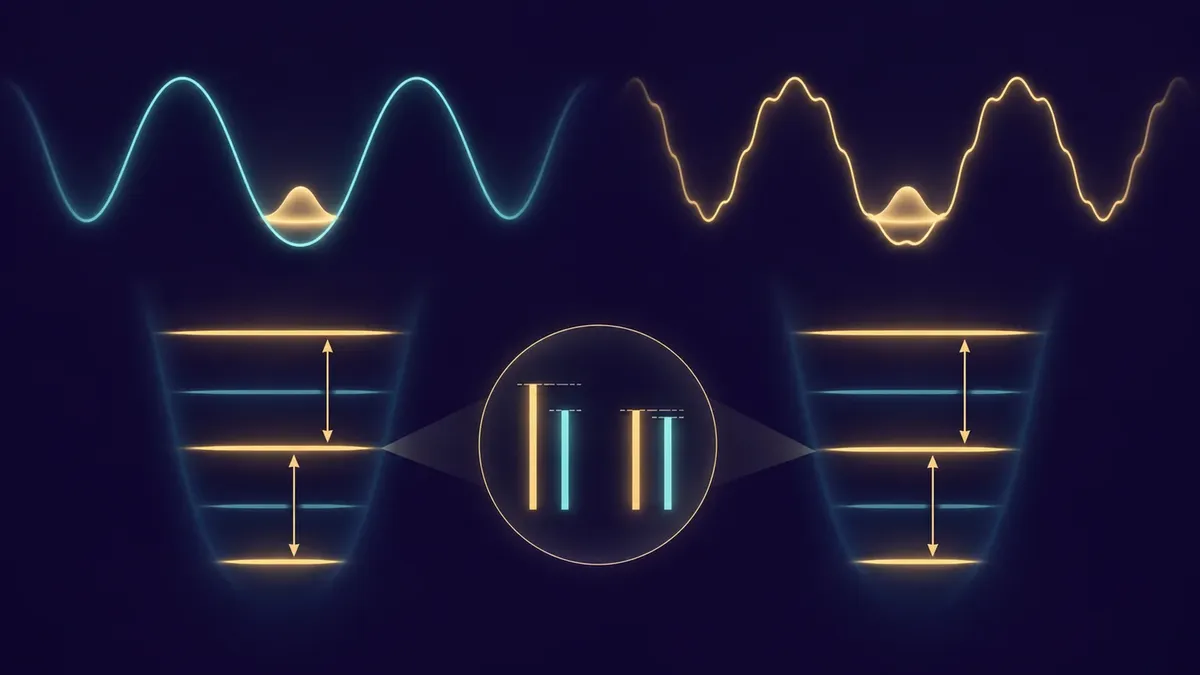
A squeezed atom’s motion can lose its carefully arranged pattern when the trapping potential is not perfectly harmonic. Researchers used numerical simulations to test whether a small change to an optical lattice’s shape could slow that early deterioration—without adjusting the added component as the atom moves.
Why squeezing fades
A trapped atom can be prepared in a motional squeezed state: its position uncertainty is reduced in one direction while uncertainty in momentum increases. In an ideal harmonic trap, vibrational energy levels are evenly spaced. The parts of a squeezed wavepacket then keep a regular rhythm, allowing its squeezing to oscillate predictably.
An optical lattice is not perfectly harmonic. Uneven energy spacings can make parts of a wavepacket drift out of step, distorting its motion and reducing squeezing. Ko-Wei Cheng, Wui Seng Leong and Shau-Yu Lan used numerical simulations to ask whether changing the lattice’s spatial shape could reduce this effect.
Testing a shaped lattice
The researchers modeled a single atom in a one-dimensional optical lattice. They added either a weak second or third spatial harmonic: a component with higher spatial frequency that modifies the shape of each trapping well. Its amplitude stayed fixed relative to the main lattice, including when the lattice depth changed.
They prepared squeezed states with two protocols: one sudden change in lattice depth, or two changes with a short hold in between. For each harmonic and preparation method, they selected an amplitude that made the simulated evolution most closely resemble that of a harmonic-oscillator reference, averaged over 1 millisecond. This procedure selected the lattice shapes; it was distinct from the later squeezing comparison.
For that comparison, they matched the initial squeezing and final trap frequency between the shaped and sinusoidal lattices. The calculations followed the full wavefunction across many lattice wells. The authors also examined energy levels in a single well to investigate which transitions contributed most to the wavepacket’s breathing motion.
What the simulations suggest
Across all four combinations of harmonic and preparation method, successive squeezing maxima initially declined more slowly in the shaped lattice. The authors’ explanation focuses on two vibrational transitions: 0→2 and 2→4. Their energy spacings became nearly equal at the chosen harmonic amplitudes, and these transitions carried most of the breathing signal in the cases studied. When the spacings are closer, those contributions can remain more nearly in step.
That interpretation has a boundary: it comes from a single-well spectral analysis, and the paper notes limits to that interpretation, particularly for some double-quench comparisons. The optimal amplitude also differed from the one that cancels the potential’s quartic term. Canceling that term makes the potential harmonic up to fourth order near the well’s bottom, but higher-order features still matter; it does not by itself equalize the dominant transition spacings.
The advantage was not permanent. Squeezing oscillated and partly revived in both lattice designs, and at some later times the unshaped lattice showed more squeezing. Deep dips in the full-state squeezing curves were interpreted with help from a separate spatial-filter calculation as potentially involving probability in distant wells. The filter changes the state, however, so it is an analysis tool, not a physical confinement method.
Limits and next steps
These are numerical results, not an experimental demonstration. The model considers one atom initially in the ground state of one well. It omits thermal motion, finite quench and measurement times, three-dimensional motion, interactions, and initially occupied neighboring wells. Assessing a particular apparatus would also require accounting for loss and coherence times. The 1-millisecond interval is a common comparison period, not a measured coherence time.
The paper is an arXiv preprint, and its authors say supplemental material is omitted from this version. They describe the supporting code and numerical data as prepared for Zenodo deposition; that wording does not establish that the materials are already publicly available. An experimental test would need to measure position and momentum variances and their covariance under realistic conditions. For now, the simulations suggest a design idea: a static change to lattice shape may slow early squeezing loss by tuning the vibrational spacings that contribute most to the motion.
- optical lattices
- quantum squeezing
- atomic motion
- quantum physics
- numerical simulation
Related reading
Automatically matched by shared topic keywords. These links do not imply that the sources agree or establish a consensus.
A quantum version of the tautochrone brings particles together
Source published
Shared keywords: optical lattices, quantum physics
A weak Kerr oscillator makes stronger squeezed states
Source published
Shared keywords: quantum squeezing
When two atoms scatter light as a pair
Source published
Shared keywords: quantum physics
When two atoms interact more strongly than they radiate
Source published
Shared keywords: quantum physics
A Raman route to anyon-like behavior in a one-dimensional lattice
Source published
Shared keywords: optical lattices