TRANSMISSION // 2611.34325v1
Two snapshots reveal a changed pulsar-companion light curve
Source published
Comparing observations from 2014 and 2024, researchers find phase-specific differences in PSR J2215+5135’s optical light curve. The cause and its effect on mass estimates remain uncertain.
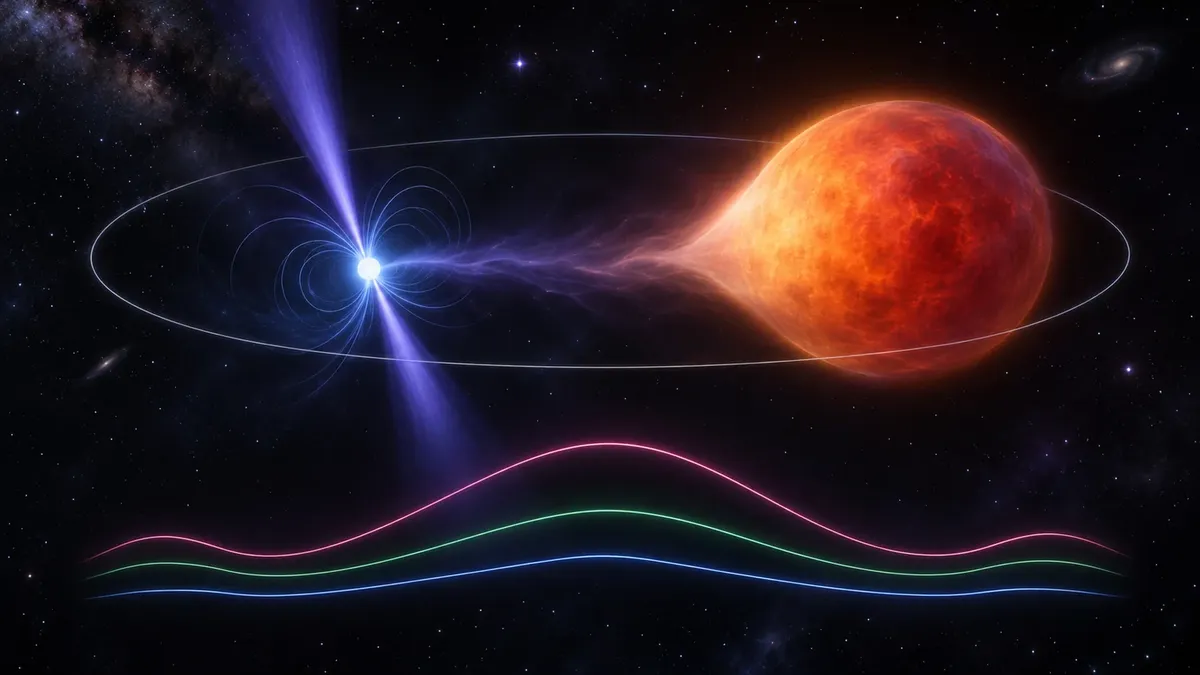
The changing brightness of a star orbiting a millisecond pulsar can help astronomers estimate the neutron star’s mass—but those estimates depend on how models describe heating of the companion. In two observations a decade apart, PSR J2215+5135 showed broader light-curve wings in 2024. The comparison reveals a difference between those observing epochs, not how long it lasted or what caused it.
A close companion to a rapidly spinning neutron star is heated by the pulsar’s output. As the binary orbits, observers see different portions of the companion, producing a pattern of brightening and dimming. Astronomers can use that pattern to infer the orbit’s tilt and estimate the neutron star’s mass. But the inference depends on assumptions about where and how heat reaches the companion.
A study of PSR J2215+5135, a redback system containing a millisecond pulsar and a low-mass companion, examines whether the observed pattern was the same at two epochs. The researchers compare new optical observations from 2024 with measurements made in 2014. With only these two snapshots, they cannot determine when the difference began or how long it lasted.
Comparing observations a decade apart
The team collected 237 measurements through three filters, g′, r′ and i′, at the Iranian National Observatory in September 2024. Each filter was observed on a separate night. After calibrating the images against reference stars, the researchers compared the resulting brightness-versus-orbital-phase curves with the 2014 data.
They also fitted the curves with ELC, a computer model that represents the binary’s geometry, the companion’s distorted shape and its irradiation. The team tested models with and without an added hot spot, a way of representing concentrated heating, and refitted the 2014 observations with a spot-inclusive model to make the epoch comparison more consistent.
The peak brightness and orbital period were consistent between the observations within uncertainties. The difference appeared in the wings—the phases on either side of the peak. On the rising branch, the 2024 data showed an excess relative to 2014 in all three filters; on the falling branch, a significant excess was reported in i′. This is a phase-localized pattern, not evidence that the companion was generally brighter across a wider portion of the orbit.
A permutation test gave a global significance of 4.26 sigma under the study’s primary noise assumption. Other resampling tests gave lower values: 3.76 sigma for a residual bootstrap and about 2.63 sigma for a block bootstrap that allows some phase-correlated residual structure. Thus, the estimated significance weakens under that correlated-residual treatment and depends on the assumptions used in the tests.
The authors checked for possible timing and instrumental explanations. Within their adopted phase-registration uncertainty—about 0.053 orbital cycles—they found that a rigid phase shift did not remove the discrepancy. They also report checks against scattered light and calibration problems. But the field-star calibration dispersion, about 0.03 magnitudes, was comparable to the deviation’s amplitude. The authors argue that its global nature, and the phase-localized pattern, make calibration an unlikely explanation; the comparison does not make the systematic concern disappear. Because the three filters were observed on separate nights within one run, activity lasting several days cannot be ruled out.
What the models can—and cannot—say
A model with a hot spot fits the 2024 data better than a spot-free model, but systematic residuals remain. Reproducing the broader wings requires correlated changes in spot properties, orbital inclination, the Roche-lobe filling factor (a parameter describing how nearly the companion fills its gravitationally defined region) and companion temperature. The authors interpret these shifts as model compensation, not evidence that the system’s geometry physically changed.
Extended or variable heating could also produce a different brightness pattern, but the study does not establish this explanation. Proposed roles for a shock, magnetic fields or atmospheric heat transport remain possibilities for further investigation. Nor do differences in fitted spot temperature prove that the companion physically cooled: the inferred values depend on the model, and two epochs cannot show whether the observed difference is gradual, sudden or short-lived.
With a hot spot included, the fitted neutron-star masses are about 2.13 times the Sun’s mass for 2014 and 1.95 times the Sun’s mass for 2024. They agree within about one statistical standard deviation, and the authors do not claim a significant mass change. The inferred mass also depends on how the spot is treated; the quoted statistical uncertainties do not capture the full uncertainty from heating prescriptions.
The result is a measured difference between two light curves, not evidence of a changing neutron-star mass or a confirmed account of the companion’s surface heating. Regular observations in several filters, alongside models that test more heating patterns, could help establish how the light curve evolves and how robust the mass estimates are.
The source is an arXiv preprint whose manuscript says it was accepted by The Astrophysical Journal Letters. Acceptance is not independent validation of every interpretation. This account is based on the supplied manuscript, and its findings should be read in light of the modeling assumptions and statistical tests described above.
- PSR J2215+5135
- redback pulsar
- neutron star mass
- optical light curves
- pulsar heating
- binary stars
Reviewed cross-references
These connections were reviewed by a model, not independently fact-checked by a human. Similarity does not imply agreement; consult the original papers and the evidence below.
A fast-spinning pulsar reveals a changing companion star
Supporting evidence: Farhang et al. report broader light-curve wings in 2024 than in 2014 for PSR J2215+5135; Karpova et al. report phase-dependent light-curve changes across observed epochs for PSR J2053+6905. These results support the bounded point that optical light curves changed over time in these two redbacks, but establish neither how common such changes are nor a shared cause. The J2215 manuscript says it was accepted by ApJL; the supplied J2053 excerpt does not state its publication status. Both sources are arXiv versions, and the excerpts are selective.
Model review: · openai-codex/gpt-6-luna
Evidence and provenance
Selected excerpts, not complete papers. PDF extraction can omit figures or damage equations, tables and reading order; sources may be preprints.
2611.34325v1 — Original paper
Excerpt reference:
static/papers/2611.34325v1.md:525-585
Basis: Paper text
Source SHA-256:a62c4558b3b2f12cf0e7e4697b27f71a7b4b42381e4ddc86abd952a43986e8802611.07668v1 — Original paper
Excerpt reference:
static/papers/2611.07668v1.md:555-651
Basis: Paper text
Source SHA-256:f92ee0d3e88e7a62202a24fc29d74ef96dc800b0c5d990284bebadc01a8b1742
Related reading
Automatically matched by shared topic keywords. These links do not imply that the sources agree or establish a consensus.
A fast-spinning pulsar reveals a changing companion star
Source published
Shared keywords: binary stars, redback pulsar
A supernova with almost no hydrogen left
Source published
Shared keywords: binary stars
A nova’s fading visible light could guide the search for gamma rays
Source published
Shared keywords: optical light curves
What stellar chemistry can tell us about binary stars
Source published
Shared keywords: binary stars
A flexible new toolkit for fitting stellar orbits
Source published
Shared keywords: binary stars