TRANSMISSION // 2611.34320v1
When cosmic-ray electrons lose energy in jumps
Source published
A deterministic model treats inverse Compton cooling as discrete, stochastic energy changes. In Geminga halo fits, the inferred diffusion coefficient shifts, but the size depends on the model setup.
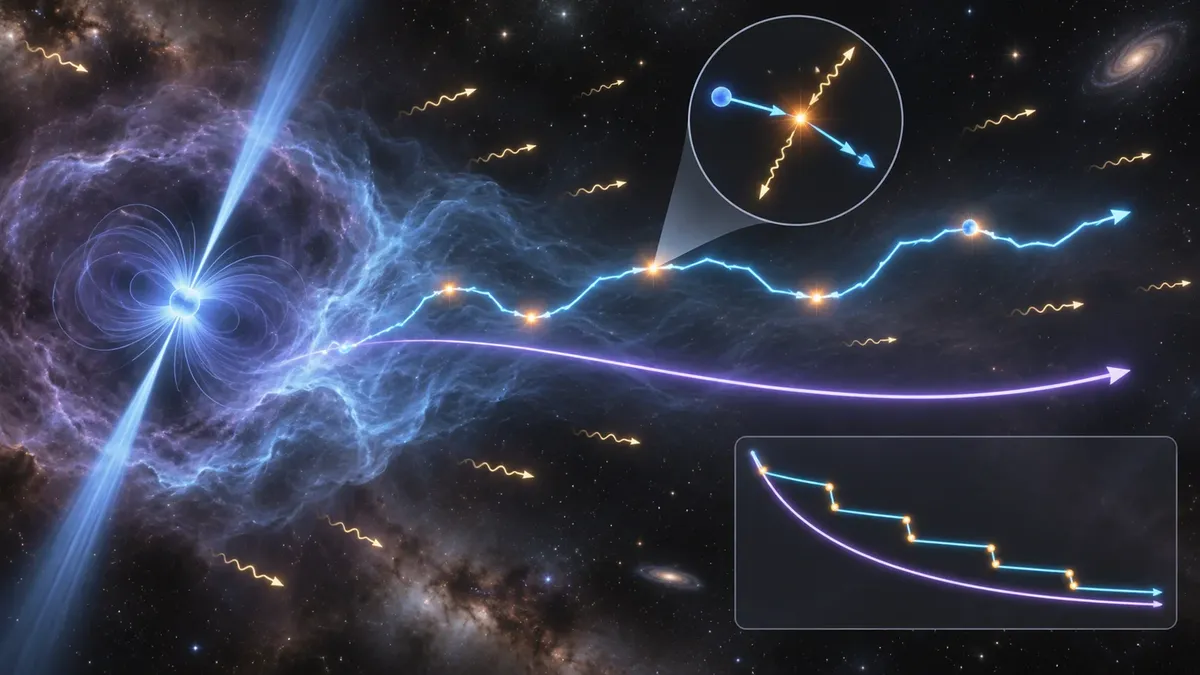
At energies around 100 TeV, an electron can lose a substantial share of its energy in one inverse Compton scattering. Ruihao Jing and Siming Liu model this as a stochastic sequence of discrete energy changes—not as a simulation tracing each electron’s actual collision history—and examine how it affects estimates of particle spread around Geminga.
Why treat energy loss as discrete?
Pulsars can inject energetic electrons and positrons into the space around them. After escaping a pulsar wind nebula, these particles diffuse through the interstellar medium and scatter light into gamma rays. Extended gamma-ray sources associated with this process are called pulsar halos.
To model a halo, researchers estimate how quickly particles spread and lose energy. A common approach treats radiative cooling as continuous: energy declines smoothly according to an average loss rate. That approximation can work when many small losses accumulate. But inverse Compton scattering (ICS)—a collision in which an energetic electron transfers energy to a photon—can behave differently at very high energies.
In the Klein–Nishina regime, the scattering rate is reduced, while an individual scattering can remove a large fraction of an electron’s energy. The paper notes that a 100-TeV electron scattering off a cosmic microwave background photon can, within the allowed kinematics, lose nearly half its initial energy. Electrons with the same starting energy can therefore end up with a spread of energies after the same time. A single smooth cooling trajectory may not capture that spread.
A deterministic way to model stochastic losses
Jing and Liu replace the continuous ICS cooling term in the electron transport equation with a collision operator. Built from the Klein–Nishina differential scattering rate, it accounts for transitions between electron energies caused by discrete scatterings. The equation describes the statistical evolution of the population; it does not track the actual sequence of collisions experienced by each electron. Synchrotron energy losses remain continuous, as does spatial diffusion.
The authors solve the equation using spatial Fourier and time Laplace transforms, then numerically invert the transformed solution. They compare the calculated energy distributions with Monte Carlo simulations of scattering events. The paper reports good agreement for the tested cases, which serves as a validation of the numerical method. The authors also describe their deterministic method as less computationally costly than traditional Monte Carlo methods.
Next, they apply the framework to Geminga’s TeV halo. They calculate electron distributions and gamma-ray surface brightness, then fit the predicted brightness profile to observations. The diffusion coefficient is a model parameter describing how rapidly particles spread; it is inferred by matching the calculated profile to the observed one.
The shift depends on the setup
For one set of Geminga parameters, the best-fit diffusion coefficient is slightly lower with discrete ICS than with continuous cooling. The authors suggest that the difference is limited in this case partly because the assumed injection spectrum is relatively soft, leaving fewer high-energy electrons, and because synchrotron losses damp the impact of discrete ICS.
They also examine a different setup: a harder electron injection spectrum, a weaker magnetic field, and observations in gamma-ray bands extending to higher energies. In this case, the continuous-loss model requires a diffusion coefficient about 15% higher than the discrete-loss model. The fitted injection efficiency—the assumed fraction of the pulsar’s spin-down power converted into injected electrons and positrons—also differs by about 15% between the models.
That percentage describes this particular fit, not a universal correction for pulsar halos. The paper says the direction and size of the change depend on the injection spectrum, magnetic field, and photon-energy range. The results show that the treatment of cooling can affect inferred halo parameters under some conditions; they do not establish the size of the effect for every source.
The discrete treatment also produces a broader predicted electron energy distribution and preserves a more pronounced high-energy tail than continuous cooling in the cases discussed. This can change predictions for gamma-ray emission and particle propagation. The work motivates including discrete losses when interpreting very-high-energy observations, but does not demonstrate that this treatment explains a specific observed feature.
What the study does—and does not—show
The paper presents a transport framework and applies it to Geminga; it is not a new observation of electron collisions. Its calculations use specified choices for the radiation backgrounds, injection spectrum, magnetic field, and observational profiles and energy bands. The authors show that changing some of these setup choices changes the difference between the discrete and continuous models. The reported fits therefore illustrate model dependence rather than a single definitive correction.
This work is an arXiv preprint dated November 26, 2026. The supplied source does not establish that it has been peer reviewed. Its methods and conclusions should be treated as provisional pending further scrutiny and independent evaluation.
- inverse Compton scattering
- cosmic-ray electrons
- Geminga
- pulsar halos
- particle diffusion
- gamma-ray astronomy
Related reading
Automatically matched by shared topic keywords. These links do not imply that the sources agree or establish a consensus.
An extended gamma-ray source hints at a pulsar-powered particle accelerator
Source published
Shared keywords: inverse compton scattering
Gamma rays reveal differences in how galaxies retain cosmic rays
Source published
Shared keywords: gamma ray astronomy
Could line photons explain GRB 221009A’s MeV feature?
Source published
Shared keywords: inverse compton scattering
A fluid model brings radiative reconnection into view
Source published
Shared keywords: inverse compton scattering
Could a hidden pulsar power the LHAASO Peanut?
Source published
Shared keywords: inverse compton scattering