TRANSMISSION // 2611.34298v1
A projection method that keeps hyperbolic geometry in view
Source published
RAP compresses hyperbolic representations by preserving their radial coordinate and projecting only their angular direction. Its authors report theoretical guarantees and favorable results in several tests, but the evidence available here is only the paper’s abstract.
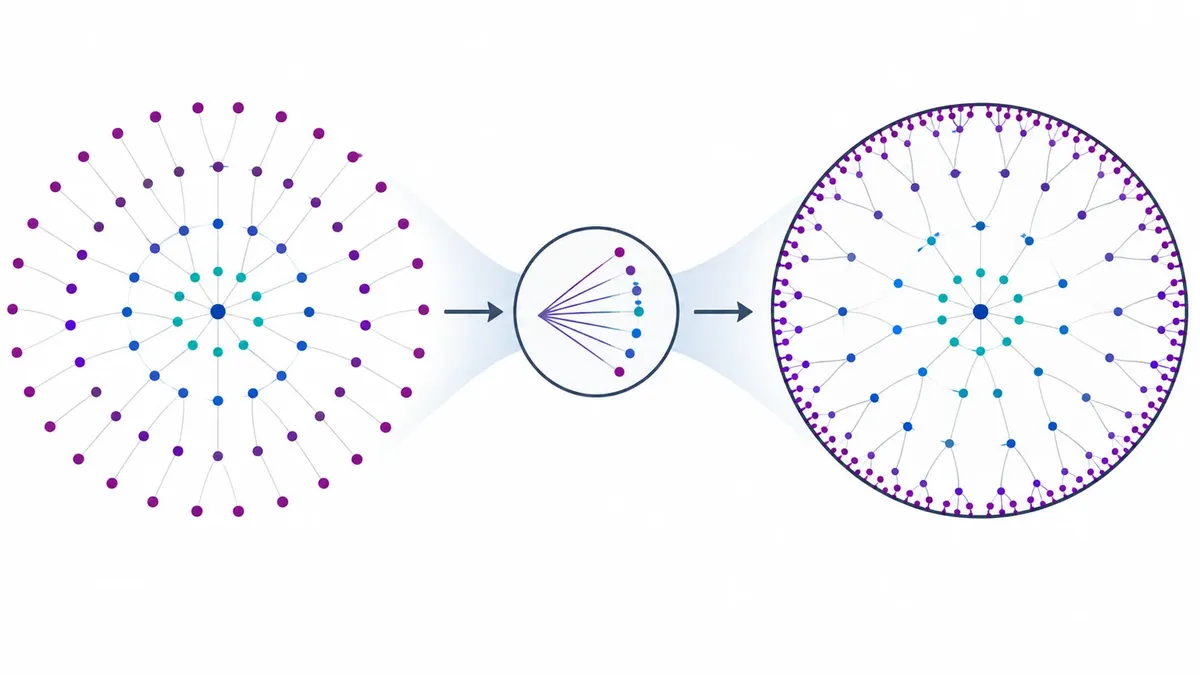
Random projections can shrink data while approximately preserving distances, but applying them to hyperbolic representations raises a geometric problem: a projection should keep the result in hyperbolic space. A new method, radial-angular random projection (RAP), separates a point’s distance from the origin from its direction and treats those two parts differently.
The problem: compress without losing geometry
Random projection is a standard way to reduce the number of dimensions in a collection of vectors while aiming to preserve distances. For representations that live in hyperbolic space—a geometry often used for hierarchical data—ordinary Euclidean projection is not directly suited to the task. The authors say there was no analogous general-purpose method for compressing such representations while keeping the output hyperbolic.
They compare two intuitive approaches. One works in a tangent space, a locally flat approximation of curved space, but the abstract says this approach is limited by its choice of chart and incurs a curvature penalty. The other projects directly in the hyperboloid model of hyperbolic space. According to the authors, it entangles errors in a point’s radial and angular components, making the resulting distance estimates sensitive to the conditioning of the inverse hyperbolic cosine function, arcosh.
Separating radius from direction
RAP, short for radial-angular random projection, splits each point into a radial coordinate and an angular direction. It keeps the radial coordinate exactly and applies a Euclidean random projection only to the angular component. The projected direction is then lifted back onto a hyperboloid of the target dimension.
The abstract describes this as hyperbolic-to-hyperbolic by construction and says the computation requires one Gaussian matrix-vector product. It also reframes the core mathematical question: how well can a normalized angular projection preserve relationships between directions on a sphere?
The paper’s abstract reports a finite-set guarantee for RAP, with an explicit dependence on the radii of the points and the space’s curvature. It also says the authors establish a local tangent-space result and analyze the arcosh conditioning involved in the direct hyperbolic comparator. These are theoretical claims; the abstract does not provide enough detail to assess the assumptions or the precise scope of the guarantees.
What the authors report
The authors say they tested RAP on four kinds of data: a point cloud centered around the origin with a broad range of radii, a balanced tree, clustered Gaussian data, and the WordNet noun hierarchy. Across the tested combinations of dataset size and target dimension, they report that RAP had the lowest mean relative distortion among the methods compared. On the broad-radius point cloud, they report roughly 48%–49% less distortion than the strongest hyperbolic baseline.
They also report scaling the method to datasets containing millions of points and improved retrieval on vision-language representations compared with hyperbolic projection baselines. The abstract does not name those datasets or baselines, define the retrieval measure, or give the experimental settings, so these results should be read as the authors’ summary rather than independently assessable evidence here.
What remains uncertain
This account is based only on the abstract of arXiv preprint 2611.34298v1, not the full paper. That means details needed to judge the proof, experimental design, variation across runs, and practical trade-offs are unavailable. The reported comparisons also do not establish that RAP will outperform other methods on every dataset or in every application.
The work proposes a focused solution to a technical compression problem and reports encouraging theory and experiments. Whether its advantages carry over to particular models or real-world workloads depends on details beyond those available in the abstract. The paper is a preprint, so its claims should be treated as provisional rather than as a settled research consensus.
- hyperbolic geometry
- random projection
- representation learning
- dimensionality reduction
- machine learning
Related reading
Automatically matched by shared topic keywords. These links do not imply that the sources agree or establish a consensus.
How a chosen geometry can shape an AI’s latent map
Source published
Shared keywords: dimensionality reduction, machine learning, representation learning
When “Hyperbolic” AI Geometry Behaves Almost Euclidean
Source published
Shared keywords: hyperbolic geometry, machine learning, representation learning
A Transformer designed for hyperbolic space
Source published
Shared keywords: hyperbolic geometry, representation learning
How Federated AI Can Learn Across Different Representations
Source published
Shared keywords: machine learning, representation learning
One Energy Lens for Many Kinds of Machine Learning
Source published
Shared keywords: machine learning, representation learning