TRANSMISSION // 2611.34290v1
How StateWeaver tackles continuity in AI video
Source published
StateWeaver uses clip review, targeted visual references and story-state records to help generated videos carry characters and event changes across shots. Its benchmark table conflicts with some ranking claims in the paper’s prose.
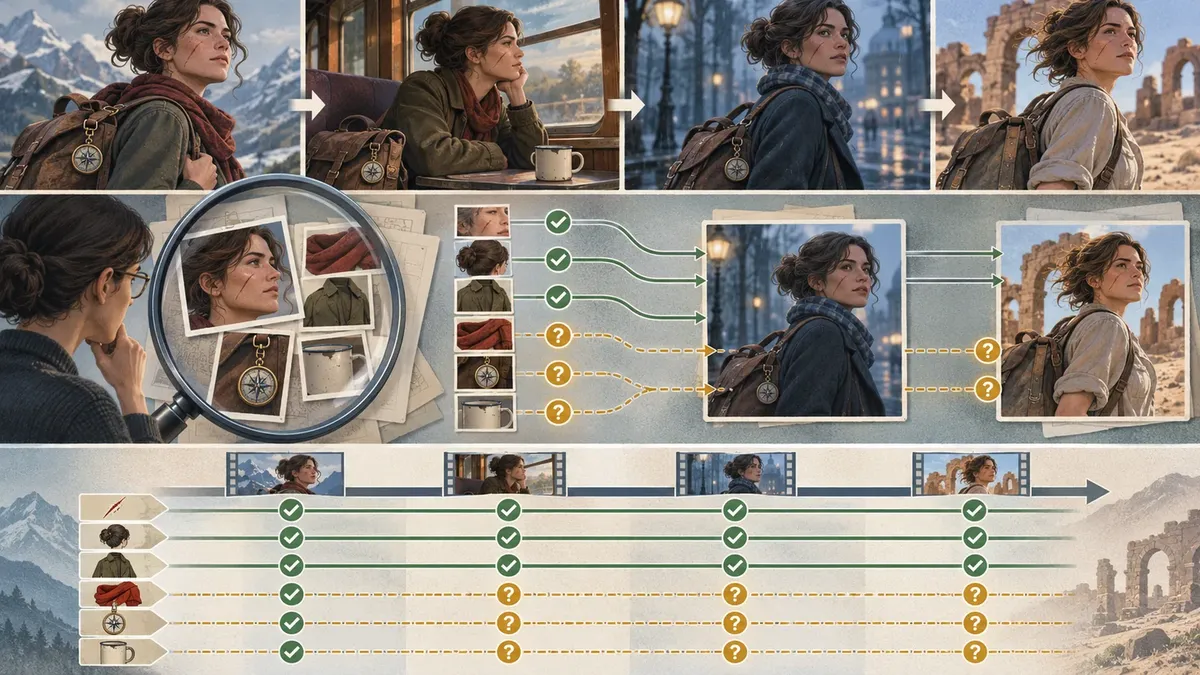
A character may look different from one shot to the next, or an object may revert to an earlier state. StateWeaver is a multi-agent workflow designed to detect and repair continuity problems while building longer videos from short clips.
The challenge: continuity across clips
Video-generation systems can produce convincing short scenes, but a longer story asks for more than good-looking footage. A character should remain recognizable across camera changes; if a door opens or a prop changes hands, later shots should reflect that event. And a correction in one clip needs to carry forward rather than vanish in the next.
StateWeaver, described in an arXiv preprint, treats this as a coordination problem. It combines short-clip video generation with AI agents that plan a story, review clips, arrange repairs and record which visual details have been confirmed. An important distinction is between a state the story calls for and evidence that the generated video actually shows it.
From review to repair
The system represents characters, props and locations with state histories. A state can record attributes such as appearance, location or ownership, and the story interval when they apply. Reference images used to guide generation are tied to particular states and versions.
After a clip is generated, a reviewing agent checks whether it shows the required identities, actions and consequences. If something is wrong or unclear, the system turns the discrepancy into a visual requirement. It may add or revise reference images, then generate another candidate. The intended repair changes the faulty attribute while preserving identity and details that were already correct.
A repair is not automatically proof that the intended change worked. The workflow records observations from the selected clip, separates confirmed from unconfirmed details, and links evidence to its source, story interval and reference version. A coordinating agent checks which observations apply before another set of shots uses them. This is meant to reduce reliance on outdated images or on a state that was planned but never visibly achieved.
The second part, Hierarchical Collaboration, separates work into sets, tasks, clips and repair rounds. Agents use context relevant to their task rather than carrying every earlier conversation into each step. Persistent memory stores broader story information and confirmed visual observations; local records retain plans and repair decisions. Tasks can proceed in parallel when they do not depend on unresolved visual evidence.
What the tests report—and a table conflict
The authors evaluated StateWeaver on 75 production tasks from four benchmarks: three with predefined storyboards and one where systems planned shots from a written brief. They compared it with four other video-production workflows, using the same text, image and video-generation models for each system. The video evaluations did not include audio.
The paper’s prose and its results table do not consistently agree about which system ranked first. On ST-Bench, the prose says StateWeaver ranked second, but Table 1 reports its Overall score as 0.648—the highest listed. On ViMax-Bench, the prose says it ranked first, while the table gives it 0.575, below MovieAgent and ATAS, both at 0.576. On EntityBench, the prose also claims first place, but the table reports 0.604, below ViMax at 0.624. The table therefore does not support first place on ViMax-Bench or EntityBench; the ST-Bench ranking claim is likewise contradicted by the table. These inconsistencies make the paper’s ranking summaries unreliable without clarification.
For DirectorBench, where systems plan shots autonomously, Table 1 reports StateWeaver’s Overall score as 0.724, the highest listed among the compared methods. The paper also describes a blinded, pairwise human evaluation of complete story-level videos. The authors report an advantage for StateWeaver in continuity and state transitions, while visual-quality differences were smaller. This is a separate evaluation from the automated scores.
Ablation tests removed components such as adaptive reference updates, context isolation and checks on shared observations. The authors report lower Overall scores for these variants on DirectorBench, though the pattern differed by component and metric. That supports contributions from parts of the workflow in this test; it does not show that every component helps equally in every setting.
Limits and uncertainty
StateWeaver remains dependent on its underlying video generator. The paper documents errors that persisted: an extra cup in a scene, a recorder in the wrong orientation, and a cat’s paws missing from view at landing. The authors also say the workflow handles visible changes more readily than gradual changes in emotion or relationships. If review misses an error, later shots may reuse the faulty observation.
The evaluation covers selected benchmark tasks and one particular combination of models and procedures. Automated metrics and human judgments capture only some aspects of video quality and story continuity. These tests do not establish how well the workflow would perform with other generators, stories or production settings. The ranking discrepancies add a specific reporting uncertainty; the table values should not be replaced by the conflicting prose claims.
This article is based on the supplied paper text. StateWeaver is presented as an arXiv preprint, not a peer-reviewed journal result. Its findings are the authors’ reported results and await independent scrutiny and replication.
- AI video generation
- video continuity
- multi-agent systems
- story-state tracking
- visual references
- arXiv preprint
Reviewed cross-references
These connections were reviewed by a model, not independently fact-checked by a human. Similarity does not imply agreement; consult the original papers and the evidence below.
Can AI Keep Math Videos Tied to Their Solutions?
Shared method: Both systems use review of generated visuals to direct revisions: StateWeaver turns clip-review discrepancies into targeted reference repairs, while ReVAgent checks rendered keyframes against a solution record and routes issues to the relevant agent. The shared pattern is verification-guided revision, not identical state representations or tasks.
Model review: · openai-codex/gpt-6-luna
Evidence and provenance
Selected excerpts, not complete papers. PDF extraction can omit figures or damage equations, tables and reading order; sources may be preprints.
2611.34290v1 — Original paper
Excerpt reference:
static/papers/2611.34290v1.md:124-173
Basis: Paper text
Source SHA-256:cca808dffc3ae30ede11f2b81f88ed7262110e37b2a1f9f6a3f4cb3920e449f62611.30163v1 — Original paper
Excerpt reference:
static/papers/2611.30163v1.md:84-143
Basis: Paper text
Source SHA-256:584945e8e6826c659196d240af2e8f96098b28fa1c3b44b59ed51c093fee1e28
Keeping game characters consistent when they leave the screen
Supporting evidence: In separate video-generation settings, both papers report results consistent with explicit state information helping preserve continuity: StateWeaver’s ablations report lower scores when adaptive references or state-handoff verification are removed, while SWAM reports improved visual and character-consistency metrics with state conditioning. The comparison is suggestive rather than a direct validation across systems: one concerns multi-shot story production and the other a custom first-person game environment.
Model review: · openai-codex/gpt-6-luna
Evidence and provenance
Selected excerpts, not complete papers. PDF extraction can omit figures or damage equations, tables and reading order; sources may be preprints.
2611.34290v1 — Original paper
Excerpt reference:
static/papers/2611.34290v1.md:906-972
Basis: Paper text
Source SHA-256:cca808dffc3ae30ede11f2b81f88ed7262110e37b2a1f9f6a3f4cb3920e449f62611.30042v1 — Original paper
Excerpt reference:
static/papers/2611.30042v1.md:742-819
Basis: Paper text
Source SHA-256:77746958ecea921dfe37c666f3a74776ac4528105ea163bb99269e1fd8d710f5
Related reading
Automatically matched by shared topic keywords. These links do not imply that the sources agree or establish a consensus.
Can AI Keep Math Videos Tied to Their Solutions?
Source published
Shared keywords: ai video generation, multi agent systems
Loupe gives video AI a research assistant
Source published
Shared keywords: ai video generation
A pixel-level test for when generated videos bend reality
Source published
Shared keywords: ai video generation
Why More Detailed Video Guides Can Backfire
Source published
Shared keywords: ai video generation
An AI agent researches products before making video ads
Source published
Shared keywords: ai video generation