TRANSMISSION // 2611.34270v1
Can an AI report help machinists decide when to replace a worn tool?
Source published
A two-part system pairs vibration-based wear classification with an AI-written report. Tests look promising, but performance on unseen tools remains limited.
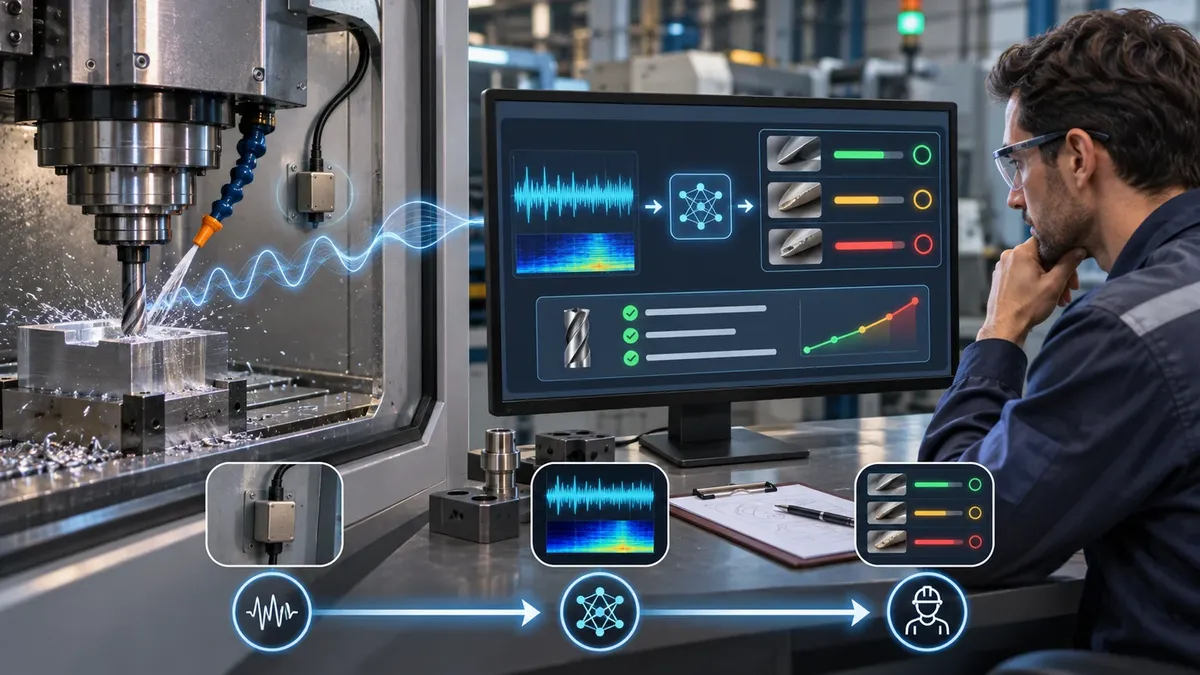
A CNC machine can reveal clues about cutting-tool wear through vibration. But a model’s wear-state label may not tell an operator what to do next. Researchers tested a system that turns classification results and other computed evidence into a natural-language report—while keeping the final decision with the human.
From sensor readings to a decision aid
A worn cutting tool can affect machining quality and interrupt production. Vibration sensors offer a way to monitor wear as a machine runs, and machine-learning models can classify a tool’s condition. Yet a label such as “severe” or a list of influential sensor features may not make the next step obvious to someone operating the machine.
In this study, researchers propose a two-part system for turning those signals into more usable guidance. First, a machine-learning model estimates one of three wear states: incipient, normal or severe. Then a large language model (LLM) turns the model’s output and other pre-calculated evidence into a written report, including a suggested action. The central idea is to have the language model explain and organize evidence—not diagnose wear from raw sensor data.
How the system works
The diagnostic model uses vibration measurements from three axes. The researchers calculated 84 features for each cutting pass, including statistics about vibration amplitude, frequency characteristics and the distribution of energy across frequency bands. They used principal-component loadings to select features, then supplied sequences of measurements to a gated recurrent unit (GRU), a type of neural network designed to process ordered data. An optimization method helped choose the GRU’s settings.
The system’s second layer receives a structured record containing the predicted wear state, confidence, the five most influential features, recent feature trends and a flag indicating when human review is advised. Feature influence is estimated by replacing one feature at a time with its training-set average and checking how the model’s prediction changes. The review flag is raised if confidence is below a set threshold or if a second classifier disagrees. A rule assigns the action code; the LLM is instructed to report it rather than change it.
The team tested the classifier on PHM2010, a public dataset with measurements from three cutting tools. They also tested the reporting layer on 146 records from NASA Ames milling data, which uses different sensors and a different classifier. Engineers compared reports from the LLM with two rule-based templates. Three experienced CNC engineers rated a sample of reports without being told which method produced them.
Strong results within the tested tools, a tougher test beyond them
On PHM2010, the selected GRU configuration achieved a macro F1 score of 98.38%—a measure that gives equal weight to performance across the three wear classes. It used 10 of the 84 features. But that high score needs context: the main evaluation split individual passes from the same three tool trajectories between training and testing. Neighboring passes can be similar, so this test measures recognition within those trajectories, not performance on entirely new tools.
When the researchers instead trained on two tools and tested on the third, mean macro F1 fell to 55.91% using the study’s wear-measurement thresholds and vibration-only input. This is an important constraint on the headline result. The thresholds also describe relative wear grades in these datasets; they are not an established universal tool-replacement standard.
For the reporting layer, the full design produced faithful reports for 550 of 552 PHM2010 records that could be parsed. The two remaining outputs were not parseable. With a minimal prompt and no detailed evidence, the language model sometimes made unsupported claims about features or trends. Providing the evidence alone was not enough: the authors report that a carefully designed prompt and pre-calculated factual fields were important to reliable outputs. On the NASA Ames records, all 146 reports passed the reported factual checks, although this tests whether the LLM communicates the supplied record accurately—not whether the underlying classifier is always right.
In the blind engineer evaluation, reports from the LLM received higher average ratings than both templates on actionability, overall quality, clarity and decision confidence. The enhanced template, however, recovered much of the improvement over the basic template. The authors conclude that organizing evidence accounts for much of the benefit, with the LLM adding a further advantage in how it connects information.
What the evidence does—and doesn’t—show
The system is a decision-support prototype, not an autonomous replacement controller. Its review threshold is exploratory, and the diagnostic models were tested on public datasets rather than in operating workshops. The authors also note that some selected vibration features may partly reflect sensor offsets or elapsed cutting time, and that feature-ablation scores describe model behavior rather than proving a physical cause of wear. The human evaluation involved three engineers and 100 records, so it does not establish how the system would affect decisions across factories or over time.
The paper is an arXiv preprint, which means it may not have undergone peer review. Its results support a narrower conclusion than “AI can reliably decide when to change a tool”: structured evidence and carefully constrained language generation may help make model outputs easier to interpret. Independent field testing, improved performance on unseen tools and calibrated review rules would be needed before judging its practical reliability.
- CNC machining
- tool wear monitoring
- large language models
- predictive maintenance
- machine learning
- manufacturing
Reviewed cross-references
These connections were reviewed by a model, not independently fact-checked by a human. Similarity does not imply agreement; consult the original papers and the evidence below.
A conversational assistant explores the trade-offs in metal 3D printing
Supporting evidence: In separate preprint studies, Chen et al. report consistent factual accuracy when an LLM generates reports from structured, precomputed evidence, while Ajenifujah and Farimani report frequent fabricated tool calls or model outputs when their agent was run without tools. These findings are compatible with the limited proposition that grounding language-model outputs in supplied tool or evidence results can help constrain unsupported claims; the tasks and evaluation measures differ, so they do not establish a general reliability effect or external validity.
Model review: · openai-codex/gpt-6-luna
Evidence and provenance
Selected excerpts, not complete papers. PDF extraction can omit figures or damage equations, tables and reading order; sources may be preprints.
2611.34270v1 — Original paper
Excerpt reference:
static/papers/2611.34270v1.md:28-82
Basis: Paper text
Source SHA-256:e506047cf0934bec46b0782e26d7de2e661a4bf46c22cdf34f9947e805094dd22611.34270v1 — Original paper
Excerpt reference:
static/papers/2611.34270v1.md:3513-3622
Basis: Paper text
Source SHA-256:e506047cf0934bec46b0782e26d7de2e661a4bf46c22cdf34f9947e805094dd22611.05171v1 — Original paper
Excerpt reference:
static/papers/2611.05171v1.md:13-85
Basis: Paper text
Source SHA-256:62c7b1c558fed7a9a5bcfc6d7ae04f6ac95edfeb52143d42a4b10cac9bded48f
Related reading
Automatically matched by shared topic keywords. These links do not imply that the sources agree or establish a consensus.
An Edge-AI Test for Monitoring a Dairy-Plant Valve
Source published
Shared keywords: predictive maintenance
Can AI Learn From Its Materials Predictions?
Source published
Shared keywords: large language models
Can a language model help protect spacecraft polymers from atomic oxygen?
Source published
Shared keywords: large language models, machine learning
How causal maps could clarify AI benchmark results
Source published
Shared keywords: large language models
An AI that learns which data to collect next
Source published
Shared keywords: large language models