TRANSMISSION // 2611.34265v1
Solar-wind waves carry a clue to their origin
Source published
A comparison of solar observations and Parker Solar Probe data finds a frequency pattern consistent with waves driven by surface convection. The authors argue this steady source adds to energy and mass supplied intermittently by magnetic reconnection.
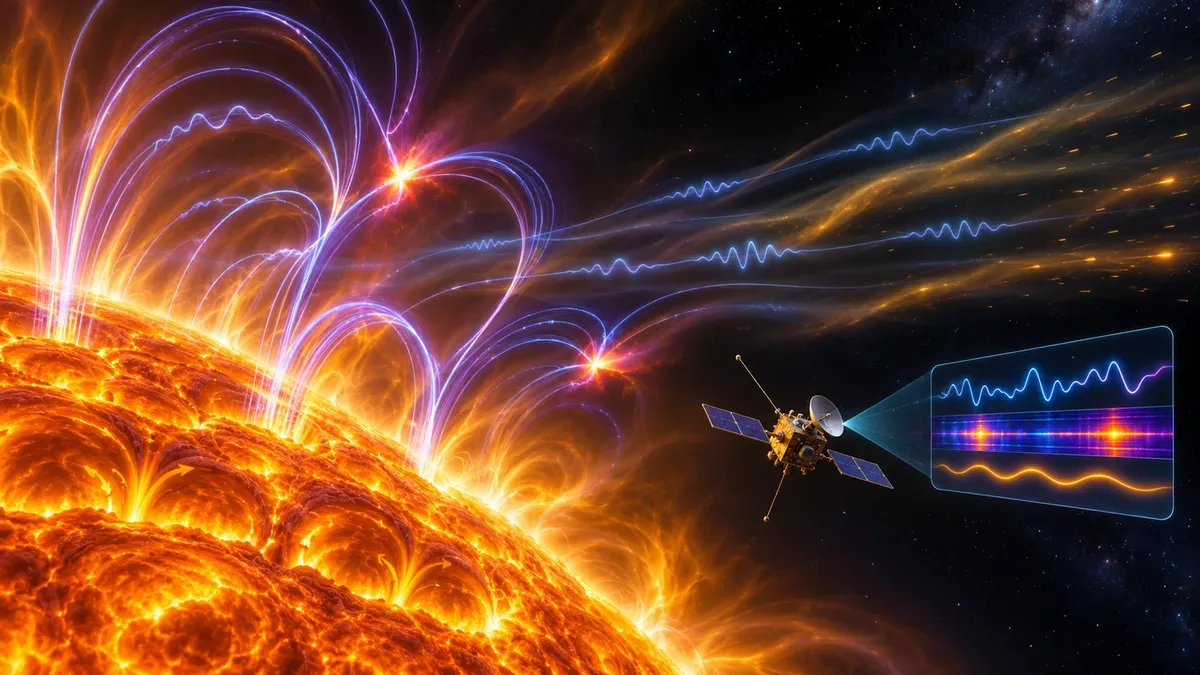
What powers the Sun’s steady outflow of charged particles? A new study finds that waves in the young solar wind bear a spectral pattern predicted for waves stirred by convection at the solar surface. The match supports convection as an important source of energy, though it does not trace individual waves from the surface to the spacecraft.
The solar wind is a continuous stream of electrically charged particles flowing from the Sun. Its energy source is still debated. One proposed contributor is magnetic reconnection: a process in which magnetic field lines rearrange and release energy. Another is Alfvénic waves—motions that travel along magnetic fields—set in motion by convection, the churning of hot material near the Sun’s surface.
The new study asks whether waves in the young solar wind retain a recognizable signature of that surface-driven motion. The authors compare the frequency patterns of waves measured in the Sun’s outer atmosphere with fluctuations recorded by NASA’s Parker Solar Probe (PSP) close to the Sun.
Following a pattern across the Sun’s atmosphere
The researchers analysed several kinds of observations. Images from the Solar Dynamics Observatory (SDO) were used to track wave-like motions in polar coronal holes, regions of open magnetic field that are sources of fast solar wind. They also examined Doppler-velocity measurements from the Upgraded Coronal Multi-channel Polarimeter (UCoMP) in polar and equatorial coronal holes. Doppler measurements show motion toward or away from an observer.
The team compared these coronal measurements with data from PSP, which sampled the young solar wind below the Alfvén surface—the boundary where the wind’s outward flow becomes faster than Alfvén waves can travel back toward the Sun. The analysis selected 270 two-hour intervals with strongly Alfvénic fluctuations. The researchers calculated power spectra, which show how fluctuation energy is distributed across frequencies. They also used high-resolution spectra from the Daniel K. Inouye Solar Telescope (DKIST) to examine components that may blend together in lower-resolution data.
This was not a direct tracking of a particular wave along a particular magnetic field line. Instead, the researchers tested whether frequency distributions in different sets of observations resemble one another and the spectrum expected from convection-driven waves passing through the lower solar atmosphere.
A similar spectral signature
In the coronal observations, wave energy is concentrated at frequencies of a few millihertz. The PSP sample shows a similar concentration: its averaged energy-containing band spans 1–30 millihertz and peaks at 5.6 millihertz. The authors report similar coronal and solar-wind distributions, with strong contributions in the 4–8 millihertz range. They interpret this resemblance as evidence that a frequency pattern imprinted by surface convection survives outward to at least the Alfvén surface.
DKIST’s higher-resolution measurements allowed the researchers to model the coronal spectrum as several components. In the 3–30 millihertz range, their fit attributes about 60% of the measured power to convection-driven waves. A component near 4 millihertz, which may be associated with conversion of p-modes (sound-like oscillations inside the Sun), contributes nearly 30%. Another component at 6–8 millihertz has an unknown origin and contributes less than 10%. The paper says both additional frequency ranges also appear in PSP magnetic-field fluctuations.
The authors conclude that convection supplies a steady, baseline contribution to the energy in solar-wind fluctuations. They do not argue that reconnection is irrelevant: they describe it as a possible source of intermittent energy and mass alongside the more persistent wave contribution.
What the comparison cannot settle
The result is a match between statistical patterns, not proof that particular surface motions generated particular waves later measured by PSP. The authors say coordinated observations of a shared source would provide a more direct test. They also note that the PSP spectrum is broader than the coronal measurements and theoretical profile. Changes as waves travel outward are one possibility, but the study does not establish the cause of the broadening.
Some measurements have practical limits. UCoMP’s usable signal is restricted in parts of the coronal holes, and its sampling limits the frequencies it can resolve. For DKIST, the observed regions are not unambiguously open magnetic field, and emission from nearby closed loops may contribute. Absolute power levels also cannot be compared straightforwardly across all instruments, in part because coronal velocity-power measurements are difficult to estimate.
Separately, using a fast-wind event, the authors estimate an upper limit of about 50 watts per square metre for wave flux at the coronal base. This is an inferred limit, not a direct measurement of the full coronal wave flux. The paper is an arXiv preprint, so its findings should be treated as preliminary research that may not yet have undergone journal peer review. The results support a role for convection in solar-wind wave energy, while leaving open how much energy comes from each process and how individual waves evolve as they travel away from the Sun.
- solar wind
- Alfvén waves
- solar convection
- Parker Solar Probe
- magnetic reconnection
- coronal holes
Related reading
Automatically matched by shared topic keywords. These links do not imply that the sources agree or establish a consensus.
Parker finds an orderly magnetic pattern near the Sun’s busy maximum
Source published
Shared keywords: coronal holes, parker solar probe, solar wind
How Magnetic Reconnection May Heat Ions Behind Shock Waves
Source published
Shared keywords: alfvén waves, magnetic reconnection
PUNCH tracks how solar-wind patterns change with distance
Source published
Shared keywords: solar wind
Reading a solar jet from its chromospheric traces
Source published
Shared keywords: magnetic reconnection
How shock-driven plasma jets may spark magnetic reconnection
Source published
Shared keywords: magnetic reconnection