TRANSMISSION // 2611.34254v1
Chemistry AI can run tools—and still get the science wrong
Source published
Crucible Bench tests whether AI agents can use chemistry software to produce valid results across the research workflow. Tool execution alone was no guarantee of correctness.
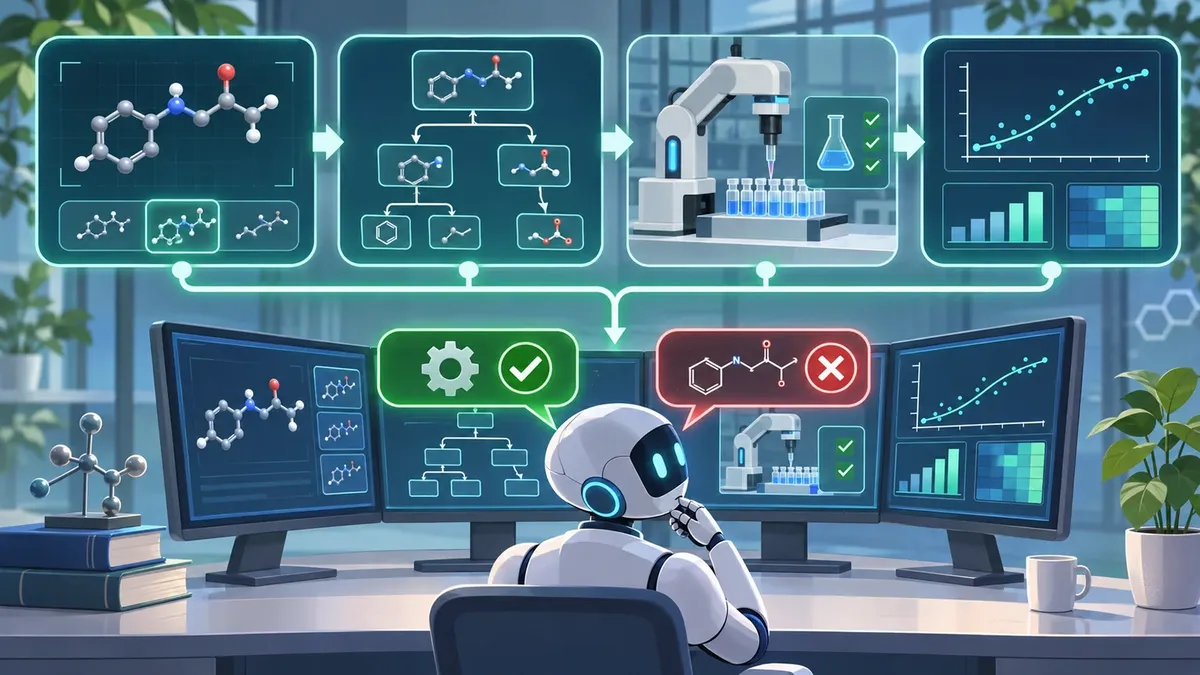
A chemistry program can finish a calculation and return a plausible number even when the setup is wrong. Crucible Bench is designed to test whether AI agents can do more than operate tools: can they use them to produce chemically valid results across research tasks?
A benchmark for chemistry work, not just chemistry answers
Many chemistry tests ask a model to answer a question or complete a single task. Research involves a longer chain: proposing molecules, planning how to make them, running experiments or simulations, and interpreting the results. At each step, scientists must choose and use specialized software—and check whether its output makes chemical sense.
A paper introducing Crucible Bench evaluates language-model agents across this design–make–test–analyze workflow. Its central concern is practical: a tool call can succeed while the scientific result fails. For example, a calculation may converge despite an incorrect molecular setup, or a synthesis route may be formatted correctly but combine transformations inappropriately.
How the test works
The benchmark contains 1,078 tasks in 12 task families, drawn from 18 published datasets. They cover molecular design, synthesis planning, experimental execution, closed-loop optimization, simulation, and analytical characterization. Agents can use 75 chemistry-related tools, made available through seven isolated environments using the Model Context Protocol. The tools include established software for quantum chemistry, retrosynthesis, lab-procedure simulation, and diffraction analysis.
Rather than relying on a general-purpose AI judge, Crucible uses task-specific graders to check submitted outputs. Depending on the task, a grader may assess whether a molecule meets stated constraints, whether a calculated value falls within a tolerance, or whether an experimental protocol contains suitable components and amounts. For simulated lab execution, the benchmark checks whether instructions can be carried out in a robotic liquid-handling simulator. For optimization tasks, agents choose conditions and receive previously measured experimental yields; they do not conduct new physical experiments.
The authors tested 14 language models as single agents in a reasoning-and-tool-use loop. Each model was evaluated three times per task, and the reported scores average those runs. Tasks were sampled and filtered from the source datasets, with checks intended to remove ambiguous cases and ensure reference answers passed the graders.
Tool use helps, but does not settle the problem
The top overall score was 0.545, meaning the best-performing model earned just over half of the available credit under this benchmark’s scoring scheme. Synthesis planning and closed-loop optimization were among the weakest areas. Experimental-execution tasks had the highest scores and the smallest differences between models, while simulation scores differentiated models more strongly.
Overall rank did not reliably indicate performance in every area. The model ranked twelfth overall achieved the highest score in closed-loop optimization. The paper also reports that every model scored substantially lower when tool access was removed, and that stronger overall performers generally gained more from access to tools. This comparison suggests that tool use contributes to performance in the tested setting; it does not show that tools alone make an agent dependable.
The error analysis helps explain why. Agents often lost credit despite successfully running software. They sometimes produced chemically invalid outputs, ignored warnings from their own tools, or reported values that their calculations did not support. In one example discussed by the authors, a model’s predicted reaction yield was far above the measured yield. In another, an agent ranked a molecular structure first even after a tool indicated that its formula did not match the target.
What the results can—and cannot—tell us
Crucible offers a structured way to test tool-using chemistry agents across a broad workflow, with reproducible tasks and explicit checks. But a benchmark score is not a direct measure of readiness for laboratory research. The tasks are curated from existing datasets, and some graders compare outputs with published reference answers. In tasks where multiple solutions may be valid, a correct alternative could differ from the reference; the authors also use constraints or accepted examples for some such cases. Scores therefore depend on the task selection and grading rules as well as on an agent’s capabilities.
The laboratory component is limited to simulation and previously measured data, not a demonstration that these agents can safely or reliably conduct new experiments. The evaluation also uses a particular agent setup, tool collection, and set of models, so the findings need not transfer to every chemistry workflow or agent design.
The source is an arXiv preprint, which may not have undergone peer review. Its results should be read as a benchmark study rather than evidence that AI agents are ready to replace chemists. The work’s clearest message is narrower: successful software execution and fluent answers are not enough. Chemical validity must be checked at the level of the result.
- chemistry AI
- large language models
- AI agents
- Crucible Bench
- scientific benchmarks
- chemistry software
Reviewed cross-references
These connections were reviewed by a model, not independently fact-checked by a human. Similarity does not imply agreement; consult the original papers and the evidence below.
A test bench for AI agents doing materials research
Supporting evidence: Both benchmark studies identify a gap between operating research tools and producing scientifically sound outputs: Crucible reports chemically invalid submissions despite successful tool runs, while CompMat-Bench attributes more failures to scientific errors than software-use errors. This is compatible evidence from different chemistry and computational-materials tasks, not a direct comparison or a result about agents across science generally.
Model review: · openai-codex/gpt-6-luna
Evidence and provenance
Selected excerpts, not complete papers. PDF extraction can omit figures or damage equations, tables and reading order; sources may be preprints.
2611.34254v1 — Original paper
Excerpt reference:
static/papers/2611.34254v1.md:126-182
Basis: Paper text
Source SHA-256:35ad8eb7e2912a73cad4f77fe01a370ff92ae20d0a2010184227a7f2ab05ba9d2610.00636v3 — Original paper
Excerpt reference:
static/papers/2610.00636v3.md:15-62
Basis: Paper text
Source SHA-256:d8a067fea2d55eda5a4399508a91b65c177a76b9a52a7544fedc15ad50b6caed
Related reading
Automatically matched by shared topic keywords. These links do not imply that the sources agree or establish a consensus.
Better tools help AI run some materials simulations—but execution checks still matter
Source published
Shared keywords: ai agents, scientific benchmarks
An AI workflow checks quantum-chemistry calculations along reactions
Source published
Shared keywords: ai agents
Can AI Agents Draw Reliable Health Conclusions? A Benchmark Says Not Yet
Source published
Shared keywords: ai agents, scientific benchmarks
FrontierPhysics tests AI agents on the work of physics research
Source published
Shared keywords: ai agents, scientific benchmarks
Can AI agents do reliable particle-physics analysis?
Source published
Shared keywords: ai agents, scientific benchmarks