TRANSMISSION // 2611.34250v1
Why Medical AI Agents Underuse Their Own Instructions
Source published
An abstract-only report on MedSkill-E² describes a benchmark for measuring when medical AI agents underuse available skills, and a method for revising those skills using feedback.
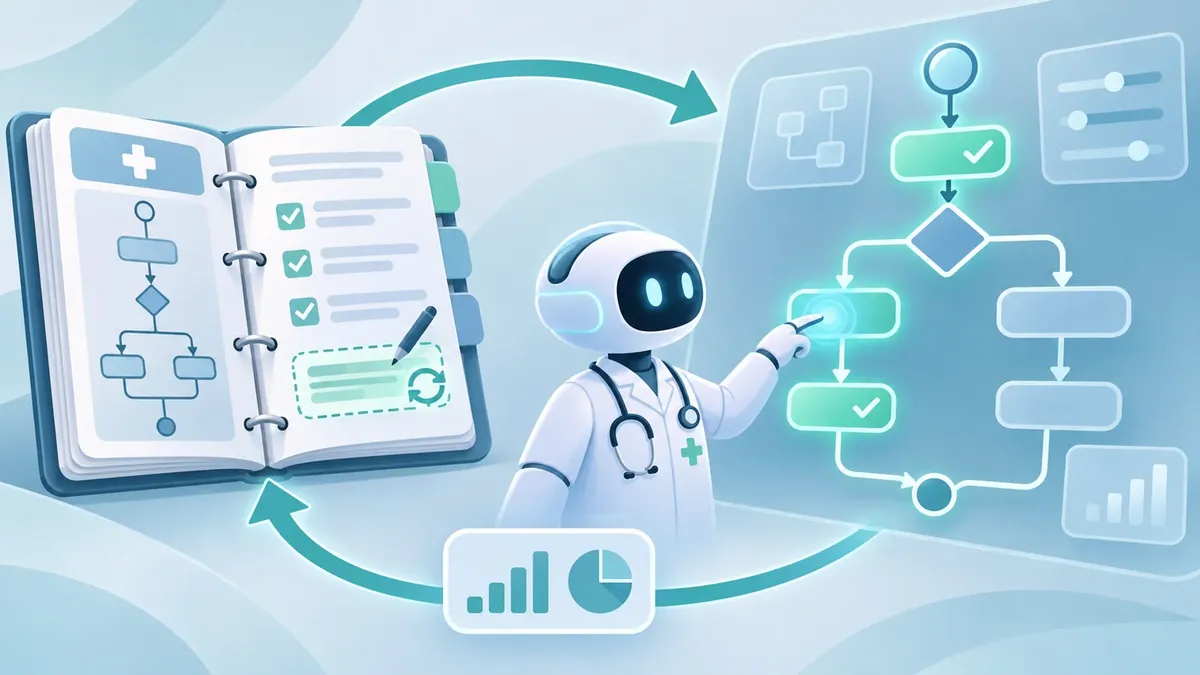
A medical AI agent may have a playbook available yet fail to apply it consistently. MedSkill-E² measures that gap and tests whether feedback can help agents use reusable instructions more effectively.
Medical AI agents can be given a “skill”: reusable instructions that set out procedures or constraints for a task. But making a skill available does not guarantee that an agent will follow it. The authors of MedSkill-E² call this problem “skill Enable But Underuse,” or EBU. They argue that in medical tasks, overlooking a critical constraint can lead to a plausible but incorrect result.
The researchers introduce EBU-Bench, a benchmark covering 12 groups of medically relevant tasks and associated skills. They compare an agent’s accuracy when it must use a skill autonomously with its accuracy when explicitly guided to read and apply that same skill. The difference between those conditions is the “EBU gap.” Because the available account is the abstract, it does not provide enough detail to assess the benchmark’s tasks, models, or scoring procedures.
Across the model-and-harness combinations they evaluated, the authors report an average EBU gap of 43.94 percentage points. The abstract does not define the harnesses, so it is best to treat the term as referring to the evaluated agent setups rather than assume what those setups contain. With the model held fixed, reported skill-use accuracy differed by as much as 38.96 percentage points across harnesses. The authors also report that model rankings could change depending on the harness. These findings indicate that results varied with both the model and the setup in which it was evaluated; the abstract does not explain why.
To address underuse, the team proposes EBU-Evolve. The method uses feedback from autonomous skill use and explicitly guided use to distill effective guidance into reusable skill instructions. Compared with the skills before revision, the revised versions improved autonomous skill-use accuracy by 33.33 to 55.17 percentage points in the reported evaluations. The authors also report gains on unseen tasks within the same skill, with improvements transferring across multiple models and harnesses.
The results suggest that revising instructions may help agents apply skills they already have. They also point to an evaluation consideration: an agent’s measured skill use may vary across harnesses, even with the same model and skill. But the abstract does not establish the cause of those differences or show that revised skills improve clinical decisions or patient outcomes. Benchmark accuracy alone is not evidence that an agent is safe or effective in real-world care.
Important details remain unclear from the available evidence. The abstract does not identify the evaluated models and harnesses, describe task-level results, or explain how uncertainty and variation were measured. This account is therefore limited to the abstract, not a full assessment of the benchmark, methods, or results. The source is an arXiv preprint; its peer-review history is not established by the supplied information. The reported gains should be understood as results within the authors’ evaluations, not as demonstrated clinical benefits.
- medical AI
- AI agents
- agent skills
- benchmarking
- large language models
- preprint
Reviewed cross-references
These connections were reviewed by a model, not independently fact-checked by a human. Similarity does not imply agreement; consult the original papers and the evidence below.
Teaching AI agents to patch their skills with code
Shared method: Both papers use agent execution evidence to revise reusable task guidance: MedSkill-E distills differences between autonomous and operationally supported runs into skill instructions, while PASE uses successful and failed trajectories to patch skills and associated programs. Their revision mechanisms differ, so this connection is limited to the shared feedback-driven skill-evolution approach.
Model review: · openai-codex/gpt-6-luna
Evidence and provenance
Selected excerpts, not complete papers. PDF extraction can omit figures or damage equations, tables and reading order; sources may be preprints.
2611.34250v1 — Original paper
Excerpt reference:
static/papers/2611.34250v1.md:340-387
Basis: Paper text
Source SHA-256:01341e4e42441e288e509a7c1b1ce481d9900a08e82c6140e54eadf8ef679e252611.14019v1 — Original paper
Excerpt reference:
static/papers/2611.14019v1.md:255-378
Basis: Paper text
Source SHA-256:455552bdd02c90fe15a1397363c2bf21a67746046f295d403c6734a0267e22d9
AI agents can make the deliverable and still miss the rules
Supporting evidence: Both studies indicate that producing a plausible deliverable is not enough to establish that an agent followed the required procedure: MedSkill-E reports skill-use failures despite available instructions, and SkillForgeBench reports lower process-rubric performance than completion-rubric performance. This is a bounded comparison across different benchmarks and task settings, not evidence of identical failure rates or mechanisms.
Model review: · openai-codex/gpt-6-luna
Evidence and provenance
Selected excerpts, not complete papers. PDF extraction can omit figures or damage equations, tables and reading order; sources may be preprints.
2611.34250v1 — Original paper
Excerpt reference:
static/papers/2611.34250v1.md:13-66
Basis: Paper text
Source SHA-256:01341e4e42441e288e509a7c1b1ce481d9900a08e82c6140e54eadf8ef679e252610.14918v2 — Original paper
Excerpt reference:
static/papers/2610.14918v2.md:15-64
Basis: Paper text
Source SHA-256:ecfb0be4cfef446d8a7ca7140bbd05ce4a68a2b29abd927183553a1d70234ff92610.14918v2 — Original paper
Excerpt reference:
static/papers/2610.14918v2.md:108-197
Basis: Paper text
Source SHA-256:ecfb0be4cfef446d8a7ca7140bbd05ce4a68a2b29abd927183553a1d70234ff9
Related reading
Automatically matched by shared topic keywords. These links do not imply that the sources agree or establish a consensus.
Teaching AI agents to patch their skills with code
Source published
Shared keywords: agent skills, ai agents, large language models
How AI agents turn successes and failures into reusable skills
Source published
Shared keywords: agent skills, ai agents, large language models
How SkillBoost aims to limit AI skill overfitting
Source published
Shared keywords: agent skills, ai agents, large language models
MetaSkill gives AI agents a reusable playbook for using skills
Source published
Shared keywords: agent skills, ai agents, large language models
How Medical AI Can Learn Which Tools to Use
Source published
Shared keywords: ai agents, large language models, medical ai