TRANSMISSION // 2611.34248v1
What Makes an AI Agent Uncertain?
Source published
EXPOSURE uses one belief network to explain how visible features affect an RL agent’s expected return and different kinds of uncertainty. Tests in two board games are promising, but limited.
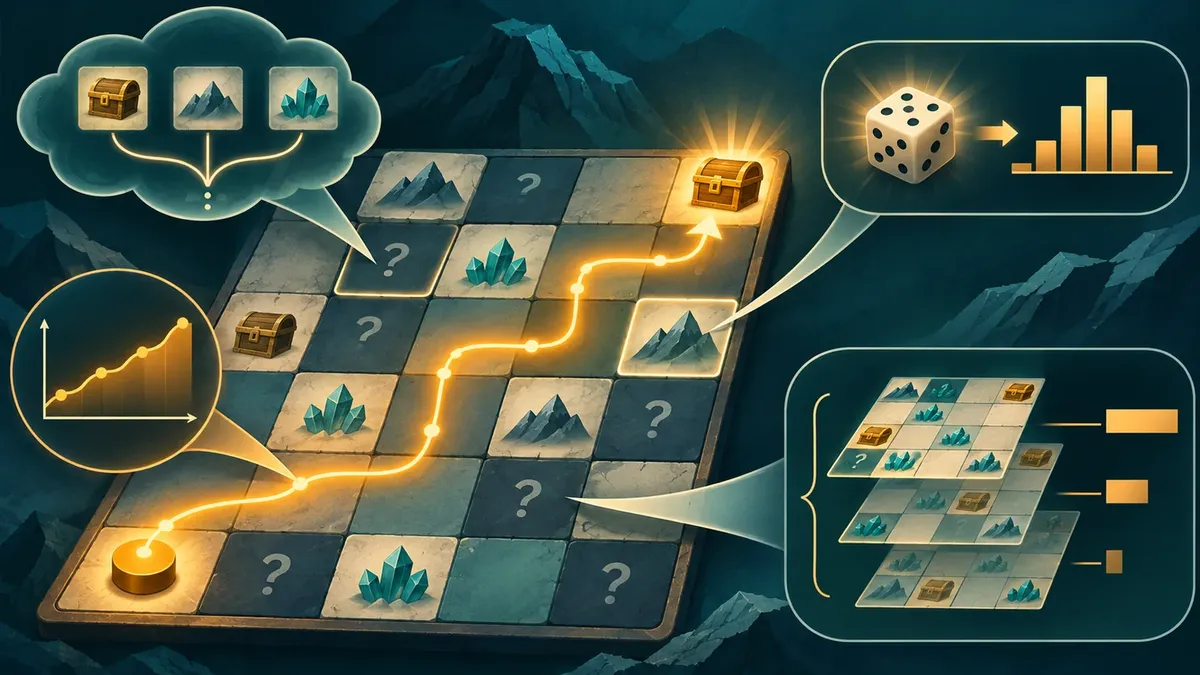
An agent can expect the same reward from two choices yet be much less certain about one. A new preprint introduces EXPOSURE, a reinforcement-learning method designed to show which parts of an observation shape an agent’s expected return, uncertainty and beliefs about features it cannot see.
Explaining more than expected reward
Reinforcement-learning agents learn to choose actions through interaction with an environment. Shapley values offer one way to explain a prediction: they estimate each feature’s contribution by averaging its effect across different combinations of features.
An explanation of expected reward alone does not say how certain the agent is. Two actions might have the same predicted value even if one has a predictable outcome and the other could lead to very different results. This paper asks whether an agent’s explanation can identify which observed features affect its uncertainty, and distinguish uncertainty caused by missing information from uncertainty that remains when all observation features are visible.
The authors call their method EXPOSURE. It uses a single network both to select actions and to produce the predictions needed for explanations. Unlike a separate surrogate trained to imitate an agent, EXPOSURE aims to explain the predictions of the agent itself.
How the method works
The network forms a belief about masked observation features, conditioned on the features that remain visible. During training, it sees randomly masked observations and learns to form these beliefs while predicting expected return and return variance. A decoder learns to reconstruct the masked features from the visible ones and the belief representation.
For each subset of visible features, the researchers estimate expected return and three uncertainty-related quantities. Observational uncertainty arises because some features are hidden. Inherent uncertainty is return uncertainty that remains even when all observation features are visible—for example, because the environment itself is random. The third quantity is the entropy of the agent’s belief about masked features: broadly, how many possible completions it considers plausible.
Shapley values estimate how revealing each feature changes each quantity across feature subsets. These targets are distinct: a feature may narrow the agent’s belief about hidden features without changing uncertainty in the return.
Tests in two games
The researchers evaluated EXPOSURE in tic-tac-toe and 4-by-4 Minesweeper with three mines. These settings allowed them to calculate exact Shapley values for comparison. They also compared it with a deep Q-network paired with a surrogate, and with a network trained to handle masked observations directly but without the same latent-belief design. The methods were assessed using states drawn from an optimal policy’s distribution, with the optimal policy obtained by exhaustive game-tree search.
Across the three tested settings—tic-tac-toe against a random opponent, tic-tac-toe against a perturbed minimax opponent, and Minesweeper—EXPOSURE had the strongest agreement with exact Shapley values for expected return and both return-uncertainty components. Its lead for expected-return explanations was marginal in one tic-tac-toe setting. EXPOSURE was also the only tested method to explain belief uncertainty. Its reported correlations with exact belief-uncertainty Shapley values were 0.76, 0.56 and 0.59 in those three settings, respectively.
The paper reports that EXPOSURE’s game performance was competitive in tic-tac-toe and that it won more often than the baselines in Minesweeper. These results apply to the tested environments; they do not establish a general performance advantage in other tasks.
What the results do—and do not—show
Agreement with exact Shapley values tests whether feature attributions resemble the exact rankings in these environments. It does not prove that the network’s beliefs or variance estimates are calibrated—that is, that stated uncertainty matches observed outcomes. The authors identify calibration as an open question.
The method’s uncertainty decomposition also does not cover epistemic uncertainty: uncertainty arising from limited knowledge about the model or its learned parameters. The authors say larger observation spaces will require more efficient attribution and tests of explanation faithfulness where exact answers are unavailable. They also propose comparing against a separately trained imputer to test whether the belief needs to be learned jointly with the agent.
The paper is a preprint submitted to the ESANN 2027 symposium; the available source does not establish peer review or acceptance. Its evaluation covers two small board-game environments. Although healthcare and other safety-critical applications motivate the work, these experiments do not establish that EXPOSURE is useful or reliable in such settings. The method offers a framework for asking richer questions about an agent’s uncertainty, while broader testing and calibration evidence remain necessary.
- reinforcement learning
- AI explainability
- Shapley values
- uncertainty
- EXPOSURE
- machine learning
Reviewed cross-references
These connections were reviewed by a model, not independently fact-checked by a human. Similarity does not imply agreement; consult the original papers and the evidence below.
What Actually Improves When Search Agents Learn?
Shared method: Both papers use Shapley values to allocate contributions across coalitions: EXPOSURE attributes return and uncertainty to observation features, while CO-GRAFT attributes reinforcement-learning gains to agent roles. The shared attribution method does not make their targets or experimental settings comparable; EXPOSURE evaluates explanations in tic-tac-toe and Minesweeper, whereas CO-GRAFT evaluates grafted search-agent trajectories.
Model review: · openai-codex/gpt-6-luna
Evidence and provenance
Selected excerpts, not complete papers. PDF extraction can omit figures or damage equations, tables and reading order; sources may be preprints.
2611.34248v1 — Original paper
Excerpt reference:
static/papers/2611.34248v1.md:87-148
Basis: Paper text
Source SHA-256:90b33680319b623bf576b3ec820a77b608cb1bff7fac8f8c3ca9de99a7b0e3552611.34248v1 — Original paper
Excerpt reference:
static/papers/2611.34248v1.md:149-244
Basis: Paper text
Source SHA-256:90b33680319b623bf576b3ec820a77b608cb1bff7fac8f8c3ca9de99a7b0e3552611.31185v1 — Original paper
Excerpt reference:
static/papers/2611.31185v1.md:82-139
Basis: Paper text
Source SHA-256:aecddadd9fb3f43bef392bbe53bae7e627411a12d90f0c1abe2b6634e0859155
When an AI’s “preference” depends on the prompt
Shared method: Both papers use Shapley values to allocate a model output across input components: EXPOSURE attributes return and uncertainty to observation features, while Mohammadi’s audit allocates simulated choices across prompt edits or words. The games, references and outcomes differ, so their results do not directly validate or contradict one another.
Model review: · openai-codex/gpt-6-luna
Evidence and provenance
Selected excerpts, not complete papers. PDF extraction can omit figures or damage equations, tables and reading order; sources may be preprints.
2611.34248v1 — Original paper
Excerpt reference:
static/papers/2611.34248v1.md:87-148
Basis: Paper text
Source SHA-256:90b33680319b623bf576b3ec820a77b608cb1bff7fac8f8c3ca9de99a7b0e3552611.34248v1 — Original paper
Excerpt reference:
static/papers/2611.34248v1.md:149-244
Basis: Paper text
Source SHA-256:90b33680319b623bf576b3ec820a77b608cb1bff7fac8f8c3ca9de99a7b0e3552404.01332v4 — Original paper
Excerpt reference:
static/papers/2404.01332v4.md:13-79
Basis: Paper text
Source SHA-256:6a04f6c0ce605b5744acf2572741b913fe70184f0e5310a73532a1fd74eae4f5
Related reading
Automatically matched by shared topic keywords. These links do not imply that the sources agree or establish a consensus.
What Actually Improves When Search Agents Learn?
Source published
Shared keywords: reinforcement learning
When an AI’s “preference” depends on the prompt
Source published
Shared keywords: shapley values
When image and caption disagree, AI explanations can go wrong
Source published
Shared keywords: ai explainability
Why AI explanations should pass through the decoder
Source published
Shared keywords: ai explainability
An AI’s step-by-step answer is not necessarily an explanation
Source published
Shared keywords: ai explainability