TRANSMISSION // 2611.34247v1
Can AI Forecast Which Drug Targets Reach Trials?
Source published
Six language models ranked targets entering trials about as well as a trial-history baseline. A boost from the newest knowledge graph often came from seeing the trial being predicted.
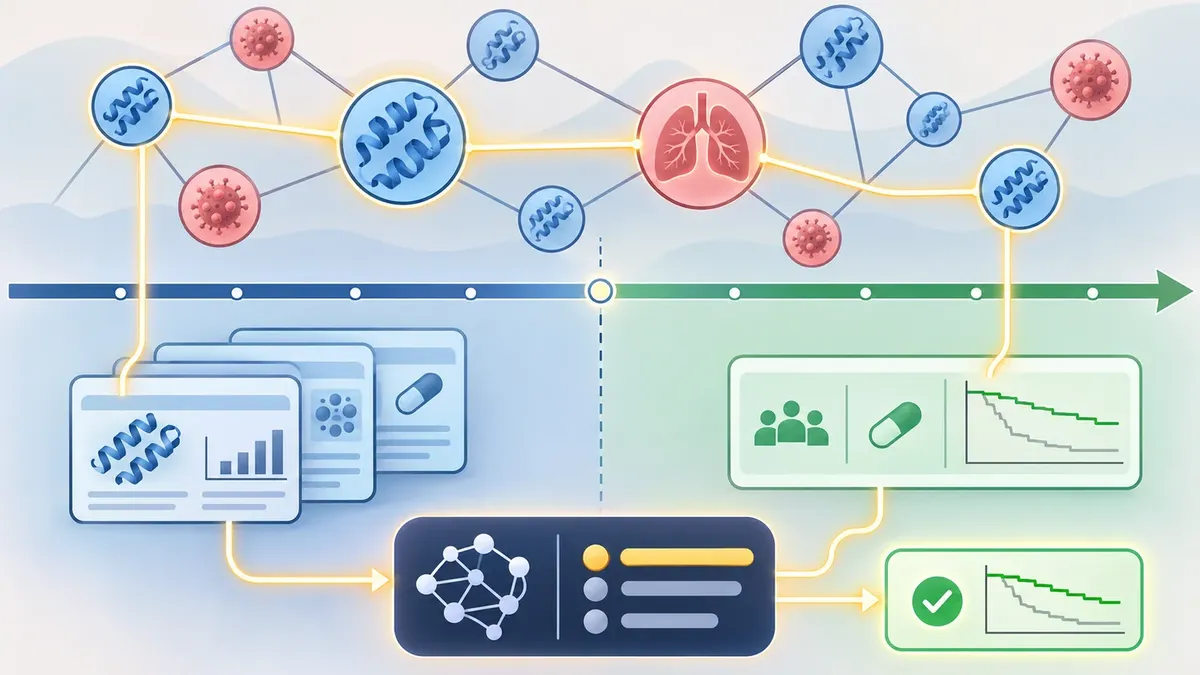
Can a language model rank drug targets before they enter clinical trials, or does it benefit from records created later? A study tested six open models with dated evidence and found that evidence available at decision time added little to their rankings.
A model that ranks a drug target highly for a disease may seem to forecast a promising research direction. But if the information it receives includes the very trial it is meant to predict, that is hindsight rather than forecasting. A preprint by Pui Chung Siu and colleagues examines how well large language models rank targets before their first clinical trial for a disease—and whether access to later records changes the result.
The researchers treated each target–disease pair as a dated event: the target’s first clinical trial for that disease. They asked six open-weight language models to rank targets entering a first trial in a given year. The models were Llama 3.1, Qwen 3 and Gemma 2, in two sizes each. The evaluation covered decision years 2021 through 2026 and assessed performance before and after each model’s estimated training-data cutoff.
To control what the models could see, the team used a biomedical knowledge graph that could be queried as it stood at the end of a particular year. In one condition, models received target and disease descriptions but no retrieved graph evidence. In another, they received paths built from evidence dated before the decision. In a third, they received the newest graph snapshot, which could include later records. The researchers compared rankings with a simple baseline: the number of trials the target had previously had for diseases in the same therapeutic area. They measured ranking performance using AUROC, average precision and mean reciprocal rank.
Without graph retrieval, the models ranked candidates about as well as the trial-history baseline. Their scores changed little after their training cutoffs, when positive examples were novel to the models. The authors interpret this stability as evidence that much of the models’ performance reflected plausibility rather than memory of the specific trial. Still, that plausibility did not give them a clear advantage over the historical count.
Evidence from the dated graph—the information available before the forecast—added little. It slightly improved AUROC for some models before their training cutoffs, but after the cutoffs, where the trial examples were also new to the models, no model showed a significant gain from dated evidence. In this test, adding time-bounded graph information did not reliably improve rankings.
The newest graph produced a much larger apparent boost: five of six models rose clearly above the trial-history baseline. But the researchers found that paths supplied from this snapshot usually included the target–disease pair’s own trial, registered after the decision date. The graph could therefore expose the outcome being predicted. This result is not evidence that the models foresaw those trials; it shows how access to later records can make a forecast look stronger.
That distinction matters for evaluations using current databases or web search. If inputs are assembled from records created after the prediction date, a benchmark can reward access to the answer rather than forecasting. The authors argue that evaluations should date both evidence and outcomes: evidence should precede the decision, and the events being predicted should follow it.
There are important limits. The study tests six open models, not proprietary frontier systems or models designed for explicit multi-step reasoning. Prompts requested a single “Yes” or “No” answer, so the experiment tests whether supplied evidence improves rankings, not the quality of written reasoning. Four model training cutoffs were approximate. The 2026 slice covers trials registered only through May, and the study samples ten negatives per positive. Its precision-based scores therefore reflect that candidate-set design as well as model performance.
The authors also report that a reviewed version used a negative-selection rule that relied on future information. They reran the evaluation with time-aware negatives. The main findings remained, but a previously reported decline in performance relative to trial history was no longer significant. This revision illustrates how benchmark construction can affect conclusions.
This is an arXiv preprint, presented in a NeurIPS 2026 workshop context; it should not be treated as settled evidence about AI across drug discovery. The study evaluates rankings against historical first-trial entries. It does not establish whether a target is biologically effective, whether a trial will succeed, or whether AI rankings improve patient outcomes. Its focused lesson is about measurement: a fair test of forecasting must keep post-decision records out of the evidence.
- large language models
- drug target prioritisation
- clinical trials
- temporal knowledge graphs
- data leakage
- AI evaluation
Reviewed cross-references
These connections were reviewed by a model, not independently fact-checked by a human. Similarity does not imply agreement; consult the original papers and the evidence below.
A Trial Simulator Can Look Accurate Without Knowing What the Drug Does
Shared method: Both use a temporal split to test performance on later data: the origin evaluates target–disease trial events against model training cutoffs, while Koyun evaluates trial contrasts by results-posting date. The tasks and outcomes differ, and only Koyun’s study adds an intervention-blind reference, so their results are not directly comparable.
Model review: · openai-codex/gpt-6-luna
Evidence and provenance
Selected excerpts, not complete papers. PDF extraction can omit figures or damage equations, tables and reading order; sources may be preprints.
2611.34247v1 — Original paper
Excerpt reference:
static/papers/2611.34247v1.md:160-207
Basis: Paper text
Source SHA-256:1257cc57d3872d6a0d93d490011ebb4cbee30be21ae5cb5b2c41b84daa56997a2611.05907v1 — Original paper
Excerpt reference:
static/papers/2611.05907v1.md:13-73
Basis: Paper text
Source SHA-256:19fca35c07e3161459c841fd054122c058a5be57d7e9919467bf4e31dcf2cb74
Related reading
Automatically matched by shared topic keywords. These links do not imply that the sources agree or establish a consensus.
Why conversation history changes RAG privacy
Source published
Shared keywords: large language models
Can evidence from one AI help another predict clinical-trial outcomes?
Source published
Shared keywords: clinical trials, large language models
How should AI forecast links for newly emerging entities?
Source published
Shared keywords: temporal knowledge graphs
Can AI Agents Draw Reliable Health Conclusions? A Benchmark Says Not Yet
Source published
Shared keywords: data leakage
Why Clinical AI Needs Statistical Guardrails
Source published
Shared keywords: clinical trials