TRANSMISSION // 2611.34235v1
A second transmon could speed up qubit readout
Source published
A proposed ancilla-assisted method may shorten transmon readout by making the resonator’s state-dependent signal stronger. The reported speed-up comes from theoretical and numerical modelling, not an experimental demonstration.
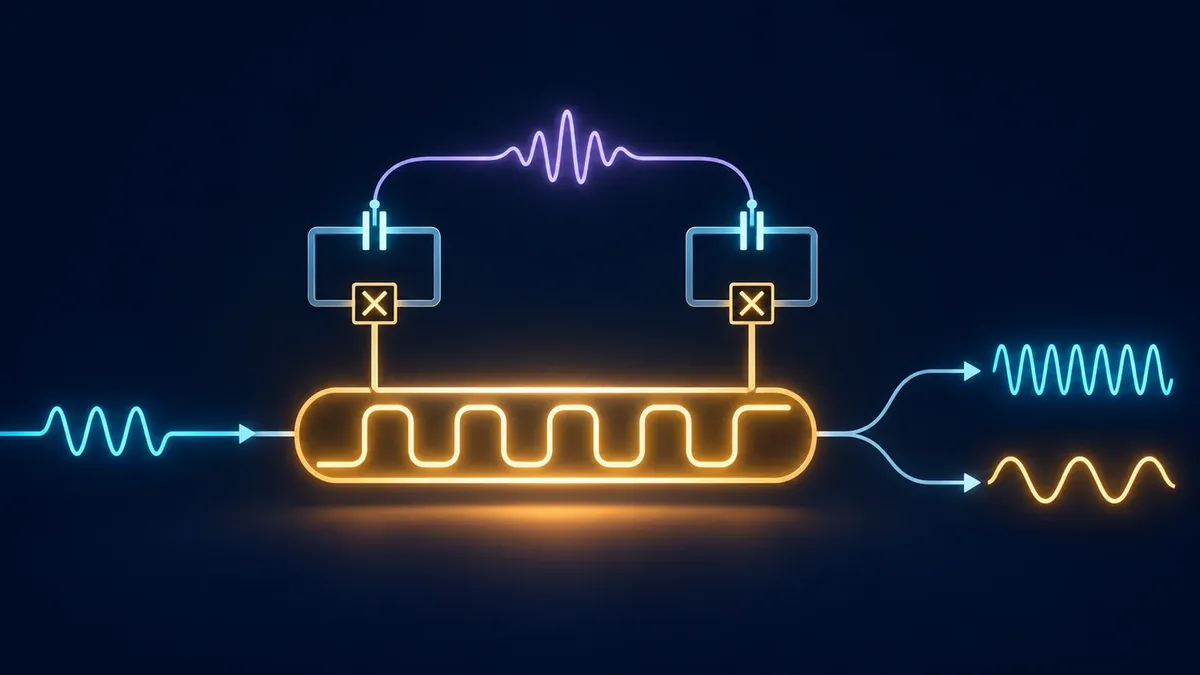
Superconducting qubits are often measured by watching how their state shifts a microwave resonator’s response. A new proposal adds a second transmon to strengthen that signal: a fast gate correlates the extra qubit with the one being measured. The authors estimate that, under their modelled conditions, this could reduce measurement time while maintaining a chosen signal-to-noise level.
Why make qubit readout faster?
Quantum processors need to measure qubits to check for errors and guide later operations. In superconducting circuits, a common approach is dispersive readout: a transmon qubit is coupled to a resonator, and the qubit’s state shifts the resonator’s frequency. Researchers drive the resonator and infer the qubit state from the returning microwave signal.
The challenge is that stronger signals can come at a cost. Driving the resonator harder, or increasing the interaction that produces the frequency shift, may push the system beyond the conditions where the simple dispersive picture works well. One possible consequence is ionization, in which the transmon is excited out of its computational states. That limits how aggressively the readout can be driven.
Christopher Corlett, Noah Linden and Paul Skrzypczyk propose a different way to increase the signal: add an ancillary transmon, coupled to the same resonator as the target qubit.
How the proposal works
Before measurement, a fast CNOT gate copies the target qubit’s computational-basis value onto an ancilla prepared in its ground state. In this scheme, if the target is in state 0, the pair is in state 00; if it is in state 1, the pair is in state 11. The resonator’s frequency shift then reflects the combined contributions of both transmons. The authors’ idealised analysis finds that this shift can be approximately doubled.
A stronger difference between the resonator responses can make the two possible measurement outcomes easier to distinguish in less time. The paper describes this using signal-to-noise ratio, or SNR: a measure of how clearly the outcomes can be separated despite measurement noise. In the dispersive approximation, the authors show that doubling the effective shift can halve the measurement duration needed to reach a given SNR, before accounting for the time required to apply the CNOT.
But the idealised approximation leaves out important complications. The researchers therefore extend a numerical method called branch analysis to estimate when nonlinear effects and ionization become important in a system with two transmons. They also model a noisy, finite-duration CNOT and allow the resonator’s effective frequency shift to change with photon number.
What the calculations suggest
Across the parameter ranges they study, the authors report that the proposed approach can reduce the measurement duration to about 0.6 times that of standard single-transmon readout, while targeting the same SNR. This is a model-based estimate, not a measured improvement in a working device. The comparison includes the CNOT’s duration, and the paper finds that the benefit is most pronounced when the two transmons have similar detunings from the resonator. It also reports an improvement across much of the explored range when their detunings differ.
The extra qubit is not free: the gate takes time and can fail, and the two-transmon system has nonlinear behaviour that may limit the usable resonator drive. The paper estimates that, for most of the parameter space it analyses, the added transmon does not lower the critical photon number enough to eliminate the proposed advantage. However, the authors explicitly describe these critical-photon-number estimates as heuristic and not yet supported by experimental evidence.
What remains uncertain
This work presents analytical calculations and numerical modelling, not an experimental test. The authors note that their model could be made more realistic by including the tunable coupler and transmon relaxation. They also identify imperfect CNOT performance as a limit on achievable measurement fidelity. Results depend on the device parameters and modelling assumptions; the reported factor should not be read as a guaranteed speed-up for existing processors.
The paper is an arXiv preprint, so its claims should be treated as preliminary rather than as established experimental results. Search results are incomplete, and the available source does not establish whether the work has undergone peer review. The proposal’s practical value will depend on whether a device can implement the gate and two-transmon readout while preserving the predicted advantage.
- transmon qubits
- quantum readout
- dispersive measurement
- ancilla qubit
- superconducting circuits
- quantum computing
Reviewed cross-references
These connections were reviewed by a model, not independently fact-checked by a human. Similarity does not imply agreement; consult the original papers and the evidence below.
Qudits: making more room for quantum information
Shared method: Both discuss dispersive readout through a transmon coupled to a resonator: Corlett and colleagues propose adding a correlated ancilla to increase the resonator shift, while Chakraborty and colleagues describe standard transmon-qudit readout using state-dependent resonator shifts. The review’s description is background, not an independent test of the proposed speed-up.
Model review: · openai-codex/gpt-6-luna
Evidence and provenance
Selected excerpts, not complete papers. PDF extraction can omit figures or damage equations, tables and reading order; sources may be preprints.
2611.34235v1 — Original paper
Excerpt reference:
static/papers/2611.34235v1.md:12-70
Basis: Paper text
Source SHA-256:b0c8647a619328c417dbed6ffbf02cb5cd8a82d74ab11dca056c8484d20ad5052611.33299v1 — Original paper
Excerpt reference:
static/papers/2611.33299v1.md:416-456
Basis: Paper text
Source SHA-256:06e2cc3a289cd0c3a1da64f3880d014b503b34132fe1102a99a2dcd9726e515b
Related reading
Automatically matched by shared topic keywords. These links do not imply that the sources agree or establish a consensus.
A quieter route to tunable light–matter interactions
Source published
Shared keywords: superconducting circuits, transmon qubits
One Extra Qubit, Many More Ways to Observe Quantum Dynamics
Source published
Shared keywords: ancilla qubit, quantum computing
Choosing better measurements for qubit tune-ups
Source published
Shared keywords: quantum computing, transmon qubits
A built-in energy drain could help superconducting qubits reset quickly
Source published
Shared keywords: quantum computing
Qudits: making more room for quantum information
Source published
Shared keywords: quantum computing