TRANSMISSION // 2611.34218v1
How GPS overlap helps connect sonar and underwater photos
Source published
GeoCAM uses survey-footprint overlap as a learning signal to match side-scan sonar tiles with underwater camera images, without seabed-class labels.
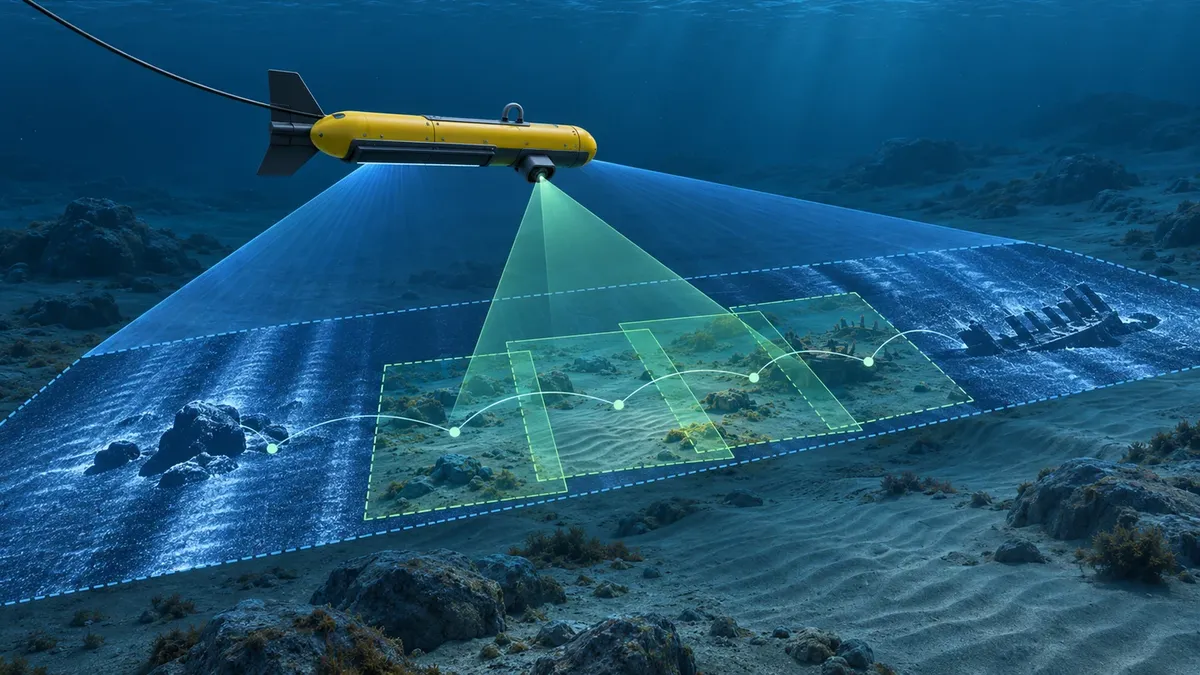
Sonar can cover the seabed where cameras struggle, but its images can be difficult to interpret. GeoCAM uses geographic overlap between sonar and camera observations as a soft learning signal, then tests whether the model can retrieve corresponding images.
Side-scan sonar can survey broad areas of the seafloor, including in conditions where underwater cameras have limited visibility. But sonar images lack the color and fine texture that can help distinguish seabed types, and different substrates can produce similar sonar patterns. That makes reliable interpretation difficult—and collecting expert labels for training is costly.
A research team proposes GeoCAM, a way to train a model to connect sonar tiles with underwater photographs without using labels such as “sand” or “rock.” The key idea is to use information recorded during surveys: the geographic footprints of sonar and camera observations. Footprint overlap provides a soft signal about how closely observations correspond; it does not guarantee that they show identical visual content.
Turning survey geometry into learning signals
The researchers tested GeoCAM on BenthiCat SSS-CAM, a dataset containing 2,080 georeferenced sonar tiles and 35,947 associated optical images. The experiments used the dataset’s pairings and survey geometry, but not its semantic annotations or segmentation masks. The data were split into training and validation subsets using a fixed random seed; during training, each sonar tile could be paired with up to eight camera views.
GeoCAM builds a shared numerical representation, or embedding, for the two kinds of images. In practical terms, it aims to place a sonar tile near camera images associated with overlapping seabed footprints and farther from unrelated images.
Two design choices address challenges in the survey data. First, one sonar tile can correspond to several camera views, which may differ in viewpoint or image quality. A Set Attention Aggregator learns how to combine those views into one representation rather than treating them as interchangeable. Second, a geometry-weighted contrastive learning objective uses measured footprint overlap to weight corresponding pairs: greater overlap means a stronger learning signal. This preserves more information than treating every match as simply right or wrong.
The team also tested an optional masked-reconstruction component. It asks the model to predict hidden sonar patches using optical information. This branch was not part of the final retrieval recipe.
Retrieval results—and a qualified comparison
The main evaluation tested cross-modal retrieval. The headline figures in the paper are for the sonar-to-optical direction: whether a sonar query retrieves its corresponding optical item. Across three runs of the full 100-epoch recipe, Recall@1—the share of queries with the correct match ranked first—averaged 29.4% (standard deviation 1.5 percentage points). Recall@10 averaged 90.8% (standard deviation 1.9 points). The paper also says retrieval was evaluated in the reverse direction, but these headline figures are not optical-to-sonar results.
To examine the components, the authors compared variants trained for a separate, shorter 20-epoch period. In that controlled comparison, the mean-pooling contrastive baseline had Recall@1 of 19.5%, while the version combining set attention with overlap-weighted contrastive learning had 20.0%. Set attention alone scored 17.5%. These results suggest overlap weighting helped in this short-budget comparison, but the difference between the baseline and combined variant is modest. The full 100-epoch result is not directly comparable to those ablations because it used a different training duration. The paper compares GeoCAM with its own baseline and variants, rather than reporting a broad comparison with established methods on this benchmark.
The reconstruction branch performed poorly in the reported short-budget test: its Recall@1 was 4.0%. The authors therefore excluded it from the final retrieval recipe. They suggest reconstruction may compete with discriminative cross-modal matching, but this is a possible explanation, not a demonstrated mechanism.
What the results do—and do not—show
GeoCAM’s results support the feasibility of using geographic overlap to help match sonar and camera observations in this dataset. They do not yet show that the learned representations improve benthic habitat classification or segmentation. Those downstream tasks are left for future work, as are tests of sonar-to-sonar matching and retrieval when camera images are unavailable at inference time.
The evaluation is limited to one benchmark and its correspondence subset. Retrieval success is not the same as correctly identifying a habitat, and results may not transfer to other surveys or conditions. The paper is an arXiv preprint, so its claims should be treated as provisional rather than independently established. The authors say code is available online, which may help other researchers examine and test the approach.
- side-scan sonar
- underwater imaging
- self-supervised learning
- cross-modal retrieval
- geographic metadata
- benthic habitats
Reviewed cross-references
These connections were reviewed by a model, not independently fact-checked by a human. Similarity does not imply agreement; consult the original papers and the evidence below.
DuoJEPA: A Bridge Between Embedding Spaces
Shared method: Both papers use contrastive objectives to learn from paired modalities: GeoCAM weights sonar–optical positives by geographic footprint overlap, while DuoJEPA applies contrastive supervision within a translated target space. This is a shared training approach, not evidence that the architectures or results are interchangeable; they study different modality pairs and tasks.
Model review: · openai-codex/gpt-6-luna
Evidence and provenance
Selected excerpts, not complete papers. PDF extraction can omit figures or damage equations, tables and reading order; sources may be preprints.
2611.34218v1 — Original paper
Excerpt reference:
static/papers/2611.34218v1.md:133-239
Basis: Paper text
Source SHA-256:2a29f1c7fcc7f7ffd59ef865b574a649962ffe3884c9a64b4dd5d07d347a77b02611.34218v1 — Original paper
Excerpt reference:
static/papers/2611.34218v1.md:609-677
Basis: Paper text
Source SHA-256:2a29f1c7fcc7f7ffd59ef865b574a649962ffe3884c9a64b4dd5d07d347a77b02611.15968v2 — Original paper
Excerpt reference:
static/papers/2611.15968v2.md:13-49
Basis: Paper text
Source SHA-256:5ea2274f0989b868adc92901e2153504bb7d0e30f20bd9dca75e15f11bfbf047
Related reading
Automatically matched by shared topic keywords. These links do not imply that the sources agree or establish a consensus.
DuoJEPA: A Bridge Between Embedding Spaces
Source published
Shared keywords: cross modal retrieval, self supervised learning
Finding the right circuit, whether it’s drawn, described or coded
Source published
Shared keywords: cross modal retrieval
Teaching grid AI to balance cost, renewables and limits
Source published
Shared keywords: self supervised learning
How DomusFM learns from smart-home sensor events
Source published
Shared keywords: self supervised learning
Learning from unlabelled smart-glasses signals improves facial-expression recognition
Source published
Shared keywords: self supervised learning