TRANSMISSION // 2611.34198v1
Galaxy pairs may host slower bars—but the evidence is tentative
Source published
Among 300 galaxies with measured bar-rotation ratios, paired galaxies tended to have higher values, but the difference was tentative. Pattern speeds showed no clear difference.
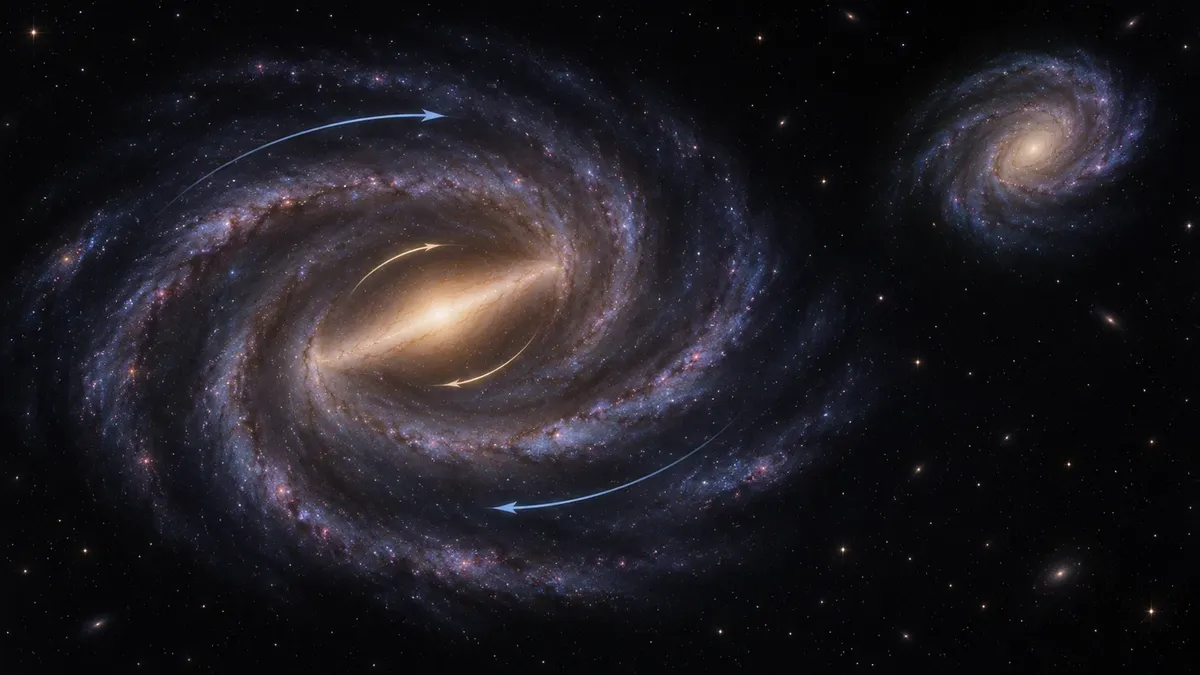
Galaxies sometimes contain a long, bright bar of stars crossing their centers. Simulations suggest that encounters with another galaxy can produce or alter bars that rotate slowly relative to the surrounding disk. An observational study tests whether bars in paired galaxies show that signature—and finds a hint, not a firm answer.
A galaxy’s stellar bar is more than a striking shape. It can move angular momentum around the galaxy and help channel gas toward its center. But do bars in galaxies with nearby companions rotate differently from those in apparently isolated galaxies? Simulations suggest that tidal encounters may create or affect bars with a higher rotation-rate ratio, a measure commonly used to distinguish “slow” from “fast” bars.
An arXiv preprint by Brian Aziz and colleagues compares bar kinematics in 314 galaxies. The study asks whether bars in paired galaxies look slower than those in isolated ones, and whether the answer depends on which measure of rotation is used.
Two ways to describe a bar’s rotation
The researchers draw on measurements from four earlier studies of galaxies observed in the MaNGA survey. Those studies used integral-field spectroscopy, which records light and stellar motions across many locations in each galaxy. One quantity, the bar pattern speed, describes how quickly the bar’s overall shape rotates around the galaxy’s center.
The second quantity, called R, compares the distance to the bar’s corotation radius—the point where stars orbit at the same angular rate as the bar—with the bar’s own radius. In the conventional classification, bars with R below 1.4 are “fast,” while those above 1.4 are “slow.” This ratio is not interchangeable with pattern speed: the two describe related but distinct aspects of bar dynamics.
To assess environment, the team matched the galaxies to the Galaxy Zoo DESI catalogue and used nearby-galaxy positions and redshifts to classify each as paired or isolated. Their criteria yielded 49 paired and 265 isolated galaxies. A companion within specified projected-distance and velocity-difference limits counted toward the paired category; the label does not establish that the companion caused the bar to form.
A trend in the ratio, not in pattern speed
The fraction of galaxies classified as paired rose across bins of increasing R: it was about 5% in the lowest bin and 31% in the highest. For the direct comparison of R distributions, measurements were available for 300 galaxies: 47 paired and 253 isolated. The mean R was 2.1 for paired galaxies and 1.75 for isolated ones. The distributions nevertheless overlapped considerably. A statistical test suggested a possible difference, but the result fell short of the authors’ stated 3-sigma threshold for statistical significance.
The other measure told a different story. The average pattern speed was about 27 km/s per kiloparsec in both groups, and the analysis found no clear difference between their pattern-speed distributions. Thus, the study’s evidence for an environmental association concerns the R ratio—not a general finding that bars in paired galaxies spin more slowly in every sense.
The authors also divided paired galaxies into major and minor interactions using companion mass ratios or differences in brightness. Some averages suggested higher R for major interactions, but those comparisons involved small groups and were not statistically significant. The study therefore does not establish that stronger encounters are associated with a particular bar rotation rate.
What the result cannot show
“Paired” and “isolated” describe galaxies’ observed surroundings, not their full histories. A bar in a paired galaxy might have formed internally before a later encounter; an apparently isolated galaxy could have experienced an interaction in the past. The observations cannot identify each bar’s origin or separate the effects of formation from later changes.
There are measurement limits, too. The bar-radius estimates used to calculate R came from studies that applied different methods, and a bar’s edge is not always sharply defined. Since R depends directly on that radius, such differences can add scatter. The sample is also modest, particularly once divided into interaction categories. The authors note that the pattern-speed method can be less reliable for some disturbed or unfavorably oriented systems, although excluding the five measurements from one study that retained more challenging cases did not change their conclusions.
Overall, the findings are consistent with the idea that bars in galaxy pairs may have higher R values, but they do not prove that encounters create slow bars. Larger samples and better information about galaxies’ interaction histories would help determine whether the hint is robust. This work is an arXiv preprint, so the results are provisional.
- galaxy bars
- galaxy interactions
- bar kinematics
- MaNGA
- galaxy evolution
Related reading
Automatically matched by shared topic keywords. These links do not imply that the sources agree or establish a consensus.
Galactic Gas May Preserve Traces of Fading Black Hole Activity
Source published
Shared keywords: galaxy evolution
Two protoclusters, different galaxy trends
Source published
Shared keywords: galaxy evolution
A better way to read gas flows in barred galaxies
Source published
Shared keywords: galaxy bars
NGC 4936’s cold gas has a complicated history
Source published
Shared keywords: galaxy interactions
A metal-poor stellar trail follows the Magellanic Clouds
Source published
Shared keywords: galaxy interactions