TRANSMISSION // 2611.34195v1
Why Hydrogen Isotopes Reflect Differently from Silicon
Source published
A theoretical study finds different quantum-reflection probabilities for hydrogen, deuterium and tritium near silicon. Rescaling velocity by a scattering-length quantity brings their calculated curves approximately together.
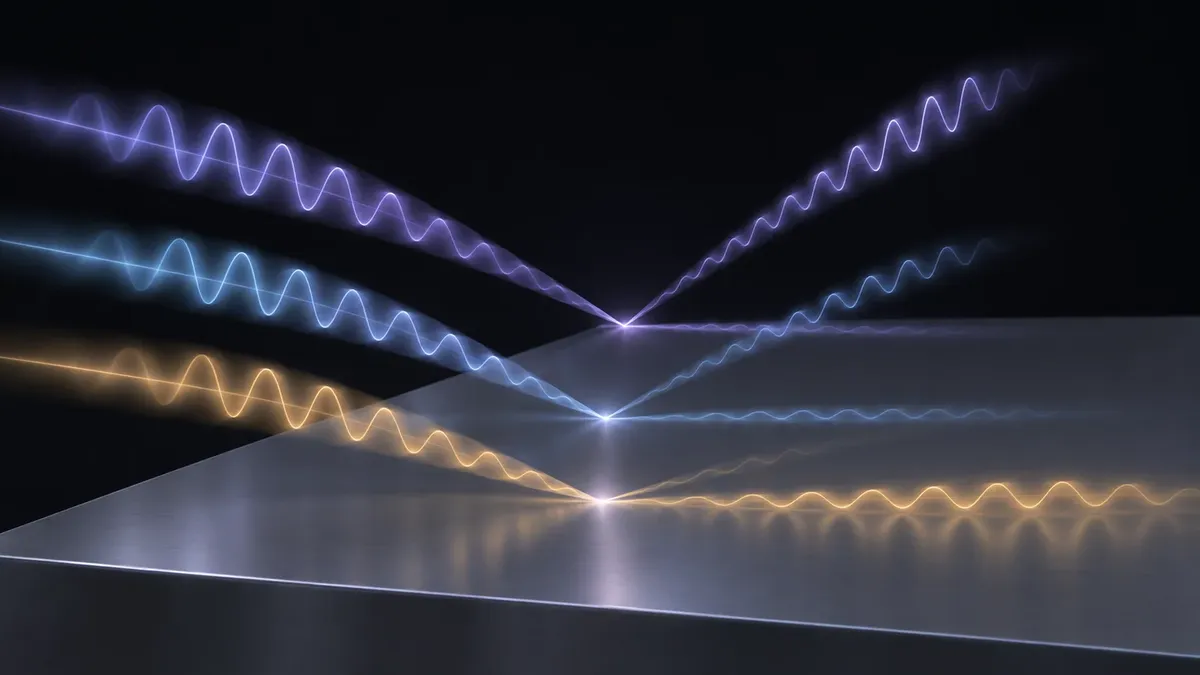
An atom can bounce away from an attractive surface because of quantum mechanics. Romain Guérout and Serge Reynaud calculate how this quantum reflection should vary among hydrogen’s isotopes approaching silicon, and identify a scaling rule that could be tested in experiments.
Quantum reflection sounds paradoxical: how can an atom turn back from a surface that attracts it? When the attraction changes rapidly over the distance scale associated with the atom’s wave-like motion, the wave can reflect instead of simply following the force toward the surface. The probability of reflection depends on both the attractive potential and the atom’s mass.
In this theoretical study, Romain Guérout and Serge Reynaud examine hydrogen (H), deuterium (D) and tritium (T) approaching a plane surface of intrinsic silicon. Their calculated polarizability functions—and, consequently, their atom–surface potentials—are nearly identical, though the authors account for small isotope-dependent differences. The isotope masses differ much more substantially, letting the researchers investigate how mass affects reflection when the potential is very similar.
Calculating reflection
The authors calculate the Casimir–Polder attraction using frequency-dependent atomic polarizabilities and a model of silicon’s dielectric response. They then solve the one-dimensional Schrödinger equation for each isotope in its calculated potential. The result gives reflection probability as a function of approach velocity.
The calculation uses a simplifying boundary condition: no wave emerges from the surface at very small distances. This allows the authors to set aside details of the atom’s behavior in close proximity to the material. Far from the surface, they compare incoming and reflected waves to determine the reflection probability.
They also calculate a scattering length. In this analysis, the imaginary part of that quantity determines the initial slope of reflection probability at zero velocity. The authors use it to define an isotope-specific velocity scale, B = mb/ℏ, where m is the isotope’s mass and b is the relevant imaginary part. They then compare the probabilities using velocity multiplied by B.
Similar curves after rescaling
At the same approach velocity, the calculated reflection probability is highest for hydrogen, lower for deuterium and lowest for tritium. This ordering follows the increase in isotope mass. When velocity is rescaled using the quantity derived from each isotope’s scattering length, however, the three calculated curves approximately align. The result is a scaling relation for this theoretical setup, rather than evidence that the isotopes have identical reflection probabilities at the same speed.
The authors investigate why this rescaling works by comparing their full calculations with a simpler model. In that model, the attraction follows the long-distance Casimir–Polder form—proportional to the inverse fourth power of distance—at all distances. The scattering lengths from the full calculation are close to those predicted by this model: the reported ratios differ from one by less than five percent for the three isotopes. The comparison supports the scaling explanation, but the simplified potential is not the full calculated potential.
The paper presents predictions, not new experimental measurements. The authors suggest that the isotope differences and scaling relation could be measurable, and point to ongoing measurements of hydrogen and deuterium reflection on silicon as a potential test. The paper does not report results from those experiments.
Limits of the prediction
The model treats silicon as an intrinsic bulk material and does not include all effects that may arise close to a real surface. The authors note that surface details, properties of the bulk solid, or charges above an oxide layer could affect measurements. Their boundary condition—no wave coming back out from the surface—also means the calculation does not resolve the close-proximity processes it sets aside.
The scaling laws should therefore be understood as predictions for the specified model, not as confirmed behavior for every silicon surface. The source is an arXiv preprint; the information available here does not establish its peer-review status. Experimental tests and further examination of the surface assumptions will be important in assessing how well the predictions describe real systems.
- quantum reflection
- hydrogen isotopes
- silicon
- Casimir–Polder force
- scattering length
- theoretical physics
Related reading
Automatically matched by shared topic keywords. These links do not imply that the sources agree or establish a consensus.
A Different Kind of Friction for Warm Inflation
Source published
Shared keywords: theoretical physics
When measurements may help a quantum engine
Source published
Shared keywords: theoretical physics
A hidden route to an ultralight axion
Source published
Shared keywords: theoretical physics
A theoretical route to magnetic sensing with light and motion
Source published
Shared keywords: theoretical physics
How much can entanglement fluctuate at an interface?
Source published
Shared keywords: theoretical physics