TRANSMISSION // 2611.34182v1
Testing a New CMOS Camera for Astronomy
Source published
Laboratory measurements and observations with a small telescope assess the Andor Toran-26B camera’s precision in two operating modes. The low-noise mode performed better against camera noise in this setup, though results may not generalize to other telescopes or observing conditions.
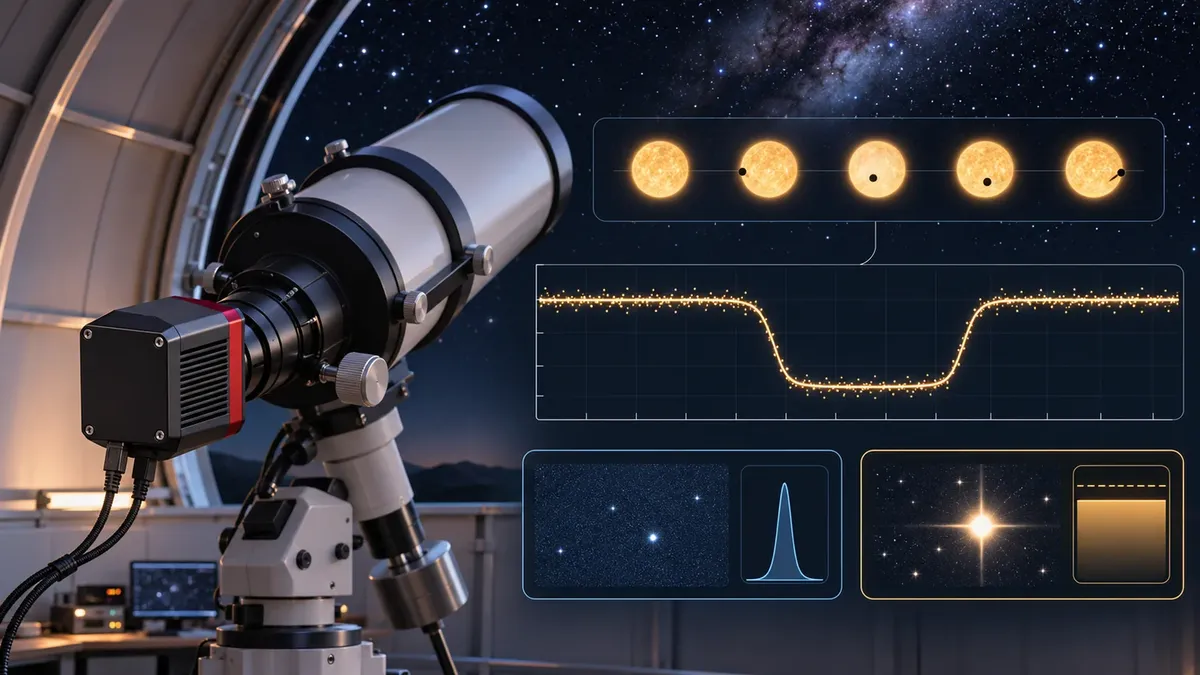
Can a modern CMOS camera measure tiny changes in starlight accurately enough for astronomy? Researchers tested the Andor Toran-26B in the laboratory and on a telescope, finding that its two modes trade low read noise against larger pixel capacity—and that the low-noise mode was less limited by camera noise in their observing setup.
Astronomers measure changes in starlight to study events such as planets passing in front of their host stars. Those changes can be small, so a camera’s own noise matters: unwanted variation in recorded pixels can obscure real changes in a star’s brightness. A new study evaluates whether the Andor Toran-26B, a scientific CMOS camera, can deliver useful precision for this kind of photometry.
The camera uses Sony’s IMX571 sensor and offers two operating modes. Low-noise (LN) mode is designed to reduce read noise—the variation introduced when the camera reads out a pixel. High-well-capacity (HWC) mode can store more charge in each pixel before saturating. That extra capacity can help with brighter signals, while low read noise can matter when measuring faint ones. The researchers tested both modes rather than assuming one would suit every observation.
From controlled light to starlight
In the laboratory, the team used a stable, approximately uniform light source to characterize the sensor. They took dark and bias images to assess read noise and dark current, and varied exposure times under illumination to measure how the recorded signal grew, how uniform the pixel responses were, and how much charge pixels could hold. Separate optical measurements were used to estimate quantum efficiency—the share of incoming photons converted into detectable signal—and the transmission of the camera’s front window.
The on-sky test used the 50-centimetre TWIST telescope at the Roque de los Muchachos Observatory on La Palma. Observations between August and September 2025 included five known transiting-planet systems. The team also studied stars in the field around KELT-16, comparing measured brightness scatter with a noise model that included starlight’s counting noise, sky background, atmospheric scintillation, read noise and dark current. Their measurements used 10-second exposures without filters. This is a specific camera–telescope arrangement, not a survey of every possible instrument or observing strategy.
Two modes, different strengths
The median read noise was 1.07 electrons per pixel in LN mode and 2.79 in HWC mode. Conversely, HWC mode held more charge before saturation: the measured full-well capacities were 50,000 electrons, compared with 15,700 in LN mode. In the range from 5% to 95% of saturation, the authors measured linearity of 99.93% for LN and 99.82% for HWC. At 0°C, measured dark current was about 0.001 electron per pixel per second in either mode when the camera’s low-dark-current setting was used.
The on-sky noise analysis showed why laboratory specifications do not alone decide which mode is best. For this telescope and 10-second exposures, the authors found that HWC mode could be limited by camera noise in particular brightness ranges, whereas LN mode was not camera-noise limited in the tested bright- or dark-sky cases. Sky background, photon-counting noise or atmospheric effects can dominate instead. The paper therefore identifies LN as the preferred mode for this test configuration; it does not establish that LN is best for every target, telescope or exposure time.
The camera also recorded transits of five known exoplanet systems. Most fitted parameters were consistent with published values within three combined standard deviations. One transit-shape parameter differed by about four standard deviations. The authors caution that it came from a single transit and can be sensitive to the amount of out-of-transit data, detrending, correlated noise and model assumptions. They treat the exercise as a consistency check, not a new measurement of those planets’ properties.
What remains uncertain
The study offers a detailed performance assessment, but its on-sky comparisons have limits. The LN and HWC observations used for the direct noise comparison were taken about a month apart, so changing sky conditions could affect the result. The tests also used one telescope configuration, a particular exposure time and a limited set of observing nights. Correlated noise appeared in some bright-star measurements, and the authors note that the bright-star samples were small. Their results should not be read as a universal ranking of camera modes.
This article is based on the paper text provided for arXiv preprint 2611.34182v1. The source identifies itself as a preprint and includes publication-status placeholders, so the work’s final peer-review status cannot be confirmed from that text. The paper reports a collaboration involving the camera’s manufacturer; it says the authors carried out the analysis and interpretation independently. Those details are relevant context, not evidence for or against the measurements. Overall, the tests show that this camera can produce precise stellar light curves under the conditions examined, while emphasizing that the useful operating mode depends on the observing setup.
- scientific CMOS
- astronomical cameras
- photometry
- exoplanet transits
- detector noise
- Andor Toran-26B
Related reading
Automatically matched by shared topic keywords. These links do not imply that the sources agree or establish a consensus.