TRANSMISSION // 2611.34172v1
Could M87’s black hole reveal light dark matter?
Source published
A model of M87’s hot accretion flow uses its radio-to-millimeter spectrum to test whether dark matter scattering cools the plasma’s electrons.
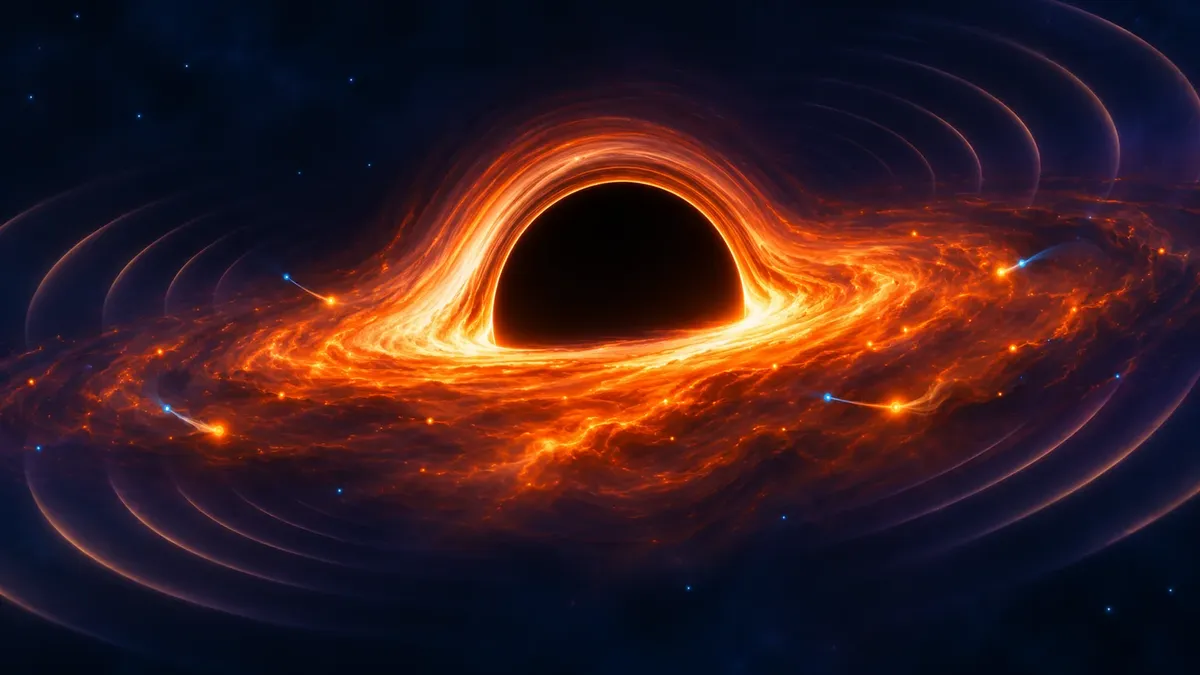
Dark matter may be too light to leave detectable signals in some laboratory searches. A new preprint explores a different possibility: look for its indirect effect on the hot gas around M87’s supermassive black hole. The result is a set of model-dependent constraints, not a detection.
A black hole as a dark-matter detector
Dark matter’s gravitational influence is well established, but its particle properties remain unknown. For very light dark matter, particles may transfer too little energy to atoms in conventional detectors to produce a measurable signal. Ran Ding, Ningqiang Song and Cong Zhang propose using a cosmic environment instead: the hot gas swirling around the supermassive black hole M87*.
The idea is to treat this accretion flow as a kind of bolometer—a system whose energy balance can reveal an otherwise hard-to-see interaction. If dark matter particles are colder, in kinetic terms, than the flow’s electrons, collisions could draw energy from those electrons. Cooler electrons would emit a different amount of radiation, especially at millimeter wavelengths. By comparing a model of that radiation with observations, researchers can estimate how strong dark matter–electron scattering could be without spoiling the fit.
Modeling the flow and its light
The authors focus on M87*, whose hot, relatively faint accretion flow is modeled as an advection-dominated accretion flow, or ADAF. In this type of flow, electrons and ions need not share the same temperature, and much of the energy is carried inward rather than promptly radiated away. The team adds dark-matter-induced electron cooling to the flow’s energy equations and calculates how the electron temperature and emitted spectrum would change.
For the baseline model, they use a semi-analytic, stationary accretion-flow code with an established prescription for viscosity and a pseudo-Newtonian gravitational potential. It includes synchrotron radiation, bremsstrahlung and inverse-Compton emission, as well as a jet contribution. The researchers fit the model to the radio-to-millimeter spectrum measured around the 2017 Event Horizon Telescope campaign, varying parameters such as the outer accretion rate, electron heating and jet normalization. They then add dark matter scattering and compare the altered spectra with the observations using a statistical likelihood analysis.
The calculation also needs an assumed dark matter distribution near the black hole. The authors adopt a “spike” profile motivated by models in which a growing black hole concentrates dark matter around itself. They examine scattering through both heavy and light mediators, using a dark-photon interaction as a benchmark for some results.
What the analysis finds
In the model, dark matter scattering cools electrons most strongly in the inner flow, reducing the accretion flow’s contribution to the millimeter emission. The team finds that sufficiently strong cooling would suppress the modeled spectrum beyond what fits the data. They therefore derive 90% confidence-level upper limits on the reference dark matter–electron scattering cross section across the keV-to-MeV mass range.
The limits become more restrictive toward lower dark matter masses in the analysis. For a heavy mediator, the authors report that their constraints surpass those from the direct-detection experiments considered in the paper below roughly 2 MeV. They also find strong constraints in the sub-MeV range for both mediator cases. These are exclusions within the model and data analysis—not evidence that dark matter has been observed. The paper further reports limits on dark-photon kinetic mixing; for its chosen benchmark parameters, the authors say the cooling limits are stronger than the cited NA64 limits below a mediator mass of about 5 MeV.
What remains uncertain
These conclusions depend on how well the accretion-flow model represents M87*. The calculation assumes a stationary, semi-analytic flow, adopts fixed values for some model parameters, and treats the jet contribution as fixed during the dark matter analysis. The authors note that including cooling in the jet could further suppress its emission, but they do not include that effect. The inferred signal also depends on the assumed dark matter density and velocity distribution near the black hole, as well as on the scattering model.
The authors suggest applying the method to other black holes, including Sgr A*, and incorporating dark matter energy exchange into more detailed simulations. Those steps could test how robust the constraints are to differences in the accretion environment and modeling choices. For now, the work presents a promising observational strategy rather than a direct measurement of dark matter interactions.
The study is an arXiv preprint, so its claims should be treated as provisional; the supplied source does not establish that it has undergone peer review.
- dark matter
- M87*
- black hole accretion
- dark matter-electron scattering
- Event Horizon Telescope
- accretion flow
Related reading
Automatically matched by shared topic keywords. These links do not imply that the sources agree or establish a consensus.
Magnetic disturbances could reshape polarized light around black holes
Source published
Shared keywords: event horizon telescope
Could Sgr A*’s radio signal distinguish a black hole from a look-alike?
Source published
Shared keywords: event horizon telescope
A kinetic bridge for modeling plasma near black holes
Source published
Shared keywords: black hole accretion
What polarized light reveals about Little Red Dots
Source published
Shared keywords: black hole accretion
What polarized light may reveal about a MOG black hole
Source published
Shared keywords: accretion flow