TRANSMISSION // 2611.34170v1
A proposed model tests quantum boundaries
Source published
A theoretical pseudo-quantum model exceeds a paper-derived quantum benchmark in a communication game, but its two examples violate information causality.
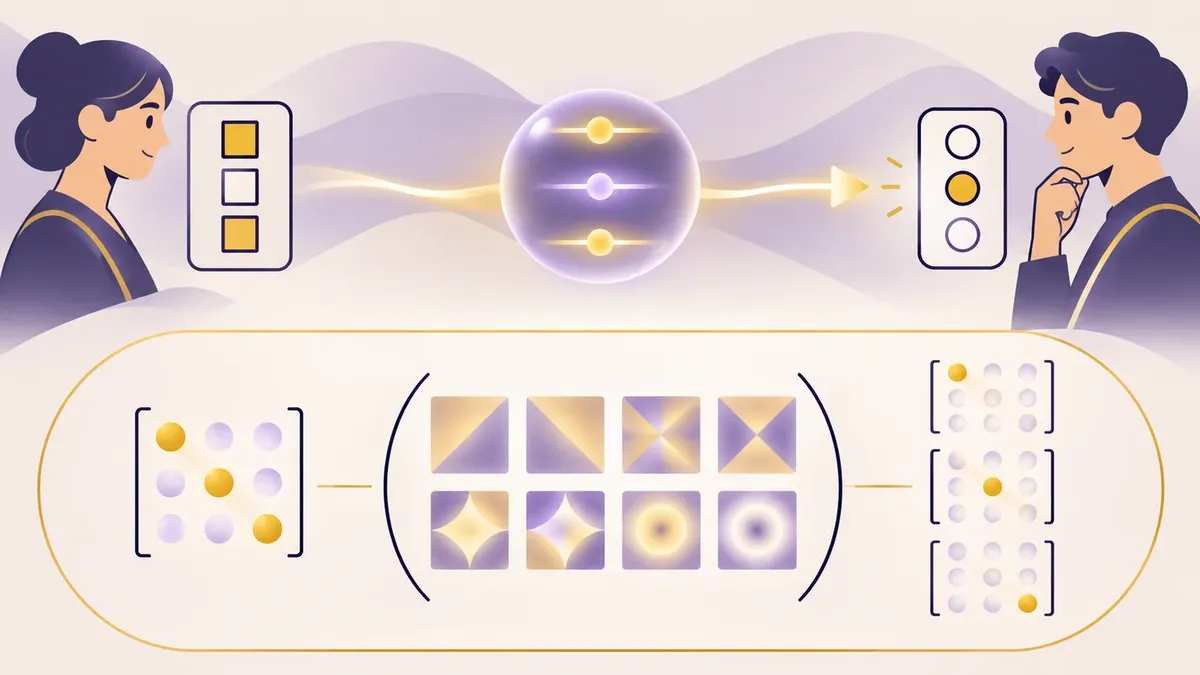
Can a mathematical model produce correlations beyond quantum theory using just one system, without combining it with another? This study explores the question by allowing states or measurement effects with negative eigenvalues while requiring valid probabilities. In two specific constructions, the model exceeds the paper’s derived quantum benchmark for a communication game. The authors also report that both constructions violate information causality, and so regard their correlations as unphysical.
Quantum theory requires the mathematical operators used to describe states and measurements to have no negative eigenvalues. What happens if that condition is relaxed, while probabilities for the situations considered remain valid? Vishnu Purushothaman and colleagues investigate this question in a proposed framework called the pseudo-quantum model (PQM).
The study considers a single three-level system, or qutrit. Unlike proposals in which beyond-quantum correlations arise from combining systems, this model asks whether negative-eigenvalue states or measurement effects can produce such correlations without any composition of systems. The results concern the model’s mathematical constructions; they do not show that ordinary quantum systems behave this way in experiments.
A game for comparing theories
The researchers analyze a three-bit random access code, a prepare-and-measure game. Alice receives a string of three bits and sends Bob one qutrit. Bob receives a randomly chosen index and tries to guess the corresponding bit. The average probability of guessing correctly lets the authors compare the capabilities of classical, quantum and pseudo-quantum strategies.
They examine two PQM constructions. In one, Alice prepares ordinary quantum states and Bob uses pseudo-effects: measurement operators whose eigenvalues need not all be positive. In the other, Bob uses ordinary quantum measurements while Alice can prepare pseudo-states. The paper specifies examples for each construction and calculates their success probabilities.
For the quantum comparison, the authors derive an upper bound of 0.859 for this game. They report success probabilities of 0.912 and 0.916 for their two PQM constructions. Both exceed the bound derived in the paper, which is the basis for their claim that these examples produce beyond-quantum correlations in the game. The figures describe the particular strategies presented, not a demonstrated maximum for every possible version of the model.
The authors then check the constructions against information causality (IC). In the formulation discussed in the paper, IC places a bound on a sum of mutual-information terms in a communication scenario where parties share a resource. The paper reports that both PQM constructions violate this bound and therefore characterizes their resulting correlations as unphysical. This conclusion applies to the examples analyzed; the study does not establish that every model allowing negative-eigenvalue operators must violate IC.
Perfect discrimination in the model
The paper gives a second example involving two non-orthogonal qutrit states. In standard quantum theory, the pair described in the paper cannot be perfectly distinguished. The authors show that a pseudo-effect measurement in their model can distinguish them perfectly. The source reports an overlap value of one half but does not make its convention clear in the extracted text, so that figure should not be interpreted more specifically here. As with the communication game, the result depends on allowing the modified measurement operators.
Scope and uncertainty
The central point is conditional: under the PQM rules and the particular preparations and measurements chosen, the reported game scores exceed the paper’s derived quantum upper bound, and a pair of states can be perfectly distinguished. The work is a theoretical exploration of what follows from relaxing positivity, not an experimental discovery about standard quantum mechanics.
The authors note that other choices of states and effects might yield a higher game score, so their constructions need not be optimal. Their broader argument—that negativity can enable beyond-quantum correlations without system composition—is about this proposed framework. The paper also notes that beyond-quantum correlations may be realized in other theoretical ways.
The source is an arXiv preprint, version 1. The supplied record does not establish its peer-review or publication status. Its results are best read as a proposed model and the authors’ reported calculations, rather than as a settled or experimentally confirmed finding.
- quantum foundations
- pseudo-quantum model
- random access code
- information causality
- state discrimination
- qutrit
Reviewed cross-references
These connections were reviewed by a model, not independently fact-checked by a human. Similarity does not imply agreement; consult the original papers and the evidence below.
A random-access test for quantum “magic”
Shared method: Both papers use prepare-and-measure random access codes to study how a sender’s encoding and a receiver’s decoding affect bit-retrieval performance. The comparison is methodological: the PQM paper studies average success for a 3-bit qutrit code with pseudo-states or pseudo-effects, while Zamora studies worst-case performance and magic certification with multi-qubit states and Pauli measurements; their findings are not directly comparable.
Model review: · openai-codex/gpt-6-luna
Evidence and provenance
Selected excerpts, not complete papers. PDF extraction can omit figures or damage equations, tables and reading order; sources may be preprints.
2611.34170v1 — Original paper
Excerpt reference:
static/papers/2611.34170v1.md:61-116
Basis: Paper text
Source SHA-256:29c9f8dca9a45c757a8aa68a1e82e273cedc32af32b471f027efb1cb8bfc70a72611.26705v1 — Original paper
Excerpt reference:
static/papers/2611.26705v1.md:191-323
Basis: Paper text
Source SHA-256:53a37df68cd4d63d1f094bdd18b529ae2078d17d93d75177c7c97455f07eae06
Related reading
Automatically matched by shared topic keywords. These links do not imply that the sources agree or establish a consensus.
How much can one quantum query tell us?
Source published
Shared keywords: state discrimination
Two Principles, One Quantum Framework
Source published
Shared keywords: quantum foundations
Could quantum behavior emerge from nonlinear waves?
Source published
Shared keywords: quantum foundations
When quantum-state compression hides dynamics
Source published
Shared keywords: quantum foundations
Can one principle explain why quantum theory works?
Source published
Shared keywords: quantum foundations