TRANSMISSION // 2611.34168v1
When Coefficient Adjustments Help an Ising Machine
Source published
An abstract-level report on tests of three coefficient-range techniques for an 8-bit coherent Ising machine finds that benefits vary by problem and mitigation strength.
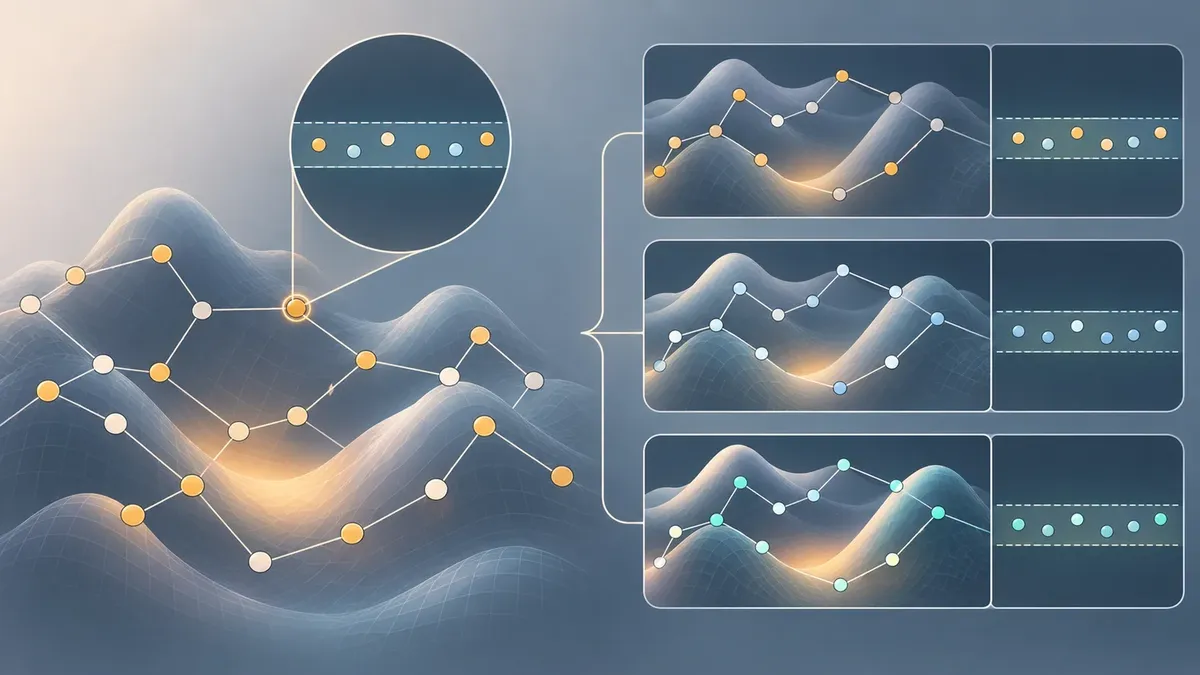
An 8-bit coherent Ising machine has a restricted coefficient range, which can distort an optimization problem’s encoded energy landscape. A preprint tests three mitigation techniques and reports selective, problem-dependent benefits—not a universal improvement.
The question: can mitigation improve optimization?
Optimization problems can be encoded as energy landscapes, but the coefficients used in that encoding may not fit an 8-bit coherent Ising machine’s restricted range. The resulting distortion can affect the landscape the machine is asked to optimize. The authors ask whether techniques previously studied for quantum annealing can improve end-to-end outcomes on a coherent Ising machine (CIM).
The preprint examines interaction extension, bounded-coefficient encoding, and augmented Lagrangian penalties. Its abstract names these methods but does not describe their implementations in enough detail to explain precisely how each changes an encoding. The tests cover weighted Max-Cut, multidimensional knapsack, and quadratic assignment.
What the reported experiments found
The results vary by technique and problem. For weighted Max-Cut, intermediate interaction extension produced higher mean best objectives at a fixed number of CIM calls. More aggressive extension degraded performance. Thus, the reported benefit was not simply “more adjustment is better.”
For multidimensional knapsack, bounded-coefficient encoding improved the mean best feasible profit on one tested instance, but not on the other. This is a mixed result across those instances, not evidence of a general improvement for knapsack problems.
The augmented Lagrangian perturbations increased feasibility when the unshifted constraint penalties were too weak. But they did not outperform the best unshifted penalty setting. The reported advantage is therefore conditional: perturbations helped relative to weak penalties, not relative to the strongest unshifted setting.
Overall, the abstract’s conclusion is that coefficient-range mitigation works selectively. Its strength needs to be tuned to the problem and encoding, and aggressive mitigation can offset potential gains.
Limits and source context
This account is based on the abstract, rather than the full paper, tables, or supplementary material. It does not provide sample sizes, uncertainty estimates, detailed experimental procedures, or enough information to assess how representative the tested instances are. The reported comparisons therefore do not establish the size or statistical reliability of the effects, or whether they extend to other instances, problems, or hardware.
The source is an arXiv preprint; the supplied information does not establish peer review. These results should be read as findings reported by the authors, not as a general guarantee that coefficient-range mitigation improves CIM optimization. The paper’s central message is more qualified: some approaches helped in some tested conditions, while the outcome depended on the method’s strength and the problem being encoded.
- coherent Ising machine
- optimization
- coefficient range
- weighted Max-Cut
- multidimensional knapsack
- augmented Lagrangian
- preprint
Related reading
Automatically matched by shared topic keywords. These links do not imply that the sources agree or establish a consensus.