TRANSMISSION // 2611.34158v1
How AI assigns teammates to contested objectives
Source published
A hybrid AI system combines learned tactical predictions with a flow solver to assign game bots to objectives. In one game mode, its full configuration beat a closest-base baseline in a separate test, but broader claims remain untested.
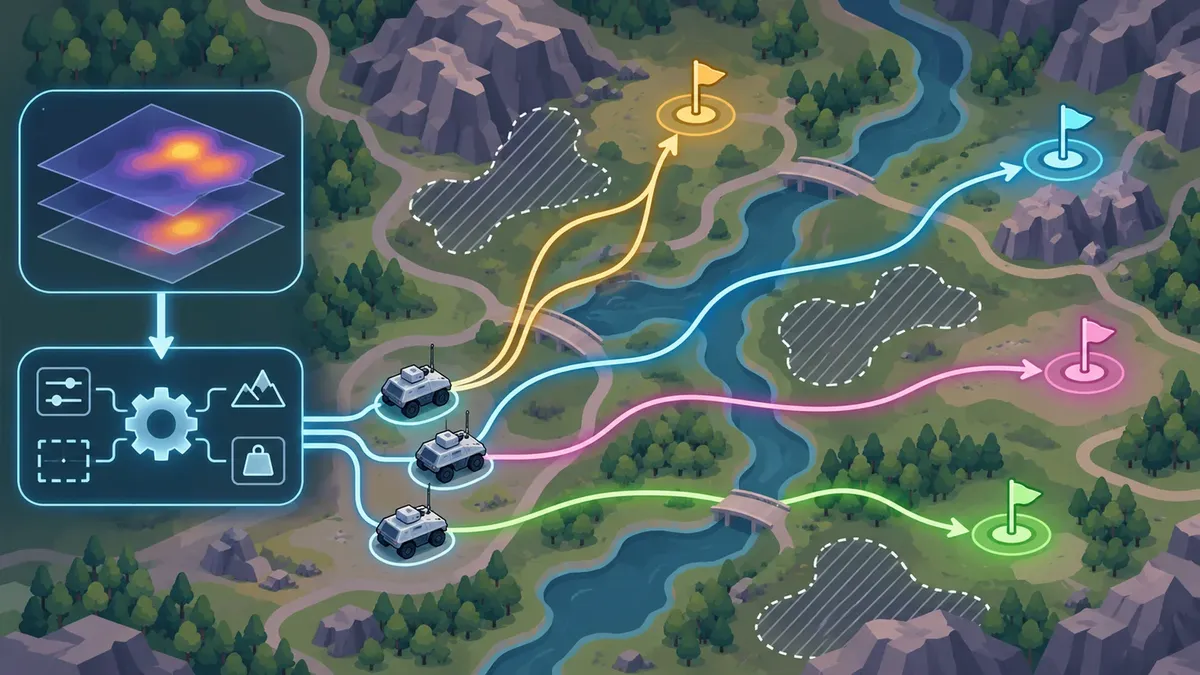
When teammates must cover several contested objectives, sending each bot to the nearest target may not produce a coordinated plan. Researchers tested a system that combines predictions about local combat conditions with a constrained assignment solver in a commercial vehicle-combat game.
The challenge: choosing who goes where
In objective-based team games, assigning a bot to a base is not just a question of distance. A base may be under pressure, already covered by human teammates, or difficult for a particular vehicle to reach. Sending several bots to one location can also leave other objectives exposed. The researchers ask whether learned estimates of tactical conditions, combined with explicit rules, can produce useful, stable assignments quickly.
The study focuses on Conquest mode in World of Tanks: HEAT. Two teams of 10 vehicles compete over three to five active bases. Every three seconds, the system recommends a target base for each controllable bot. It observes other allied vehicles, including human-controlled ones, but does not assign them. The system handles high-level task allocation, not the lower-level work of navigating or fighting.
Predictions meet a constrained solver
The approach separates estimating tactical value from choosing a team-wide assignment. A neural model uses vehicle, objective and battle information to predict signals such as survival, local force advantage, travel time and contribution. It has separate predictions for dealing damage and receiving damage. The model is trained on roughly 22,500 logged battles, with labels inferred from observed player actions and outcomes rather than direct records of strategic intent.
Those estimates are combined with hand-designed terms, including distance penalties and a penalty for switching a bot’s previous target. A minimum-cost flow solver assigns bots to objective slots while accounting for capacity and human occupancy. Put simply, the model scores possible choices, and the solver selects an assignment that fits the specified constraints. Designers can inspect score components, although the paper does not quantitatively evaluate how interpretable those explanations are.
The researchers assess prediction quality, assignment behavior on historical replays, battle outcomes in online A/B tests, and runtime. These checks answer different questions. Replay diagnostics show how recommendations relate to the single trajectory that actually happened; they cannot reveal what would have happened under a different assignment. The online tests compare outcomes with a closest-base baseline.
What the tests found
The paper reports that several model outputs—including estimates related to survival, damage dealt or received, and local superiority—distinguished relevant outcomes better than chance. The prediction of which team would ultimately win was weaker, consistent with that being a longer-term result. These prediction results do not prove that any single estimate independently improves strategy.
On replay-based diagnostics, the full system had a higher Reach@60 rate—the share of observed vehicle trajectories that entered the assigned base’s radius within 60 seconds—than the two simpler variants. It also switched targets less often. But it covered fewer critical bases and had lower capture-conversion and defensive-retention scores. The authors caution that these replay measures depend on which objectives a policy selects: a policy pursuing urgent, contested bases may score worse on measures that favor easier objectives. Replay data cannot establish which policy would have produced better outcomes in those same situations.
In separate online comparisons with the closest-base baseline, each of the three tested variants had a higher reported win rate than its corresponding control group. The full system’s reported win rate was 68.5% across 410 battles; the other variants were tested in separate sets of 400 battles each. These results do not establish that the full system is statistically better than the other variants, or isolate the effect of the flow solver. Each variant was compared with its own baseline, rather than directly tested against the others.
The full pipeline’s reported 99th-percentile processing time was about 28 milliseconds on the tested CPU, well within the three-second recommendation interval. That measurement excludes network and game-server communication, so it is not a complete measure of end-to-end production latency.
What remains uncertain
The training labels are imperfect proxies for intent: a vehicle moving toward a base does not necessarily reveal why its player chose that route. Training uses battles without bots, while recommendations are made for bots in mixed human–bot matches. Human behavior is represented mainly through estimated occupancy; the bots do not model complex human tactics or communicate with allied players. The score weights were chosen and adjusted by the team, rather than learned end-to-end or independently validated.
The evidence is limited to one game mode in one commercial game, with a specific baseline and evaluation setup. The paper describes the system as an R&D research prototype, not a feature deployed in the released game. It is listed on arXiv; the supplied material does not establish whether it has undergone peer review. The results offer evidence about this design in the tested setting, not proof that it will generalize to other games, modes, maps or teams.
- game AI
- multi-agent systems
- task allocation
- minimum-cost flow
- objective-based games
- artificial intelligence
Related reading
Automatically matched by shared topic keywords. These links do not imply that the sources agree or establish a consensus.
When AI Takes the Task, Does Enjoyment Count?
Source published
Shared keywords: task allocation
AI game characters can think locally—and still forget to show up
Source published
Shared keywords: game ai
When should a digital twin be trusted—and what should it change?
Source published
Shared keywords: artificial intelligence, multi agent systems
How MAWAM imagines teamwork for robots
Source published
Shared keywords: artificial intelligence, multi agent systems
How MAWAM helps robot teams act together
Source published
Shared keywords: artificial intelligence, multi agent systems