TRANSMISSION // 2611.34142v1
Turning Kernel Bug Reports Into Reproductions
Source published
ReproCue aims to turn suspected Linux kernel bugs into runnable proof-of-concept programs, giving maintainers evidence to assess AI-generated reviews.
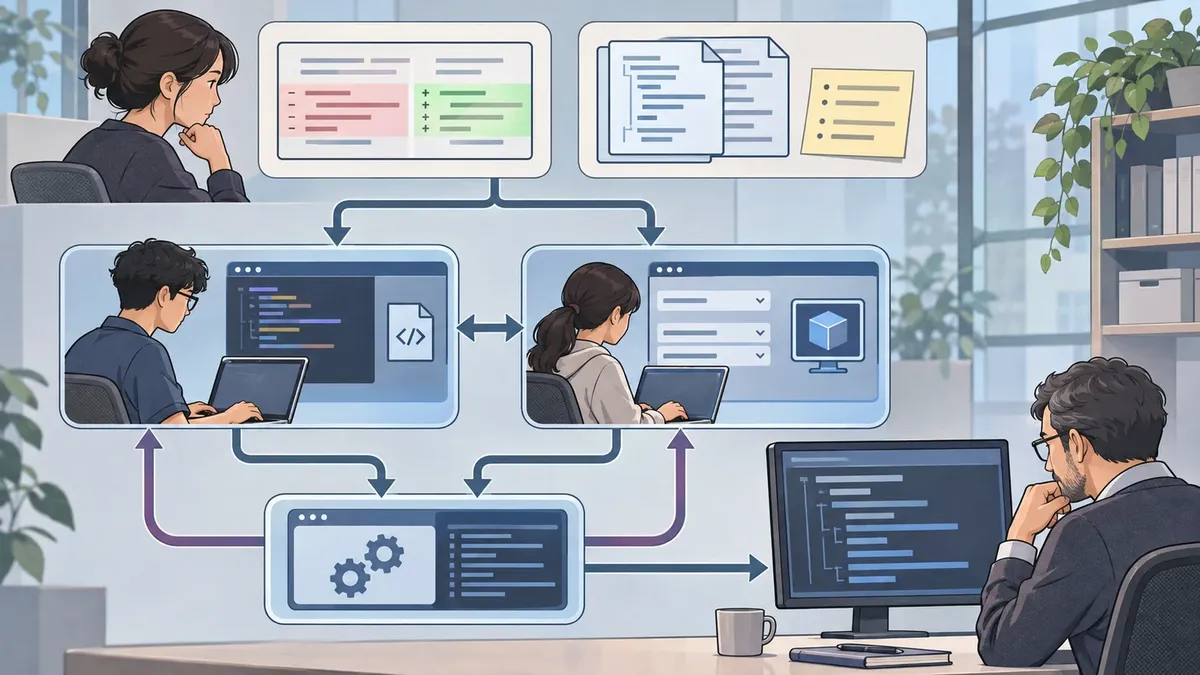
An AI review can describe a plausible kernel bug without showing how to trigger it. ReproCue tries to bridge that gap by learning reproduction steps from past bugs, then adapting both a proof-of-concept program and its virtual test environment for new reports.
A detailed bug explanation is not the same as evidence that a bug can happen. When an agent flags a possible flaw in a Linux kernel patch, maintainers may still need to work out the inputs, system state and configuration that would make it fail. That investigation takes effort, especially when a report arrives without a runnable example.
A preprint by Xiao Wu and colleagues introduces ReproCue, a system designed to generate such examples, known as proof-of-concept programs, or PoCs. Its central idea is to treat reproduction as a joint problem: the system must construct a trigger and set up an environment in which that trigger can work.
Learning from earlier reproductions
ReproCue first replays previously reported kernel bugs. From successful reproductions, it builds a finite-state machine for each kernel subsystem. In plain terms, this is a map of the steps involved—such as examining code, configuring and building a kernel, writing a PoC and running it—plus guidance drawn from failures encountered along the way.
For a new review, ReproCue selects the relevant subsystem’s map and uses two AI agents with separate roles. One works on the PoC; the other configures the kernel and virtual machine. Execution results guide revisions. A rejected BPF program, for instance, may need changes to its code, while a missing kernel option may require rebuilding the environment. The authors designed this separation to structure a process that could otherwise become repeated, unfocused retries.
The authors tested ReproCue on 100 recent review-and-patch pairs flagged by Sashiko, an agentic Linux kernel review system. They counted a result as a match only when the generated program triggered a kernel fault whose call trace corresponded to the defect described in the review. They also manually rechecked matched crash logs. Comparisons included an agentic reproducer and directed greybox fuzzing, which searches toward a target code location.
What the evaluation found
For the 100 reviews, ReproCue produced matching PoCs for 49. The comparison systems produced matches for 10 and 9, respectively. ReproCue triggered 52 crashes, of which 49 matched the reported defect; a crash alone did not count as success.
The researchers then submitted those 49 matched PoCs to kernel mailing-list threads. Maintainers replied to 35 submissions and explicitly confirmed 34 bugs. The paper also reports a 69.4% confirmation rate for ReproCue-backed correspondence, alongside 9.3% for Sashiko correspondence. These rates come from separate correspondence samples: to estimate rates for Sashiko and Syzbot, the authors sampled emails across subsystems and repeated the sampling. They describe the comparison as a partial demonstration that executable evidence can make reviews easier to assess—not as a controlled, like-for-like test of the effect of adding a PoC.
A separate evaluation used 50 Syzbot reports and 50 historical kernel vulnerabilities with known triggering scenarios. With one of the tested language models, ReproCue generated matching PoCs for 34 Syzbot cases and 30 CVE cases. In ablation tests on the review set, matches fell from 49 to 14 when the learned state machines were removed, and to 11 when environment-adaptation tools were removed. This suggests that both learned reproduction guidance and environment setup contributed to performance in these experiments.
Evidence, with limits
A matching crash trace is useful evidence, but it is not a complete proof that every part of a report is correct. The authors note that a similar crash could be mistaken for the reported defect, or a valid reproduction could be missed if it takes another path. Failure to produce a PoC does not show that a review is wrong. The maintainer study is observational, too: only reviews for which ReproCue produced PoCs were submitted in that part of the evaluation.
The study covers one review system, two language-model backbones and a particular experimental setup. It focuses mainly on bugs that cause observable kernel crashes; silent logic errors, data corruption and performance problems may need different checks. Hardware-dependent faults can be difficult to reproduce in QEMU, and learned subsystem maps may miss rare strategies. The authors also say that matching crashes still require manual checking.
This work is an arXiv preprint, so its results should be treated as preliminary, not as independently established findings. The study shows that ReproCue generated useful executable evidence in the cases tested; it does not establish that automated PoCs can replace maintainer judgment. Its narrower contribution is to show how a runnable reproduction may help maintainers evaluate some AI-flagged kernel bugs.
- Linux kernel
- AI code review
- bug reproduction
- proof of concept
- ReproCue
- software testing
Reviewed cross-references
These connections were reviewed by a model, not independently fact-checked by a human. Similarity does not imply agreement; consult the original papers and the evidence below.
AI Agents Search Windows Kernel Binaries for Flaws
Shared method: Both make executable crash-inducing PoCs central to checking bug reports: ReproCue generates PoCs for suspected Linux kernel patch bugs, while DeepBinary requires agents to report vulnerabilities with crashing PoCs and replays reports on fresh VMs. The shared element is execution-based reproduction; the systems address different tasks and kernel environments.
Model review: · openai-codex/gpt-6-luna
Evidence and provenance
Selected excerpts, not complete papers. PDF extraction can omit figures or damage equations, tables and reading order; sources may be preprints.
2611.34142v1 — Original paper
Excerpt reference:
static/papers/2611.34142v1.md:13-110
Basis: Paper text
Source SHA-256:46a6ac1ba5c94ae6215c7263ff7da283e2db4a2b919158feeb147fff8aeabbb62611.33486v1 — Original paper
Excerpt reference:
static/papers/2611.33486v1.md:65-175
Basis: Paper text
Source SHA-256:035c4a9c75185e6a1c328cba8bb75c1f6e4f91b1bcc941625ce2812d6cd4e7ed
Related reading
Automatically matched by shared topic keywords. These links do not imply that the sources agree or establish a consensus.
How Much Effort Helps an AI Code Reviewer?
Source published
Shared keywords: ai code review, software testing
Can developers’ actions benchmark AI code reviews?
Source published
Shared keywords: ai code review
AutoRefine adjusts AI code reviewers using software workflow outcomes
Source published
Shared keywords: ai code review
What Coding Agents Can—and Can’t—Do With Tests
Source published
Shared keywords: software testing
DynaFix gives AI code repairs a closer look at execution
Source published
Shared keywords: software testing