TRANSMISSION // 2611.34130v1
WorldPhy Tests Robot World Models’ Physics
Source published
WorldPhy evaluates 13 image-and-instruction-conditioned world models, finding their lowest scores in contact causality and support and motion dynamics.
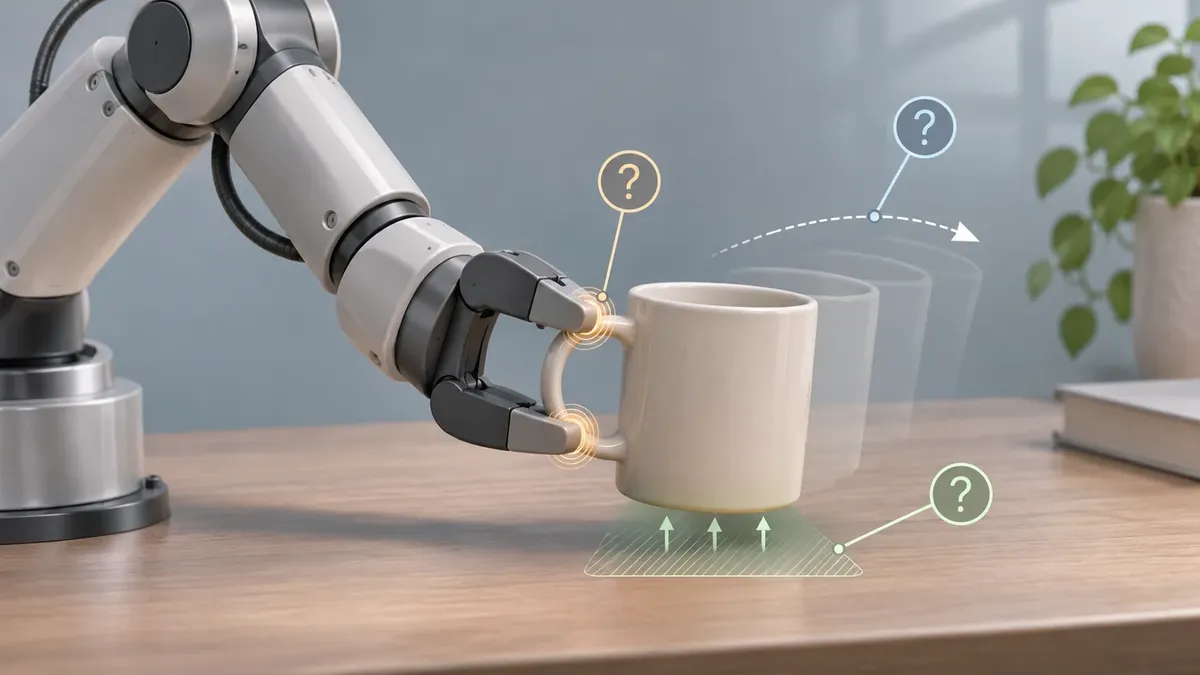
A generated robot video might follow its instructions yet show an object moving without contact or behaving implausibly after release. WorldPhy tests those physical details—and evaluates how well a dedicated scoring model can detect them.
World models generate video from inputs such as an initial image and a task instruction. In robotics, a convincing-looking clip may still show a robot or object behaving implausibly: a gripper might seem to move an object without touching it, for instance. A benchmark that checks only whether the video looks coherent could miss such details.
In WorldPhy: Benchmarking Fine-Grained Physical Plausibility of World Models in Robotics, Ziyuan Chu and colleagues introduce a robotics-focused benchmark and use it to assess 13 world models. They also train a dedicated evaluator, WorldPhyReward, to score generated videos against detailed criteria.
What the benchmark checks
WorldPhy contains 300 tasks, each pairing an initial image with an instruction. The tasks vary in viewpoints, robot configurations, end effectors—including hands and grippers—task categories and scenes. The researchers collected robotics videos from public repositories, selected image–instruction pairs, and manually checked the resulting task descriptions and labels.
The benchmark scores seven dimensions. Six concern physical plausibility: consistency of objects and robot parts; plausible geometry and materials; valid connections and joint movement; avoidance of objects passing through one another; whether contact plausibly causes object movement; and whether support, motion and collisions behave plausibly. The seventh dimension checks whether the video follows the instruction.
These checks can distinguish task completion from plausible execution. A video might depict an object reaching its intended destination but show it moving without a visible contact path. Or it might leave an object hovering after support disappears. Such cases can fail physical criteria even if other parts of the video look convincing.
Building and testing WorldPhyReward
The researchers generated about 2,000 videos from the benchmark tasks. Four annotators with robotics experience scored the videos across the seven dimensions. The resulting dataset contains more than 12,000 human ratings, paired with explanations: GPT-6 Astra drafted rationales for violations, and annotators reviewed them, reassessing unclear cases and adding details where needed. The team used the ratings and reviewed explanations to fine-tune WorldPhyReward, which takes the initial image, instruction and generated video as input and returns scores and reasons.
On a held-out set of 1,400 ratings, WorldPhyReward achieved the highest macro F1, micro F1 and overall accuracy among the compared general-purpose vision-language models. It also had the highest reported Pearson and Spearman correlations with human physical-plausibility scores among the compared reward models. These are different evaluation measures and comparison groups, rather than one all-purpose measure of accuracy. The paper also reports that some comparison models did better on individual dimensions.
The authors additionally tested whether model scores matched human choices between video pairs. Annotators could choose either video or indicate no preference; the evaluator’s scores were used to predict the preference. It matched the reported human judgments in 39 of 50 pairs from generators represented in its training data and 38 of 50 pairs from other generators. Those results come from limited sets of pairs and should not be treated as a broad guarantee that the evaluator will match people in other settings.
What the world models scored lowest on
Across all 13 evaluated world models, contact and interaction causality and support and motion dynamics were the two lowest-scoring dimensions. In plain language, the models had more difficulty depicting a clear physical link between robot actions and object responses, and showing objects’ movement and support plausibly, than meeting several other checks.
Instruction following was generally a relative strength, but no model received a perfect score on that dimension. Following the requested task, the results suggest, does not by itself ensure physically plausible movement throughout a video. The authors also report lower scores for gripper scenarios than hand scenarios for 12 of the 13 models. Among the six highest-scoring models overall, wrist-view scenarios had the lowest scores of the three viewpoints.
These findings apply to the models, tasks and scoring process in this study. The benchmark covers 300 tasks drawn from public robotics videos; it cannot establish how often similar failures occur across all possible robot scenarios. WorldPhy assesses generated videos, not whether a model will control a physical robot successfully. The paper does not demonstrate that higher benchmark scores improve real-robot performance or make a generated video a reliable simulator.
The source is an arXiv preprint, so its claims should be read as reported research rather than settled conclusions. The authors say code is available online. WorldPhy provides a structured way to examine specific physical properties of generated robot videos, but its scores depend on the chosen tasks, annotation process and evaluator’s interpretation of visual evidence.
- WorldPhy
- robotics
- world models
- video generation
- physical plausibility
- AI benchmarks
- robot manipulation
Reviewed cross-references
These connections were reviewed by a model, not independently fact-checked by a human. Similarity does not imply agreement; consult the original papers and the evidence below.
Teaching Robots Through Verified Synthetic Touch
Shared method: Both papers use a task-specific, fine-tuned vision-language model to assess generated robot videos against multiple physical-plausibility criteria and provide judgments with explanations. WorldPhyReward is trained on over 12K human-annotated examples; VeriEval’s visual verifier is fine-tuned on about 900 annotated videos. This is a shared evaluation approach, not evidence that either verifier has equivalent accuracy or scope; VeriTouch also adds separate tactile checks.
Model review: · openai-codex/gpt-6-luna
Evidence and provenance
Selected excerpts, not complete papers. PDF extraction can omit figures or damage equations, tables and reading order; sources may be preprints.
2611.34130v1 — Original paper
Excerpt reference:
static/papers/2611.34130v1.md:13-130
Basis: Paper text
Source SHA-256:32c503f749caf1beb366c2455992225c73511116ff40b25254dd9940d0ec68e52611.34130v1 — Original paper
Excerpt reference:
static/papers/2611.34130v1.md:131-218
Basis: Paper text
Source SHA-256:32c503f749caf1beb366c2455992225c73511116ff40b25254dd9940d0ec68e52611.30572v1 — Original paper
Excerpt reference:
static/papers/2611.30572v1.md:2969-3037
Basis: Paper text
Source SHA-256:3a556e823387ef6a21c430ed29565613ad56d4ae76ec2df38d235e2f4bca5f24
Related reading
Automatically matched by shared topic keywords. These links do not imply that the sources agree or establish a consensus.
Can AI Predict How Emotions Change the World?
Source published
Shared keywords: ai benchmarks, video generation, world models
Can AI-generated worlds keep up with robots and self-driving cars?
Source published
Shared keywords: video generation, world models
WorldFlow predicts motion in both pixels and 3D
Source published
Shared keywords: video generation, world models
A robot's-eye view, generated from outside video
Source published
Shared keywords: robot manipulation, world models
Teaching robot video models to focus on what moves
Source published
Shared keywords: video generation, world models