TRANSMISSION // 2611.34127v1
Fast oxygen, narrow nitrogen in a supernova remnant
Source published
A search of NGC 253 found one oxygen-rich supernova remnant. Its narrow nitrogen lines point to nitrogen-rich material around it, though the authors say deeper observations are needed to test that interpretation.
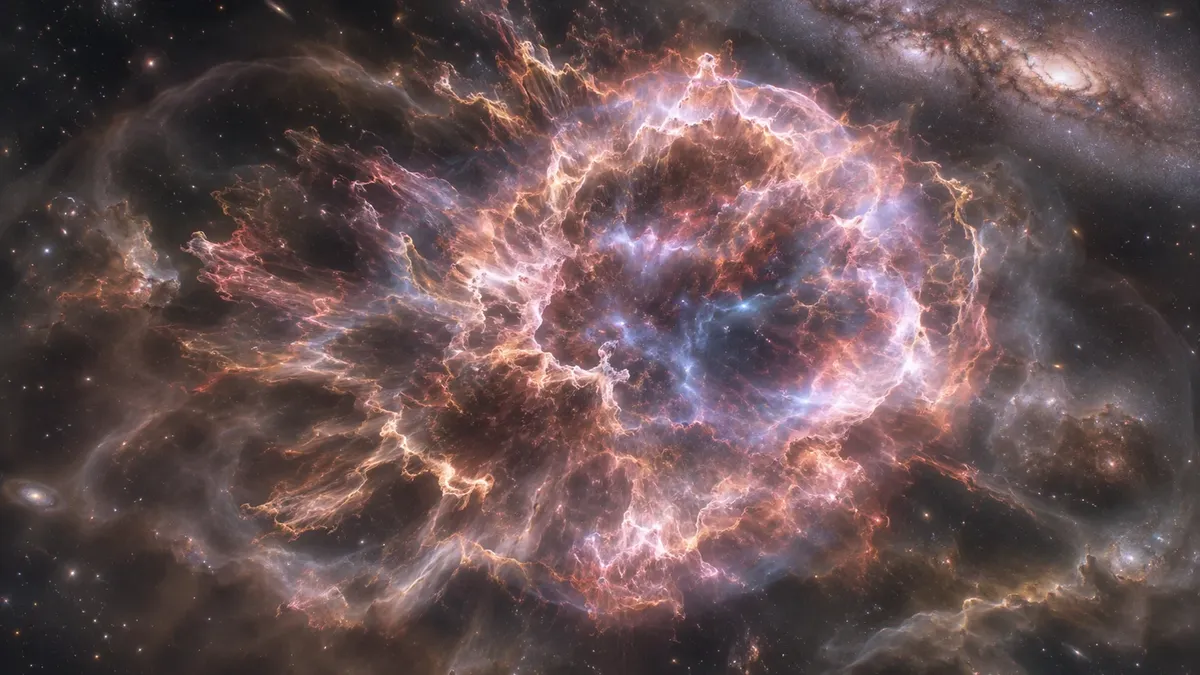
In NGC 253, astronomers have identified a supernova remnant whose oxygen emission is much broader than its nitrogen emission. The team interprets the contrast as evidence that the remnant is interacting with nitrogen-rich material shed by its progenitor star—but says further observations are needed to confirm the apparent enrichment.
Supernova remnants are the evolving remains of stellar explosions. A rare subset, rich in oxygen and still bright in visible light, can offer clues about fast-moving debris and material around a star before it exploded. A team searching the galaxy NGC 253 reports one such object, named SNR 253-A, with an unusual contrast between its oxygen and nitrogen emission lines.
The researchers analyzed observations from MUSE, an instrument on the Very Large Telescope that records spectra across a field of sky. The mosaic covers most of NGC 253’s galactic disk and totals more than 50 hours of exposure. They searched maps for unresolved sources with broad emission in three sets of oxygen lines: [O III], [O I] and [O II]. The method was designed to distinguish broad-line sources from narrower emission and other sources of contamination. The team also looked for counterparts in archived observations from other telescopes.
Only one clear oxygen-rich remnant emerged, in the [O III] search. Its [O III] emission has a complex profile, with multiple features. The authors interpret the two strongest as the same oxygen line emitted by gas at different velocities; their measured full widths at half maximum are about 1,570 and 1,760 kilometres per second. A further redshifted feature is less certain and could be noise. No broad [O I] or [O II] source was found.
The spectrum also contains [N II] emission, broadened to about 230 kilometres per second after the instrument’s contribution is removed. The researchers detected no hydrogen emission or [S II] lines. The paper notes that low signal-to-noise or high gas density could help explain the missing sulfur lines.
Other observations support the identification. Hubble images show a resolved, lobe-like structure that the authors describe as shell-like and associate with the remnant. Chandra data show a nearby X-ray source. The paper estimates an age of roughly 500 years using the measured size—about 6.8 by 5.8 parsecs—and an assumed expansion speed of 6,000 kilometres per second. This is an assumption-dependent estimate, not a direct age measurement.
JWST observations in two mid-infrared filters did not detect a counterpart. The authors estimate an upper limit on dust mass of about one ten-thousandth of a solar mass, assuming Milky Way-like dust composition and a temperature of 120 kelvin. The non-detection does not show that the remnant is dust-free: dust could be scarce, destroyed, or too cool to detect in these observations.
The contrast between the lines helps the authors interpret the remnant’s surroundings. They propose that the complex, fast oxygen emission comes from inner supernova ejecta, while the narrower nitrogen emission comes from interaction with nitrogen-rich circumstellar material—gas around the star that was expelled before the explosion. The absence of detected hydrogen supports this picture, according to the paper’s abstract and conclusion. However, the discussion cautions that deeper observations are needed to establish whether the apparent nitrogen enrichment is real and to distinguish it from other explanations.
The findings concern one object in one galaxy. Finding only one in this search is consistent with oxygen-rich remnants being scarce, but does not by itself measure how common they are across nearby galaxies. The study is available as an arXiv preprint and as an Astronomy & Astrophysics manuscript marked as proofs; it should be read as a research report rather than settled consensus. Further observations could test the nitrogen interpretation and clarify the remnant’s dust and evolution.
- supernova remnant
- NGC 253
- oxygen-rich supernova remnant
- emission lines
- MUSE
- JWST
- Chandra
Reviewed cross-references
These connections were reviewed by a model, not independently fact-checked by a human. Similarity does not imply agreement; consult the original papers and the evidence below.
XRISM separates Tycho’s supernova debris
Shared method: Both studies fit emission-line spectra with Gaussian profiles to estimate kinematics: Kravtsov et al. fit oxygen and nitrogen lines in MUSE data, while Godinaud et al. use Gaussian line models for XRISM spectra. The instruments, wavelengths, and physical components studied differ, so this is a methodological connection, not a comparison of their measured velocities.
Model review: · openai-codex/gpt-6-luna
Evidence and provenance
Selected excerpts, not complete papers. PDF extraction can omit figures or damage equations, tables and reading order; sources may be preprints.
2611.34127v1 — Original paper
Excerpt reference:
static/papers/2611.34127v1.md:187-250
Basis: Paper text
Source SHA-256:fb8a470ef0b558b0a4d5e6e86e969c467937ed02aced10e469c4478841d452c12611.29910v1 — Original paper
Excerpt reference:
static/papers/2611.29910v1.md:341-445
Basis: Paper text
Source SHA-256:3b7715deeb75c3fe72fadfb9a5a0048381fe417a982570a5eed595b6ea4c8319
Related reading
Automatically matched by shared topic keywords. These links do not imply that the sources agree or establish a consensus.
Chandra spots two extended X-ray sources in a supernova remnant
Source published
Shared keywords: supernova remnant
Star Motions Reveal Clues to a Past Merger in NGC 253
Source published
Shared keywords: ngc 253
Gamma rays reveal differences in how galaxies retain cosmic rays
Source published
Shared keywords: ngc 253
The Einstein Cross offers a fresh measure of a quasar’s glowing disk
Source published
Shared keywords: emission lines
Can SPHEREx map the glow of early galaxies?
Source published
Shared keywords: emission lines