TRANSMISSION // 2611.34126v1
Video AI often struggles to guess from partial clues
Source published
A benchmark study finds that video-language models often treat partial visual evidence as either enough to answer or a reason to refuse, rather than making a cautious guess.
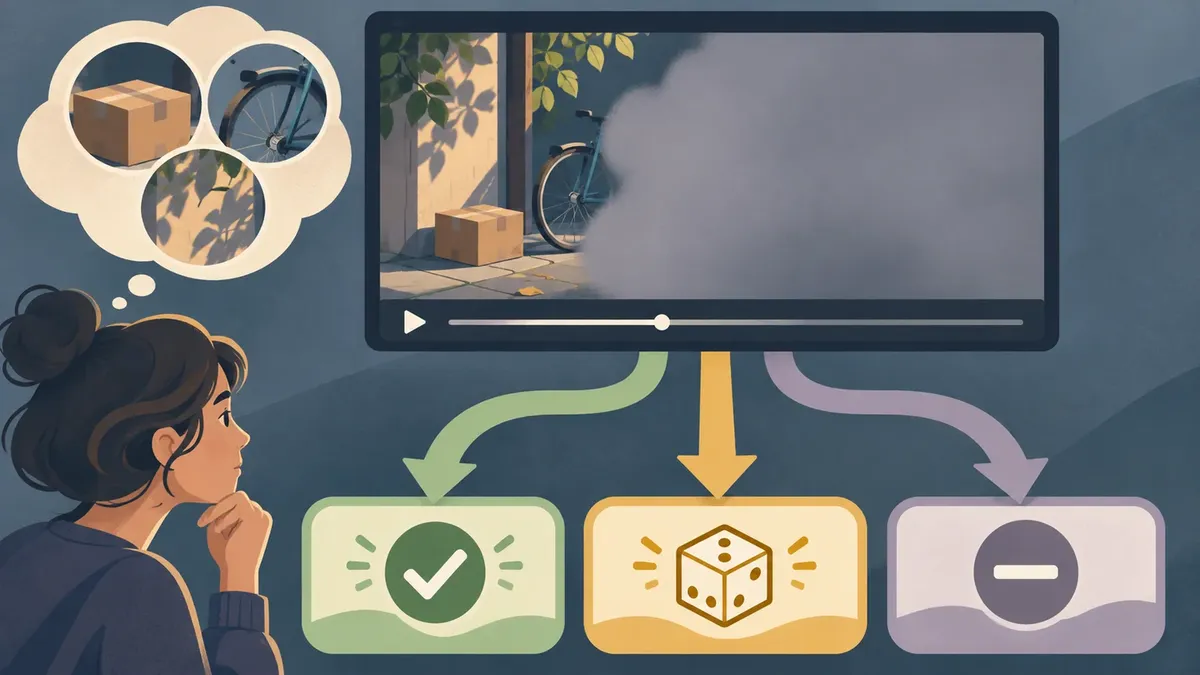
When a video leaves out a crucial detail, an AI system may still have clues. A new benchmark tests whether video-language models can distinguish those clues from enough evidence to answer—and from evidence too thin to support any answer.
The problem: evidence is not simply present or absent
A video question can be answerable even when the relevant event is clearly shown. But sometimes the recording captures only part of what happened: a person or object is visible, for example, while the detail needed for a definite answer is not. In that situation, a useful system might offer a tentative answer based on the clues, while making its uncertainty clear. If the video supplies no relevant clue, it should abstain.
The paper Out of Sight, Not Out of Clues: Can Video LLMs Guess from Partial Evidence? argues that many existing evaluations miss this middle ground. They divide questions into answerable and unanswerable, making it hard to tell whether a model fails to notice visual information or notices it but judges its adequacy poorly.
A benchmark with three evidence levels
The authors introduce ClueProbe, a benchmark of 1,721 human-annotated questions about 598 natural videos. Each question is labeled as Answerable, Guessable, or Unanswerable. The categories distinguish evidence that supports a direct answer, partial clues that may support a qualified guess, and cases where relevant evidence is absent.
The benchmark also includes controlled changes to wording or visual input. These perturbations are intended to help separate recognizing evidence from deciding whether it is sufficient. The authors evaluated 10 open-source and proprietary video-language models and report that they also fine-tuned models with targeted supervision to test whether training on the three evidence levels changes responses.
What the authors report
According to the abstract, the models often appeared to perceive relevant evidence but did not reliably calibrate their responses to its strength. They tended to answer outright or refuse, and rarely chose the intermediate response: guessing from partial clues.
The authors report that targeted fine-tuning to teach the guess level raised appropriate guessing from 1.6% to 40.4%, without additional false refusals. By contrast, conventional refusal tuning rejected 92% of questions labeled Guessable. These figures describe the study’s reported evaluations; they do not establish how the systems would behave across every video task or in real deployments.
The authors interpret the results as evidence that the problem is not simply a lack of visual perception or model capacity. In their account, models need supervision that teaches graded judgments about evidence sufficiency. The abstract summarizes the diagnosis, but does not provide the experimental details needed here to independently assess the measures, model-by-model variation, or how broadly the fine-tuning result generalizes.
Why the distinction matters—and what remains uncertain
Treating every uncertain case alike can create opposite problems: a model may state a weakly supported answer as fact, or refuse even when the video contains useful clues. Separating “guessable” from “unanswerable” offers a way to study that trade-off more precisely. In applications such as accessibility or reviewing recorded footage, a qualified answer could be more useful than either confident overstatement or silence—but this benchmark does not show that the tested systems are ready for those settings.
There are important limits to what can be concluded from the available evidence. This account is based on the paper’s abstract, not a full-text examination, so details about question construction, annotation agreement, evaluation procedures, and limitations are not available here. The benchmark covers a defined collection of natural videos and questions; its results should not automatically be generalized to all video models, datasets, or practical environments. The reported improvement after fine-tuning is promising within the evaluation described, but does not by itself show that models can express calibrated uncertainty reliably in everyday use.
The work is an arXiv preprint, which may not have undergone peer review. The authors say that data and code will be released, but the abstract does not establish whether they are already available. ClueProbe’s central contribution is therefore a diagnostic framing: judging partial evidence is different from simply seeing it, and deserves to be measured separately.
- video-language models
- partial visual evidence
- AI uncertainty
- abstention
- ClueProbe
- video question answering
Reviewed cross-references
These connections were reviewed by a model, not independently fact-checked by a human. Similarity does not imply agreement; consult the original papers and the evidence below.
Why Video AI Misses Brief, Crucial Moments
Supporting evidence: Both studies indicate that video-question-answering errors cannot be explained solely by absent visual evidence: ClueProbe reports that models often reach clue-supported answers but misjudge whether to state them as facts or guesses, while Moment-Video reports persistent errors in an audited subset where reviewers judged sampled evidence sufficient. The tasks and diagnostics differ, so this supports only the bounded point that evidence availability alone may not explain errors; it does not establish a common cause across benchmarks.
Model review: · openai-codex/gpt-6-luna
Evidence and provenance
Selected excerpts, not complete papers. PDF extraction can omit figures or damage equations, tables and reading order; sources may be preprints.
2611.34126v1 — Original paper
Excerpt reference:
static/papers/2611.34126v1.md:215-332
Basis: Paper text
Source SHA-256:489fbbd9c01e0804e26960650c1f7a24151f5fa824e53da761a0f0faca0e37852606.02522v3 — Original paper
Excerpt reference:
static/papers/2606.02522v3.md:72-130
Basis: Paper text
Source SHA-256:5837b1d511f2bcba2925ee70d05614d5b45994edd3880727b2e87ff522915228
Related reading
Automatically matched by shared topic keywords. These links do not imply that the sources agree or establish a consensus.
Teaching Vision AI When to Say “I’m Not Sure”
Source published
Shared keywords: ai uncertainty
When a broad clue makes an AI guess
Source published
Shared keywords: ai uncertainty
Can video AIs edit their own memory efficiently?
Source published
Shared keywords: video language models
A Tokenizer-Aware Approach to Faster Video AI
Source published
Shared keywords: video language models
Can video AI remember what happened before?
Source published
Shared keywords: video question answering