TRANSMISSION // 2611.34125v1
A recurring artifact in GMOS-N IFU data—and a proposed correction
Source published
A study describes a broad spectral artifact in some Gemini North integral-field observations and demonstrates an empirical correction. Its origin and wider applicability remain uncertain.
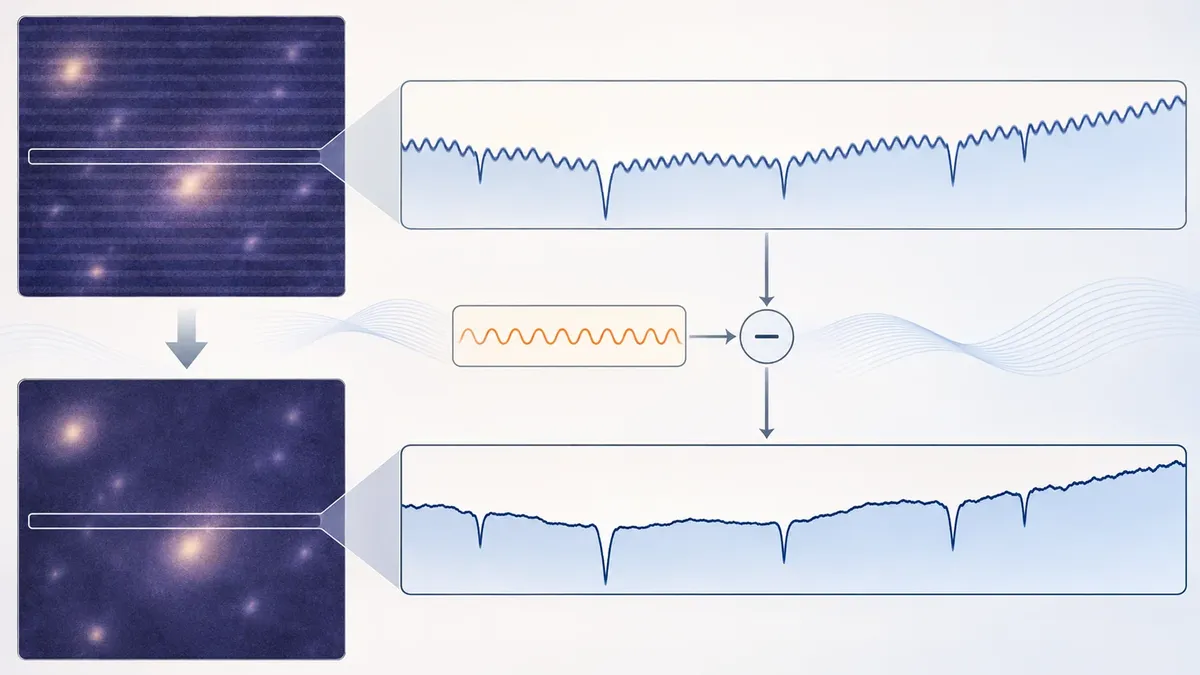
A feature in an astronomical image may come from the instrument rather than the object being observed. Xiaoyang Chen reports a recurring spectral excess near 8000 angstroms in a particular Gemini North observing configuration and describes a template-based method that substantially suppresses its visible spatial pattern.
Integral-field spectroscopy records light from many positions across a small patch of sky, allowing astronomers to reconstruct images at different wavelengths. But not every pattern in a reconstructed image necessarily comes from the astronomical target. A new study describes a recurring feature in observations from the Gemini North telescope and demonstrates an empirical way to reduce its visible imprint.
The work concerns the integral-field unit, or IFU, of the Gemini Multi-Object Spectrograph on Gemini North (GMOS-N). In this observing mode, light from different positions is recorded through optical fibers, and the resulting spectra are mapped back to positions in the field. An unwanted signal associated with a group of fibers can therefore appear as artificial structure in reconstructed images.
A feature tied to particular fibers
The author examined GMOS-N observations obtained between 2020 and 2022 with the R150 grating in the two-slit IFU mode. The reported artifact appears as a vertically aligned structure and is associated mainly with fibers in blocks 5 and 6. In the spectra, it takes the form of a broad excess around 8000 angstroms.
The paper describes observations of two targets. In J0941, the artificial structure lies largely apart from the astronomical source, providing a useful setting for characterizing the feature. The author used those observations to construct an empirical template, then applied it to independent observations of J0916, where the artifact partly overlaps the source. The paper presents this as a correction demonstration, not as a formal validation of how accurately the method recovers the source’s true signal.
Similar features were also encountered in observations of other targets, and the affected fibers largely recur in similar locations. This repeatability suggests an association with the instrument or data-reduction system rather than with the individual targets’ intrinsic structure. It does not identify the cause.
How the correction works
The method represents the artifact using a common spectral profile and an amplitude distribution that varies from fiber to fiber. Multiplying these patterns gives an artifact template. The author estimates a separate overall scaling for each exposure, then subtracts the scaled template from the calibrated fiber spectra before reconstructing the data cube.
In the J0916 images, the artificial structure is substantially suppressed after correction, while the main spatial pattern associated with the astronomical source remains visible. This is a qualitative comparison. The paper says that measuring residual contamination and the accuracy of recovery of the intrinsic astronomical signal is beyond its scope.
What remains uncertain
The artifact’s physical origin is unidentified. It was not apparent in the flat-field exposures examined during the original reduction; whether that relates to exposure duration or illumination conditions remains unclear. Nor does this study establish whether similar features occur with other gratings, IFU configurations, detector systems, or at later epochs. The template is therefore an empirical correction for the observations examined, not a universal calibration for GMOS-IFU data.
The method assumes that the artifact’s spectral profile and relative distribution among fibers remain sufficiently stable across observations. It also needs some affected fibers where the astronomical contribution is negligible, so the exposure’s scaling can be estimated. That may be difficult when a source fills the entire IFU field. Subtracting the modeled artifact cannot remove the observational noise associated with the original contamination, and the uncertainty introduced by constructing and scaling the template has not been independently quantified. The paper cautions that its variance treatment is not a rigorous uncertainty prescription.
The study’s conclusion is that the feature’s repeatability offers a practical way to identify and treat contamination in the observations examined; broader applicability remains to be investigated. As a practical implication—not a tested recommendation—researchers working with similar data could check whether their observations show a comparable pattern before considering this method. The paper is an arXiv preprint, so its findings should be understood as the author’s reported work, not as evidence of peer review. The article says its template and scripts are available from the author upon request.
- Gemini North
- GMOS-N IFU
- integral-field spectroscopy
- spectral artifact
- astronomical data reduction
- fiber spectroscopy
Reviewed cross-references
These connections were reviewed by a model, not independently fact-checked by a human. Similarity does not imply agreement; consult the original papers and the evidence below.
Webb reveals gas differences hidden in a galaxy’s optical glow
Shared method: Both studies use integral-field spectroscopy to examine spatially resolved emission: Chen models and subtracts a recurring artifact in GMOS-N fiber spectra before cube reconstruction, while Pereira et al. analyze JWST/NIRSpec line emission across regions of NGC 4696. The instruments, wavelength regimes, and scientific goals differ, so this is a methodological connection, not evidence that the reported artifact affects NIRSpec data.
Model review: · openai-codex/gpt-6-luna
Evidence and provenance
Selected excerpts, not complete papers. PDF extraction can omit figures or damage equations, tables and reading order; sources may be preprints.
2611.34125v1 — Original paper
Excerpt reference:
static/papers/2611.34125v1.md:93-157
Basis: Paper text
Source SHA-256:af8f6a2b04bb5a3df7ed8c9336c46fd755839b729e24b4523cab296a536c96402611.13116v1 — Original paper
Excerpt reference:
static/papers/2611.13116v1.md:397-442
Basis: Paper text
Source SHA-256:22650df3b023d9c6482b75febf5deab19257ae6219a159e5cff87a5bd5a14945
Related reading
Automatically matched by shared topic keywords. These links do not imply that the sources agree or establish a consensus.