TRANSMISSION // 2611.34111v1
Galaxy spins preserve clues to the early universe
Source published
IllustrisTNG simulations show that halo and stellar spin directions remain correlated across space, with patterns that a tidal-torque model can partly explain.
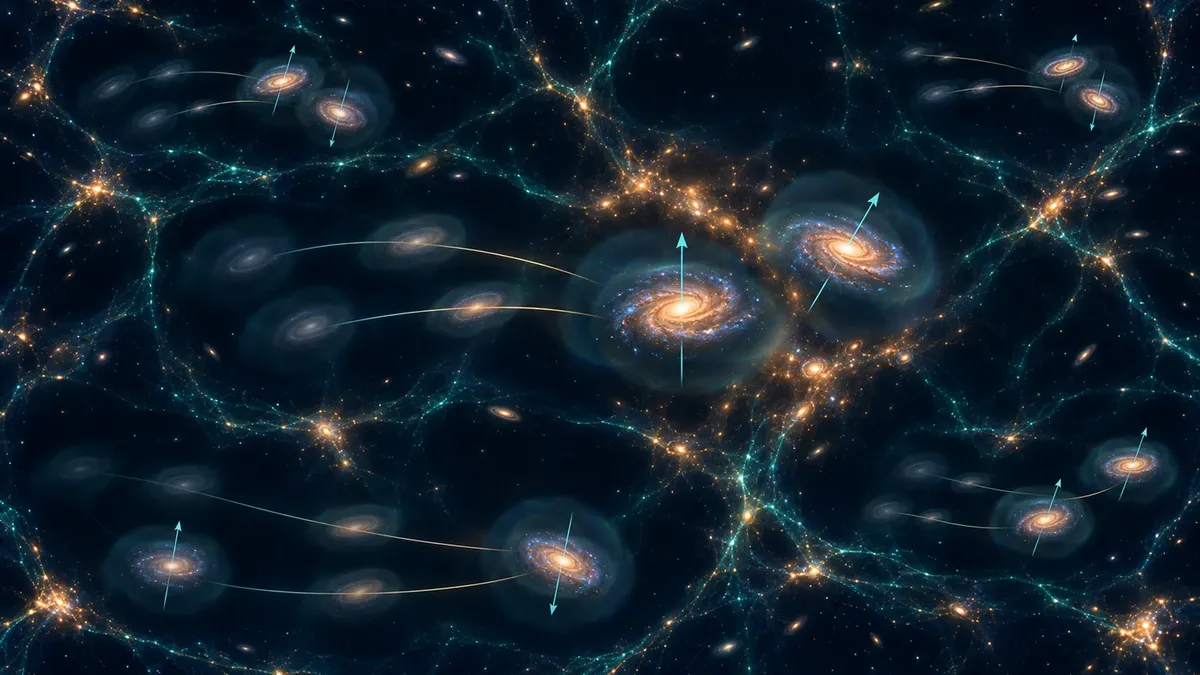
A galaxy’s spin is more than a measure of how it rotates: its direction may preserve traces of the conditions in which cosmic structure formed. Simulations suggest that neighboring dark-matter halos and their stars have correlated spin axes. A new study tests how much of that pattern can be explained by early gravitational tides—and how later motion changes the distances at which the correlations appear.
Why study galaxy spins?
Galaxies and the dark-matter halos around them rotate. If nearby objects tend to have similarly oriented spin axes, those alignments may preserve information about the large-scale gravitational field that shaped them. The challenge is that theories of how spins first arise describe objects in their initial positions, while astronomers measure galaxies at their present-day locations. Cosmic motion changes the separation between pairs, and observations based on redshift add another distortion from galaxies’ motions along our line of sight.
Jun-Sung Moon, Teppei Okumura and Ue-Li Pen investigate these effects using the TNG300 simulations from IllustrisTNG. Their study asks whether a model based on linear tidal torque theory can describe simulated spin-axis correlations once the changing pair separations are taken into account, and how the results differ for dark matter and stars.
Following pairs from the initial universe
The researchers use both a hydrodynamic simulation, which includes gas and galaxy-formation processes, and a dark-matter-only run that shares the same initial density field. They identify subhalos at the present epoch and trace their member dark-matter particles back to the simulation’s initial conditions. This lets them measure the same spin directions against three kinds of pair separation: initial (Lagrangian), present-day real-space, and redshift-space separation.
Their statistic measures whether two spin axes tend to be parallel or perpendicular; it does not distinguish a spin direction from the opposite direction along the same axis. They compare the measurements with a tidal-torque model, which links spin alignments to correlations in the early gravitational tidal field. To translate the model from initial to present-day separations, they measure from the simulation how initial pair distances are distributed at each present-day distance. They then average the model over that distribution, rather than treating initial and current distances as interchangeable.
What the simulations show
At the present epoch, dark-matter halo spin axes show positive correlations as a function of initial pair separation, with correlations generally declining as separation grows. The tidal-torque model captures the broad pattern, and its fitted amplitude varies only weakly across the mass thresholds studied.
The separation mapping is important: at small present-day distances, pairs can have originated across a broad range of initial distances. Applying the measured mapping to the model reproduces much of the overall correlation trend in real space and redshift space without fitting a new amplitude to those measurements. This is a broad success, not a perfect match. In particular, the dark-matter-only run shows a stronger-than-predicted signal at the smallest real-space separations; the excess is less pronounced in the hydrodynamic run. The authors suggest that nonlinear interactions between nearby halos may contribute, but the study does not establish a definitive cause.
The two simulations otherwise show broadly similar dark-matter spin correlations when measured against initial separations. Their differences are most evident at small present-day real-space separations, so the results do not imply that baryonic physics has no effect on spins.
Stellar spins in the hydrodynamic run also show positive correlations. Their dependence on initial separation resembles the dark-matter pattern, but their fitted correlation amplitudes are lower—roughly 60% of the corresponding dark-matter amplitudes in the study’s comparison. The model and separation mapping also capture the broad trends for stellar spins in real and redshift space. The stellar analysis is limited to two higher-mass samples because the researchers require enough stellar particles to estimate a galaxy’s spin reliably.
Finally, the team compares spins measured in the initial conditions with present-day spins. Initial spin-axis correlations are substantially stronger at the same initial pair separations. That pattern is consistent with later, nonlinear evolution weakening the correlations, although the analysis does not isolate a single mechanism responsible for the change.
What remains uncertain
The work is based on one simulation volume and its matched dark-matter-only counterpart, not a direct measurement of the whole universe. The separation mapping is measured from these simulations, so its success does not by itself show that the same mapping will apply unchanged to every galaxy sample or cosmology. The tidal-torque model is an effective description: it captures broad trends, while residuals remain, including significant mismatches in some initial-correlation fits and small-scale excesses in some present-day measurements.
The authors discuss comparisons with observations, but emphasize that differences in sample selection, projection and measurement definitions limit direct comparisons. Testing the framework against mock observations and real galaxy surveys remains important. The paper is a preprint prepared for submission to JCAP; its findings should be treated as research in progress rather than as a settled consensus.
- galaxy spins
- dark matter halos
- IllustrisTNG
- tidal torque theory
- cosmological simulations
- redshift-space distortions
Related reading
Automatically matched by shared topic keywords. These links do not imply that the sources agree or establish a consensus.
Reading the early universe through the cosmic web
Source published
Shared keywords: cosmological simulations, dark matter halos
A giant galaxy’s stellar layers preserve clues to its dark halo’s past
Source published
Shared keywords: dark matter halos
A U-Net Emulates Lyman-Alpha Forests in Vast Volumes
Source published
Shared keywords: cosmological simulations
Small-scale galaxy patterns may improve cosmology’s priors
Source published
Shared keywords: cosmological simulations
Tracing the branching roots of dark-matter haloes
Source published
Shared keywords: cosmological simulations