TRANSMISSION // 2611.34101v1
AlignPre links rain forecasting to verification scores
Source published
AlignPre is a proposed pixel-space generative method for short-term radar forecasting. Its authors report higher forecast skill across three benchmarks, while key details remain unavailable in the abstract.
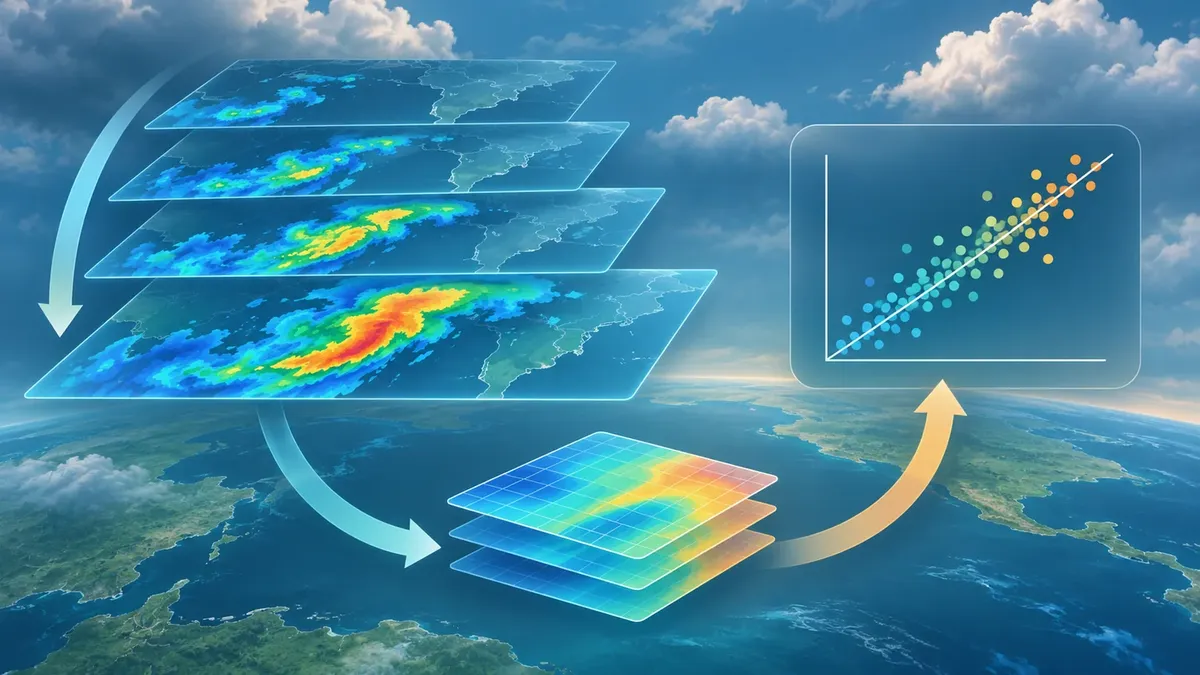
A model can match patterns in radar data without directly optimizing the measures used to evaluate forecasts. AlignPre proposes a post-training step that uses forecast-verification scores as feedback. Its authors report improved skill on three benchmarks, but the abstract does not provide enough detail to gauge the size or scope of those gains.
Can forecast scores help train a rain-forecasting model?
Precipitation nowcasting concerns short-term forecasts of precipitation. The abstract for AlignPre: Skill-Aligned Post-Training for Latent-Free Generative Precipitation Nowcasting describes the task as short-term radar forecasting. It notes that generative diffusion models can produce detailed radar forecasts by modeling conditional distributions, while arguing that distribution matching alone does not directly optimize operational forecast skill.
Demin Yu, Kenghong Lin and Xutao Li propose AlignPre as a way to connect model training more directly to forecast verification. The method uses an end-to-end flow-matching forecaster with a hierarchical spatiotemporal architecture. It generates radar fields directly in pixel space, without latent compression.
Verification as training feedback
The central contribution is skill-aligned post-training (SAPT). According to the abstract, SAPT uses the analytic structure of forecast-verification scores to build a differentiable objective. The objective’s gradients are backpropagated from radar fields to the generator, turning verification scores into direct training feedback.
The abstract presents SAPT as post-training after distribution matching, but does not give procedural details about how the objective is implemented or how the training stages are configured. It also does not name the verification scores used.
What the authors report
Across three real-world benchmarks covering different forecast horizons, the authors report that AlignPre surpasses state-of-the-art deterministic and generative baselines in forecast skill. They argue that aligning generative modeling with domain-specific verification may offer an effective approach to meteorological forecasting.
The abstract does not identify the benchmarks or horizons, provide numerical scores, or specify the evaluation measures. It also gives no uncertainty estimates. These omissions mean the abstract alone cannot show how large the reported gains are or how consistent they are; whether the full paper supplies further analysis is not established by the abstract.
Nor does the abstract establish whether any reported score improvements extend to other properties of forecasts. For example, do they improve calibration, performance on rare extremes, or usefulness for particular decisions? These remain open questions here, not outcomes the abstract reports.
This account is based on the abstract rather than the full paper, so its methods, results and limitations cannot be assessed in depth. The source is an arXiv preprint; the supplied information does not establish that it has undergone peer review. The findings should therefore be read as the authors’ reported benchmark results, not as evidence of improved operational forecasting.
The proposal’s main idea is straightforward: verification scores can serve not only to evaluate forecasts, but also to guide post-training. Whether that produces robust gains beyond the reported benchmarks—and whether those gains matter for real-world forecasting—requires evidence beyond the abstract.
- precipitation nowcasting
- radar forecasting
- generative models
- flow matching
- forecast verification
- machine learning
Reviewed cross-references
These connections were reviewed by a model, not independently fact-checked by a human. Similarity does not imply agreement; consult the original papers and the evidence below.
When a model’s uncertainty may be a sign it has not learned enough
Shared method: Both studies use conditional flow-based generative modeling: AlignPre applies flow matching to radar nowcasting, while Sharma et al. study conditional flow models and their generated distributions. The tasks and objectives differ, so the uncertainty findings in regression do not establish how AlignPre behaves.
Model review: · openai-codex/gpt-6-luna
Evidence and provenance
Selected excerpts, not complete papers. PDF extraction can omit figures or damage equations, tables and reading order; sources may be preprints.
2611.34101v1 — Original paper
Excerpt reference:
static/papers/2611.34101v1.md:13-81
Basis: Paper text
Source SHA-256:83dfe2f3b5ab409b2bc7118c2601dd553bce777f9cc69486230d80289fbd3e0e2610.29172v2 — Original paper
Excerpt reference:
static/papers/2610.29172v2.md:13-76
Basis: Paper text
Source SHA-256:ca32f2808a197c605014e9849ac995b71d1ad7abb8cf4834e2e50a44d9731fbf
Related reading
Automatically matched by shared topic keywords. These links do not imply that the sources agree or establish a consensus.
A discrete-time bridge between deterministic diffusion and flow matching
Source published
Shared keywords: flow matching, generative models
How BEACON changes the starting point for microscopy restoration
Source published
Shared keywords: generative models
A neural network learns several possible maps of cosmic filaments
Source published
Shared keywords: flow matching
RefMix gives image models more room to vary
Source published
Shared keywords: flow matching
A Mathematical Case for Neural Flow Matching
Source published
Shared keywords: flow matching