TRANSMISSION // 2611.34079v1
How WorldBridge connects scattered images into explorable 3D scenes
Source published
WorldBridge aims to turn photographs with little visual overlap into coherent, camera-guided 3D scenes. Its authors report stronger benchmark results than the tested alternatives, while noting that fine geometry and weakly connected views remain difficult.
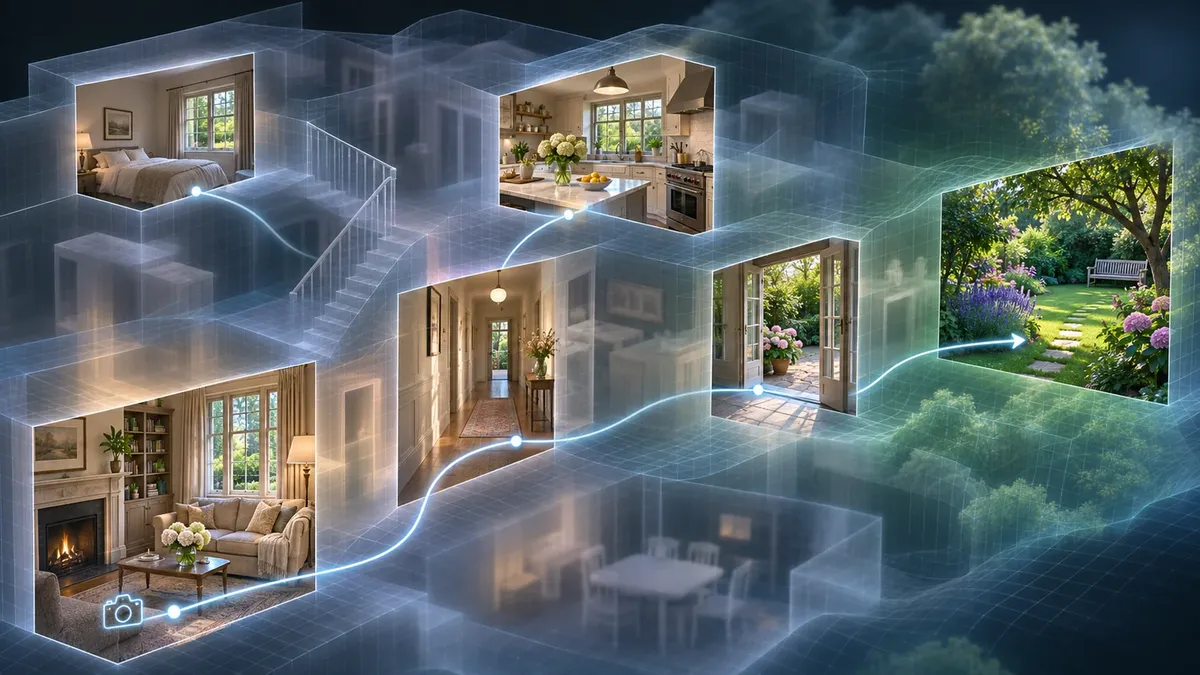
A few photos can show very different parts of a place without revealing how those parts fit together. WorldBridge is a system designed to use such scattered views to generate new, navigable viewpoints—and plausible content between them.
The challenge: connecting views that barely overlap
Imagine trying to build a map of a building from photos of its entrance, a distant corridor and a room, with no shared details to link the images. Each photo reveals only part of the scene, so the geometry and appearance of the unseen space are uncertain. A system might invent a plausible connection, but still place objects inconsistently when the camera moves.
That is the problem addressed by WorldBridge, a computer-vision framework described in a research preprint by Weilong Yan and colleagues. It takes reference images together with their camera poses—the positions and orientations from which they were captured—and generates images and 3D geometry for requested viewpoints. The goal is to preserve what the photos show while filling in unseen areas in a spatially coherent way.
A shared scene picture, plus details from each photo
WorldBridge combines two kinds of information. First, a scene encoder collects the posed reference images into a shared, global representation. For each requested camera, a scene reader uses that representation to provide guidance about the view’s broader layout. Second, a separate pathway retains detail from individual references, helping generated views stay faithful to what was actually observed.
The system also distinguishes between temporal references, which have known places along the camera’s route, and spatial references, which show relevant parts of the scene but do not sit on that route. Its attention mechanism handles these groups differently rather than assigning off-route images artificial positions in time. An optional text prompt can guide what appears in unseen regions.
During generation, a further technique called latent-reference consistency compares generated views with reference content projected into the requested cameras. It uses that comparison to adjust the generated representation while keeping the model’s parameters fixed. In practical terms, it is a way to nudge the output toward the observed images during the generation process, not a guarantee that every detail will be reconstructed accurately.
Testing both familiar and difficult views
The authors introduce the WorldBridge benchmark suite because, they argue, existing tests do not adequately measure generation from references with little overlap. It has three parts: Short tests transitions between two low-overlap images from real-world video; Long tests longer sequences guided by multiple references; and Agent uses synthetic scenes to test references both on and off the requested camera route.
The paper also evaluates the method on two existing novel-view-synthesis benchmarks. Its comparisons include several recent systems, using released checkpoints and adapting their input formats and procedures to the tests. The authors report that WorldBridge achieves the strongest image-fidelity scores among the compared methods on those public benchmarks and on their Short test. On Long, they report better image fidelity and depth accuracy than the strongest cited baseline for those measures. On Agent, they report lower camera-pose and geometric reprojection errors than the alternatives overall, though not every individual metric is best in every setting.
The researchers also remove components in ablation tests. Without the global scene pathway, image fidelity falls on the Long test and geometric reprojection error rises in the off-route Agent setting. Removing the inference-time consistency step worsens image fidelity and reference error in the reported tests. These comparisons support the value of the components in the authors’ experimental setup; they do not establish that the same gains will hold in every scene or application.
What the results do—and do not—show
The approach is not a complete solution to 3D reconstruction. The authors say its geometry can lack fine detail: broad layouts may be convincing even when narrow edges or small structures become sparse or uneven in the generated point maps. They also report that off-route references become less useful when requested views show little of what those references depict. In that situation, more of the output is unconstrained, leaving the system greater scope to vary the surroundings.
There are other reasons to interpret the results cautiously. Some benchmark labels rely on estimated camera poses and depth rather than direct ground truth; the Agent scenes are synthetically authored. The paper’s comparisons depend on particular benchmark choices and baseline adaptations. Its supplementary material says the model and benchmark are intended for release upon acceptance, so the reported experiments should not be mistaken for independent validation or evidence of real-world deployment.
WorldBridge’s contribution is a method for combining broad scene-level guidance with the details of scattered images, alongside a test suite aimed at this unusually low-overlap setting. The reported results suggest that this combination can help produce more consistent generated views under the tested conditions. How reliably it handles unfamiliar scenes, fine geometry and weakly relevant references remains an open question.
Source note: This article is based on arXiv preprint 2611.34079v1. A preprint is a research manuscript and may not have undergone peer review; the results and claims summarized here are those reported by its authors.
- WorldBridge
- 3D scene generation
- computer vision
- novel view synthesis
- sparse images
- camera-guided generation
Related reading
Automatically matched by shared topic keywords. These links do not imply that the sources agree or establish a consensus.
The hidden frequency setting in geometric RoPE
Source published
Shared keywords: computer vision, novel view synthesis
Why Update Direction Matters in Sparse-View 3D Scenes
Source published
Shared keywords: computer vision, novel view synthesis
An AI that learns your taste in room design
Source published
Shared keywords: 3d scene generation
Predicting the street a car’s cameras cannot yet see
Source published
Shared keywords: novel view synthesis
Can AI Judges Follow Vision Criteria?
Source published
Shared keywords: computer vision