TRANSMISSION // 2611.34068v1
When AI Bidders Think Too Briefly—or Read Their Own Work Wrong
Source published
In a study of six open reasoning models, auction bids often went wrong not because of arithmetic but because of token limits, answer readout, or a final choice that ignored the model’s own calculations.
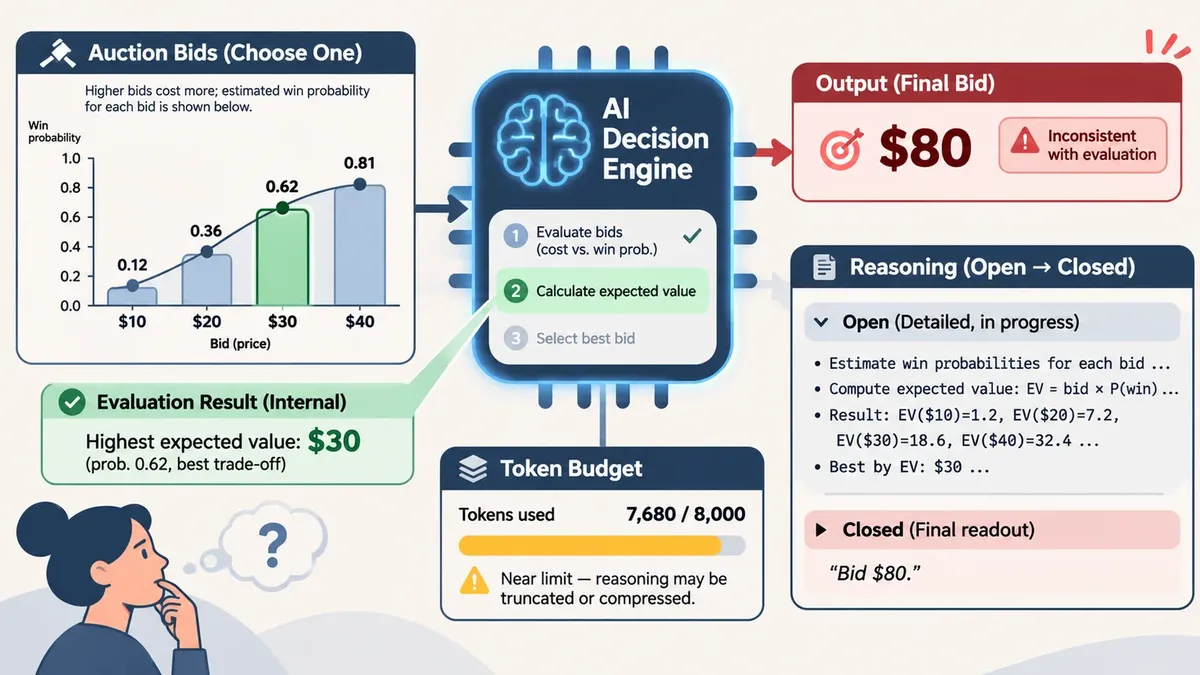
Reasoning models can spend hundreds of tokens weighing auction bids—but does that effort help? In a controlled study, researchers gave six open models estimated win probabilities and asked them to choose profitable bids. The results point to several distinct failure points, from truncated reasoning to answer extraction, while leaving open how well the findings apply to live markets.
Online marketplaces and ad platforms can give bidders a bid landscape: a list of possible bids and an estimate of the chance each one will win. A bidding agent can compare the likely gain from winning with the amount it must pay. But when an AI model makes that choice, where does it lose value: by stopping too soon, calculating badly, or choosing an answer that does not follow its own reasoning?
A new preprint examines that question using six open reasoning models, ranging from 4 billion to 14 billion parameters. The researchers gave each model a private value, a short menu of bids, and estimated win probabilities. The best bid could be found exactly by calculating each option’s expected profit: its win probability multiplied by the difference between the bidder’s value and the bid. That calculator provided a benchmark for measuring the models’ decisions.
The tests used 216 scenarios based on eBay closing prices and 216 based on AuctionNet, a simulated advertising market. The models were evaluated on held-out auctions or opportunities, rather than the data used to build the win-probability estimates. Researchers varied how many reasoning tokens the models could use, also tested runs where the models stopped on their own, and examined the text of their reasoning traces to locate mistakes.
More tokens helped—but so did closing the answer
Under a forced limit of 768 reasoning tokens on the eBay scenarios, models recovered between 42% and 85% of the calculator’s advantage over a model that did no reasoning. The shortfall had different sources for different models. For several, traces were cut off before the model evaluated every option. When allowed to stop on its own within a larger 4,096-token limit, five models recovered 91% to 100% of the calculator’s lead. This does not mean more reasoning always improves decisions; it shows that, in this task, tight caps could interrupt useful work.
Another problem arose when researchers requested the final answer while the reasoning block was still open. Closing the block first improved the weakest model’s recovery from 42% to 84% on eBay and from 24% to 81% on AuctionNet. The researchers interpret this as a readout problem: the answer selected after reasoning did not reliably match the model’s stated conclusion. In fact, among traces where this model explicitly stated a choice, that choice was often better than the letter ultimately returned.
Arithmetic errors accounted for a relatively small share of the performance gap for five of the six models, according to the paper’s trace-based estimates. The researchers used automated code—not human annotation—to identify calculations in the traces, and reported lower and upper bounds because the parser could misread a number. One model, Granite-8B, was an exception, with a larger estimated arithmetic contribution.
Even when a model had written down and ranked the best option first, it sometimes chose another bid. Wrong choices also tended to favor the highest bid in the menu. That pattern persisted when the researchers changed the readout or sampled multiple answers. Because bid order was randomized, the authors argue that the tendency related to bid size, not simply an option’s position. In the study’s pay-your-bid scoring setup, wrong answers on eBay cost 7% to 17% of the calculator’s surplus at 768 tokens.
A trace can help flag risky answers
The authors also tested an audit: software extracts the model’s own per-option figures and flags an answer that conflicts with those figures. When flagged bids were replaced with the calculator’s choice, the share of the calculator’s lead recovered on eBay rose from 42%–85% to 84%–100% in the tested validation setups. Settings selected on eBay also transferred to AuctionNet. The flag itself does not require a calculator, but the reported override does; the study does not measure the cost of review or establish that this procedure is practical in a live bidding system.
These results come from a deliberately narrow task: models received the win estimates, had only a short menu, and were scored under pay-your-bid pricing. The researchers did not model eBay’s proxy-bidding rules or AuctionNet’s actual payment and ad-slot mechanics. AuctionNet is simulated, the eBay sample covered three product types, and real advertising exchange logs were not tested. The models were also all open models in a particular size range; the findings should not automatically be extended to larger or newer systems.
The source is an arXiv preprint, not evidence of peer-reviewed publication. Its results show how specific prompts, token caps, and answer-reading procedures affected these models in this benchmark. They do not establish how much value AI bidding agents lose in real markets or prove that the same problems will occur in every auction. Still, the study offers a practical lesson for evaluating such systems: check not only the reasoning budget, but also whether the final bid agrees with the reasoning the model actually produced.
- reasoning models
- AI bidding
- online auctions
- bid landscapes
- language models
Related reading
Automatically matched by shared topic keywords. These links do not imply that the sources agree or establish a consensus.
How ACTR Tries to Connect AI Safety Reasoning to Answers
Source published
Shared keywords: reasoning models
A Small AI ‘Scout’ Could Help Predict the Cost of Larger Models
Source published
Shared keywords: reasoning models
Can Reinforcement Learning Help Small Models Translate the Law?
Source published
Shared keywords: language models
Can AI reasoning models apply a visual rule consistently?
Source published
Shared keywords: reasoning models
Can an AI’s confidence signal predict when it will backtrack?
Source published
Shared keywords: reasoning models