TRANSMISSION // 2611.34047v1
How Euclid Helps Ground Telescopes Tell Stars from Galaxies
Source published
A study tests two ways to classify point-like sources and galaxies in UNIONS ground-based images, using Euclid observations as a reference. One method finds nearly all point sources but admits more galaxy contamination at faint magnitudes; a neural network produces a purer, less complete sample.
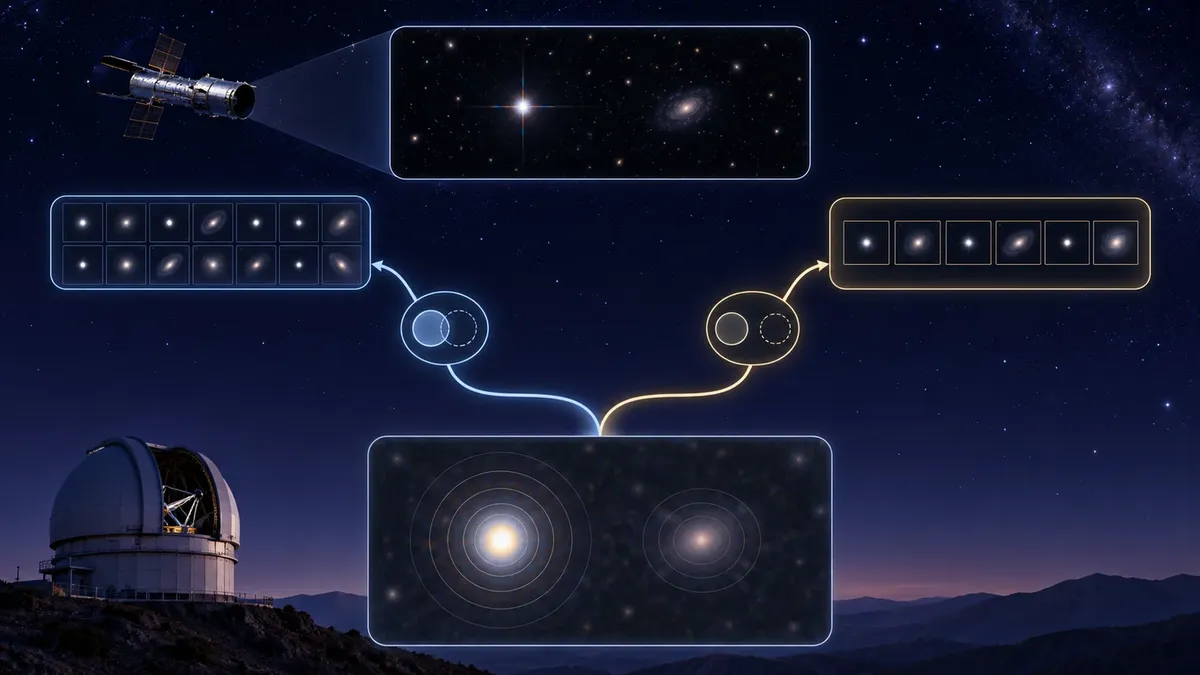
In deep sky surveys, distant galaxies can look almost like stars: both may appear as tiny points of light. Researchers tested two ways to separate these sources in ground-based images, using sharper observations from the Euclid space telescope to check the classifications. The results reveal a practical trade-off: keep nearly all point sources, or select a cleaner sample while missing more of them.
A star usually appears point-like in a telescope image, while a galaxy spreads its light over a larger area. But as objects grow fainter, galaxies become harder to resolve, and measurement noise blurs the distinction. Getting it wrong matters: studies that count stars or measure galaxy shapes can be affected by objects assigned to the wrong category.
A team led by G. Thomas tested two ways to separate point sources from extended objects using images from the Ultraviolet Near-Infrared Optical Northern Survey (UNIONS). Their goal was to see how well methods based on a single ground-based filter could work, including in survey regions without matching space-based observations.
A sharper view for checking the labels
The researchers compared UNIONS images in the r band with images from Euclid’s visible instrument, covering 8 square degrees and more than 756,000 sources detected in both surveys. The area included a contiguous region of about 7 square degrees and four tiles in a separate region. Euclid’s sharper images let the team label sources by their apparent shape at fainter brightness than was practical with the ground-based images alone. These Euclid-based labels served as the reference for testing methods applied to UNIONS data.
Both approaches used information about how a source’s measured light changes with aperture size. A point source’s light profile tends to follow the image’s point-spread function—the blur produced by the telescope and observing conditions. A galaxy’s light is generally more spread out. The first method compared light measurements in two apertures, scaled to image quality. The second fed aperture measurements, image quality and source-shape measurements into a supervised neural network trained on the Euclid labels.
Two useful trade-offs
The simpler curve-of-growth method was designed to capture almost all point sources. It achieved more than 95% completeness across the non-saturated magnitude range studied: in other words, it missed relatively few of the reference point sources. But completeness is not the same as purity, which measures how many selected candidates are genuinely point-like. Purity fell as sources grew fainter, dropping below 10% around an r-band magnitude of 24 in the paper’s reported results. The method can therefore produce many candidates while also including many extended objects.
The neural network made a different trade. Its detailed results report about 74% purity at r = 24; the paper’s broader summary describes purity of at least 80% down to approximately magnitude 24. Completeness at a similar depth fell to about 50%. That means a cleaner candidate list than the high-completeness approach, but with roughly half the reference point sources missed. Image quality strongly affects both methods’ performance; the network’s completeness, in particular, varies with image quality.
The practical choice depends on the scientific task. A search where overlooking possible stars is costly may favour the more complete method, followed by checks to remove contaminants. A study that needs a cleaner point-source sample may prefer the neural network and accept that it misses more objects. Neither method eliminates the underlying difficulty: at faint brightness, the images themselves carry less decisive shape information.
What the test can—and cannot—show
The results come from areas observed by both surveys and from sources detected in both. The authors note that objects on bright galaxy backgrounds were often missed or failed quality cuts, so blended and overlapping systems are largely absent. The tested sample therefore does not establish performance for every crowded or difficult field. The Euclid reference labels are also not perfectly immune to error: compact galaxies or unresolved star clusters could sometimes be mistaken for point sources, although the authors consider this contamination marginal at the studied depth.
The paper discusses applying the methods to future ground-based surveys such as the Legacy Survey of Space and Time (LSST). That is a possible use, not a guarantee that performance will transfer unchanged: image quality affects the results, and survey data can differ. The source is a preprint manuscript, so its findings should be read as research results rather than a settled comparison across all surveys. Its main contribution is a calibrated demonstration of how a sharper space-based reference can help build and test classifiers for ground-based images.
- star–galaxy separation
- Euclid
- UNIONS
- astronomy surveys
- neural networks
- image quality
Related reading
Automatically matched by shared topic keywords. These links do not imply that the sources agree or establish a consensus.
Vision-language models struggle to predict their visual weak spots
Source published
Shared keywords: image quality
Can neural networks have representational atoms?
Source published
Shared keywords: neural networks
Training Wireless AI to Handle Signals It Has Never Seen
Source published
Shared keywords: neural networks
Why Some Neural Networks Need More Depth
Source published
Shared keywords: neural networks
A Hadamard Transform Helps Neural Networks Avoid Some Multiplications
Source published
Shared keywords: neural networks