TRANSMISSION // 2611.34040v1
Why three-dimensional quantum channels can do what qubits cannot
Source published
A mathematical study finds that two channels unable to transmit quantum information perfectly on their own can do so together—and that three-dimensional inputs are the smallest setting where this one-shot effect can occur.
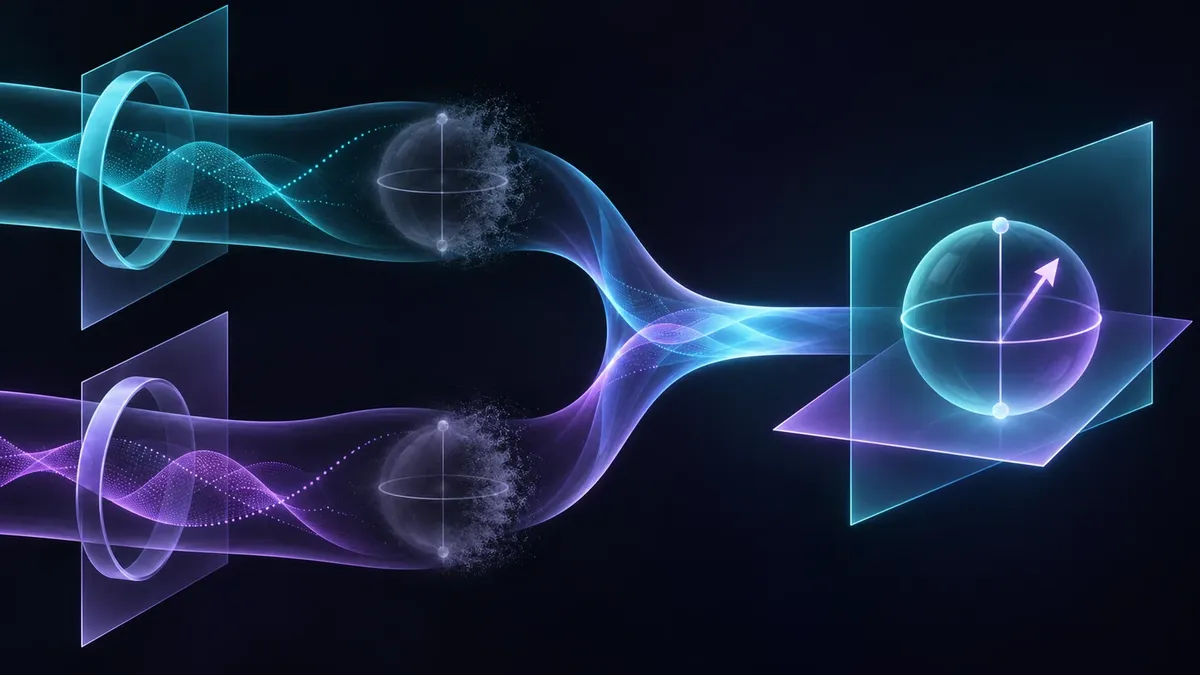
Can two quantum channels that each fail to carry even one perfectly recoverable qubit become useful when combined? A mathematical preprint answers yes for channels with three-dimensional inputs, and proves that two-dimensional inputs are too small for this particular effect.
Quantum channels describe how information changes as it passes through a physical process. Noise often makes recovery imperfect. This paper studies a stricter question: can a quantum state be transmitted with exactly zero error after a single use of a channel?
The surprising possibility is superactivation: two channels, neither of which can transmit a qubit perfectly by itself, may be able to do so when used together. Earlier work had established examples, but the smallest input dimension that could support the effect was not settled. Andrei Shcherbakov’s preprint asks where that minimum lies for one-shot zero-error quantum capacity.
What “one-shot” and “zero-error” mean
A quantum code is a set of states that can be sent through a channel and recovered. In the zero-error setting, recovery must be exact—not merely very reliable as the number of transmissions grows. “One-shot” means considering a single use of the channel. The paper measures capacity through the largest code space that can be perfectly recovered.
This is not the same as the more familiar asymptotic quantum capacity, which concerns reliable transmission over many uses and allows errors that become small in a suitable limit. The paper notes that superactivation is known in that broader setting too, but its main result concerns the one-shot, exact-recovery version.
How the argument works
The author represents each channel by a noncommutative graph: an operator system, or a structured collection of matrices that captures the constraints relevant to exact error correction. A code is valid when the matrices in this collection act on the code space in a way that does not reveal which encoded state was sent. This is the Knill–Laflamme condition, a standard criterion for perfect quantum error correction.
The proof has two parts. First, it establishes additivity for any finite collection of channels whose input spaces are two-dimensional. In plain terms, combining such channels cannot produce a one-shot zero-error capacity greater than the sum of their individual capacities. This rules out superactivation for a pair of qubit-input channels.
Second, the paper constructs two explicit operator systems in the space of three-by-three matrices. Each system has no code larger than a single state, so each corresponding channel has zero one-shot zero-error quantum capacity. But for their tensor product, the author exhibits a two-dimensional code space and verifies that it satisfies the exact-recovery condition. That space can carry one qubit perfectly. The paper also states that these operator systems can be realized as the noncommutative graphs of quantum channels with three-dimensional inputs.
Together, the lower-dimensional impossibility result and the three-dimensional construction establish the claimed minimum: three.
What the result does—and doesn’t—show
This is a result about mathematical channel models and perfect transmission under a specific one-use definition. It does not show that a laboratory device has been built, that noisy physical channels will exhibit the effect in practice, or that combining channels improves ordinary communication in general. Nor does it establish a minimum dimension for every other notion of quantum capacity: the conclusion is specifically about one-shot zero-error quantum capacity.
The paper reports that ChatGPT GPT-6 Astra assisted in obtaining the pair of operator systems. It says the claims used in the proof—including the absence of larger individual codes and the validity of the combined code—were then checked separately in exact algebraic form. That disclosure describes part of the research process; it is not independent validation of the result.
The source is an arXiv preprint, not evidence here of peer review or independent replication. The argument is mathematical rather than experimental, and the source material available for this article does not provide external confirmation. The result is therefore best read as a precise proof claim whose significance depends on the correctness of its definitions and derivations, rather than as a demonstrated practical technology.
- quantum information
- quantum channels
- zero-error capacity
- superactivation
- quantum error correction
- noncommutative graphs
Related reading
Automatically matched by shared topic keywords. These links do not imply that the sources agree or establish a consensus.
How quantum systems behave over the long run
Source published
Shared keywords: quantum channels, quantum information
A probability table may reveal what a quantum channel does—and what the lab is doing
Source published
Shared keywords: quantum channels, quantum information
New bounds map uncertainty across quantum channels
Source published
Shared keywords: quantum channels, quantum information
Why finite quantum circuits cannot reproduce the quantum switch
Source published
Shared keywords: quantum channels, quantum information
Bound entanglement can help reconstruct quantum processes
Source published
Shared keywords: quantum channels, quantum information