TRANSMISSION // 2611.34035v1
One learned policy, many team sizes
Source published
A simulated collection game tests policy replication across team sizes. Warm-start retraining reduced training episodes by up to 90% in a reported comparison.
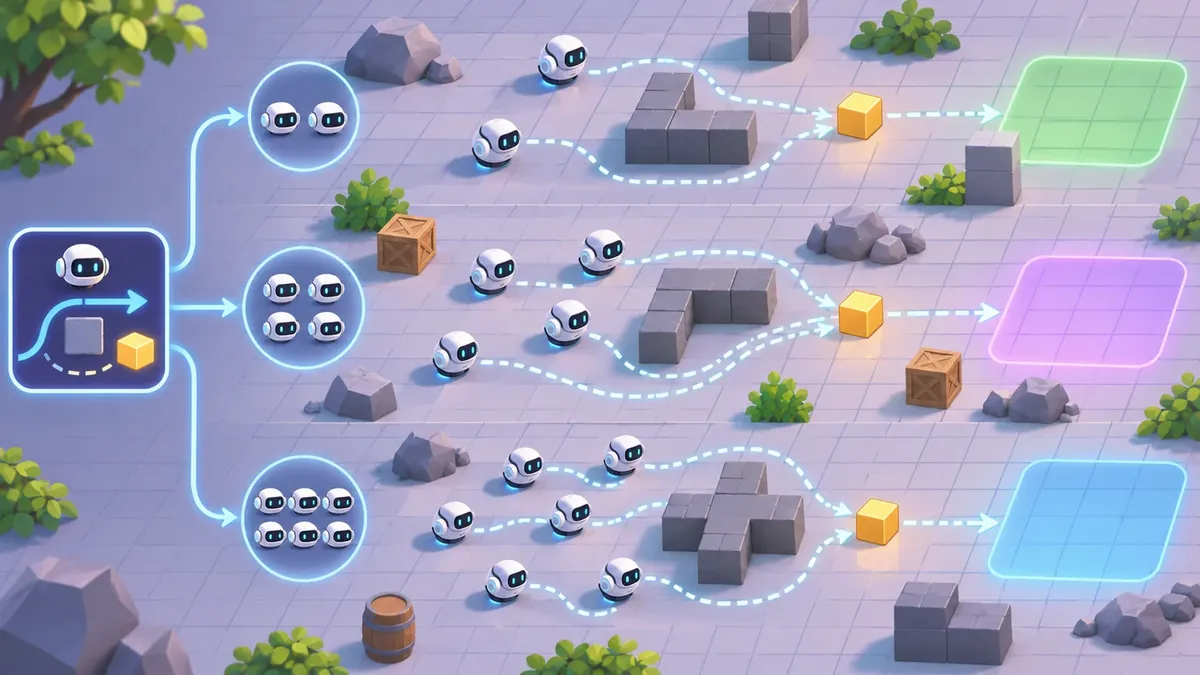
Training coordinated AI teams can be costly when the number of agents or their assigned tasks changes. A new arXiv preprint tests whether a policy trained for one team size can be reused across differently sized teams instead of training each from scratch.
In a team of AI agents, coordination means more than having each agent perform well on its own. The group must avoid collisions, cover assigned areas and respond to instructions about where to work. Training across many combinations of team sizes and instructions can become computationally expensive.
A new study explores whether a trained policy can be reused. The researchers tested this approach in a simulated object-collection game, transferring policies between teams of different sizes. The paper is an arXiv preprint; the supplied material does not establish its peer-review status or independent replication.
Making observations independent of team size
The study builds on sfDA7-X, which gives agents regional instructions through a “destination channel”: a grid indicating where an agent should collect objects. An aggregated destination channel summarizes teammates’ assigned regions, helping an agent account for where others are meant to work.
In sfDA7-X, observations include separate channels for each agent, as well as channels for obstacles and objects. The input structure therefore changes with team size, complicating direct policy reuse. The proposed sfDA8-X architecture combines nearby agents into one channel. Alongside channels for obstacles and objects, this produces a fixed three-channel local observation, regardless of the number of agents.
The researchers first compared learning in four-agent teams. Using the same reinforcement-learning head, sfDA8-X achieved performance comparable to sfDA7-X in total reward and objects collected. They then selected among four separately trained four-agent policies and copied a selected policy’s parameters to all agents in teams of three, four or five. Although the agents shared parameters, their different locations and instructions provided different inputs, allowing their actions to differ. Which source policy was selected mattered to performance.
What happened when policies were reused
In zero-shot tests—where the copied policy received no further training—the results varied by team size and measure. The individually trained baseline is listed first, followed by the replicated policy. For three agents, average reward was 103.118 versus 116.068, while objects collected were 117.845 versus 117.618. For four agents, reward was 141.536 versus 131.533 and objects were 143.814 versus 134.130. For five agents, reward was 145.556 versus 140.311 and objects were 149.951 versus 145.785. The authors describe the four- and five-agent decreases as not severe. Still, replication did not consistently match or outperform individually trained policies.
These comparisons used four destination-channel arrangement patterns. For a four-agent example, one agent received a broad instruction covering the collection area while the others received instructions for a half-region; the patterns varied the key region. The reported three-, four- and five-agent results should be understood in the context of these tested arrangements.
The researchers also tested warm-start retraining: using a copied policy to initialize training at a new team size. For three agents, after 3,000 episodes the warm-start model exceeded the individually trained baseline’s final reward and object count; that baseline trained for 10,000 episodes. For five agents, the warm-start model exceeded both final measures after 5,000 episodes, versus 50,000 episodes for the baseline—a 90% reduction in episodes in that comparison. The three-agent comparison represents a 70% reduction. These are specific results, not guaranteed savings across tasks. In the five-agent run, performance was lower at 50,000 episodes than at 20,000; the authors suggest excessive updates may have caused overfitting.
Heatmaps offered a qualitative check of instruction following. In a representative setup, one agent received a broad destination channel while others were assigned restricted regions. The authors interpreted the collection patterns as showing broad-instruction agents filling areas that would otherwise be less covered, while restricted agents followed their assigned regions. Heatmaps also showed deployments to six- and eight-agent teams, with broad-instruction agents supplementing areas not covered by others. These larger-team illustrations are qualitative, not quantitative comparisons with teams trained from scratch.
What the evidence does—and doesn’t—show
The results suggest that a fixed-size observation design can make policy replication feasible in this particular simulated game. But performance depended on which of the four trained policies was selected, and the study tested a limited set of source policies and instruction arrangements. Sharing one policy also removes differences among agent-specific policies that may have developed during training.
The evidence is limited to one grid-based collection environment and the tested team sizes and setups. It does not establish that the approach will work in real-world settings, more dynamic environments or other cooperative tasks. The authors identify adaptive source-policy selection and testing with larger teams and wider, more dynamic environments as future work. Because this is an arXiv preprint, its peer-review status and independent replication are not established by the supplied source.
- multi-agent reinforcement learning
- AI coordination
- policy replication
- team size
- reinforcement learning
- simulation
Reviewed cross-references
These connections were reviewed by a model, not independently fact-checked by a human. Similarity does not imply agreement; consult the original papers and the evidence below.
AI swarms learn when to share—and when to split the search
Shared method: Both use a shared policy across agents: sfDA8-X copies one trained agent’s parameters to a differently sized team, whereas s³ trains a shared language-model policy for its swarm. This is a parameter-sharing connection, not evidence that either method’s results transfer to the other’s setting.
Model review: · openai-codex/gpt-6-luna
Evidence and provenance
Selected excerpts, not complete papers. PDF extraction can omit figures or damage equations, tables and reading order; sources may be preprints.
2611.34035v1 — Original paper
Excerpt reference:
static/papers/2611.34035v1.md:489-577
Basis: Paper text
Source SHA-256:026f97b9ba6d9c4abbe563c6506a1d285ab5f0e925248d64429a4006378b7fda2611.08615v1 — Original paper
Excerpt reference:
static/papers/2611.08615v1.md:61-115
Basis: Paper text
Source SHA-256:a79f9e5a9b3ee13983fb8ea2bec7559c66d82abb436fcc37e9d96ec3fcf6d33a
Related reading
Automatically matched by shared topic keywords. These links do not imply that the sources agree or establish a consensus.
How Game Agents Handle New Partners and Layouts
Source published
Shared keywords: multi agent reinforcement learning
AI swarms learn when to share—and when to split the search
Source published
Shared keywords: ai coordination, multi agent reinforcement learning
CARGO trains simulated vehicles to distinguish helpful cooperation from avoidable risk
Source published
Shared keywords: multi agent reinforcement learning
How TeamFlowRL trains coordinated AI teams
Source published
Shared keywords: multi agent reinforcement learning
An AI city-building game explores the trade-offs of urban resilience
Source published
Shared keywords: multi agent reinforcement learning