TRANSMISSION // 2611.34032v1
Can edited images reveal what a deepfake detector uses?
Source published
Counter-DECEIVR uses detector-guided image edits to flip deepfake verdicts, offering a way to examine model behavior while highlighting limits of the approach.
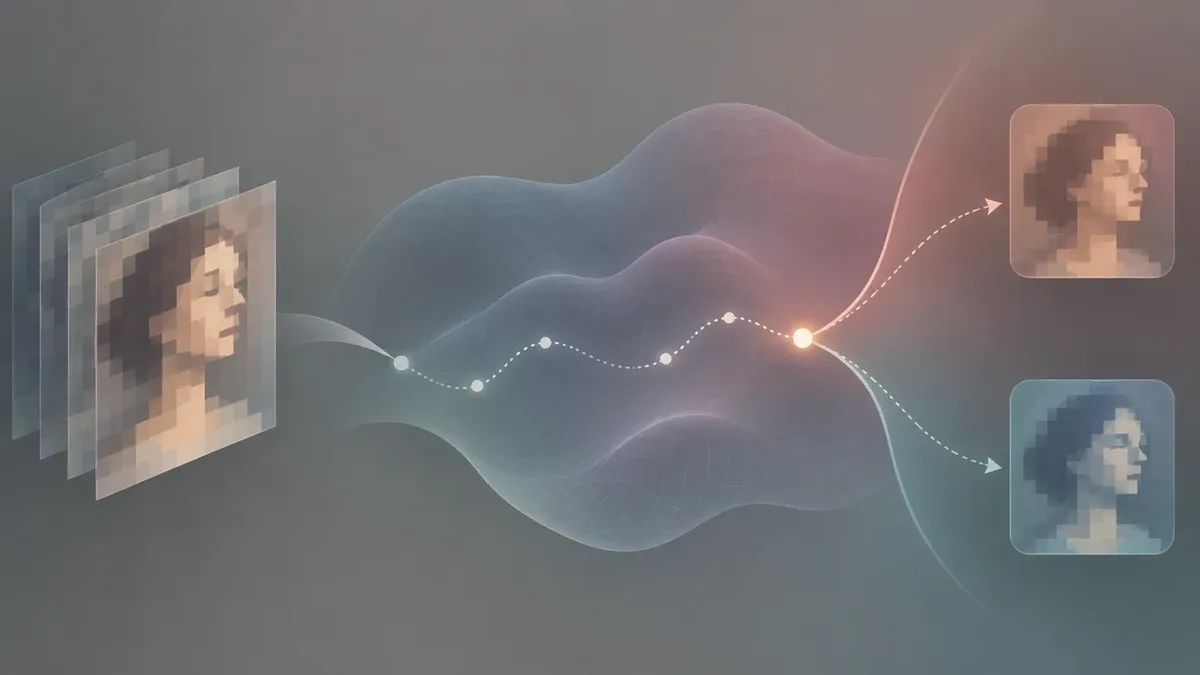
A deepfake detector can label an image “fake” without making its reasoning easy to inspect. Counter-DECEIVR explores a different kind of explanation: alter an image until the detector changes its verdict, while guiding edits toward regions its own explanation map highlights.
The question: what would change the detector’s mind?
Deepfake detectors can label an image as real or manipulated, but their reasoning may be difficult to inspect. A heat map can indicate which areas mattered to a model; however, the features it highlights may be subtle or hard for a person to interpret. The researchers behind Counter-DECEIVR ask whether a more concrete probe is possible: can a system make an image edit that flips a detector’s decision while keeping the change localized?
Such an edit is called a counterfactual. Here, it does not establish what caused an image to be fake, or whether the image is genuinely authentic. It shows a hypothetical change that makes one particular detector switch its classification. That is evidence about the detector’s behavior, not proof of its reasoning or of the image’s real-world origin.
How the method works
Counter-DECEIVR starts with a pretrained rectified-flow image model, which maps between image representations and noise along a learned trajectory. The method first maps a face image toward a noise representation, then runs the process in reverse to reconstruct the image. During that return journey, gradients from a deepfake detector steer the image toward a chosen target class.
Because the detector evaluates ordinary images rather than noisy intermediate representations, the method estimates a clean image at each guided step and uses the detector’s gradient to adjust the latent trajectory. It also uses the detector’s Grad-CAM explanation map as a soft spatial mask. This encourages changes in highlighted regions while steering other areas toward reconstruction of the original.
A control parameter determines how far reconstruction proceeds before guided editing begins, allowing the strength of the intervention to vary. The framework is described as training-free: it does not train a new generator or fine-tune the detector for each case. But it does require access to detector gradients, so it cannot be applied to detectors available only through a standard prediction API.
What the tests found
The researchers tested Counter-DECEIVR with two image-based deepfake detectors on FaceForensics++ and Celeb-DF. Both detectors had been trained on FaceForensics++. For each dataset, the evaluation used 400 manipulated test images, and included an image only when the detector had classified it correctly. The task was to change a fake verdict to real, rather than to correct an existing detector error.
The authors compared the method with four counterfactual-generation approaches. They assessed whether edits changed detector scores and how much the resulting images differed from the originals, using measures that included image-distribution distance and perceptual or structural similarity. Since stronger edits may make a verdict flip more readily while also changing the image more, the paper compares trade-off curves instead of treating a single edit strength as best in all cases.
Across the tested detectors and datasets, the authors report that Counter-DECEIVR achieved a better balance between changing detector scores and preserving similarity to the input than the compared methods. Its edits were concentrated in regions highlighted by the detector’s explanation map. In an ablation, removing the map-based mask led to broader edits and a worse trade-off on the reported measures.
These findings are bounded by the evaluation. The authors selected operating points using a chosen range of FID values, and note that similarity measures do not by themselves establish that an edit is realistic or meaningful to a person. They also show that very strong edits can reflect the pretrained flow model’s prior—for example, details it tends to generate—rather than evidence specific to the detector.
What remains uncertain
The experiments cover two detectors, two datasets and image-based face-manipulation cases. They do not establish that the approach works for other detectors, image domains or video deepfakes. The paper says counterfactuals are specific to the detector being tested; transfer is not expected when different detectors rely on different evidence.
Nor does a flipped verdict prove that the edit exposes the detector’s true reasoning in a human-meaningful way. The approach uses the detector’s own gradients and explanation map, so its output is tied to that model’s behavior. Plausibility is encouraged by using a pretrained flow model and assessed indirectly with image metrics; it is not guaranteed. The authors also note that conventional white-box adversarial attacks may be cheaper for open detectors. Their proposed distinction is that Counter-DECEIVR links edits to detector-highlighted regions, rather than offering an advantage over such attacks in general.
This account is based on the version 1 arXiv record and paper text supplied for this article. That material does not establish whether the work has been peer reviewed or independently replicated. Code is described as forthcoming upon acceptance. The results therefore show how Counter-DECEIVR performed in the reported tests, not whether it will provide dependable explanations in practical forensic use.
- deepfake detection
- counterfactual explanations
- rectified flow
- computer vision
- AI interpretability
Reviewed cross-references
These connections were reviewed by a model, not independently fact-checked by a human. Similarity does not imply agreement; consult the original papers and the evidence below.
Can AI infer ECG waveforms from pulse recordings?
Shared method: Both papers use rectified flow for generation: Counter-DECEIVR guides a pretrained image-flow trajectory with deepfake-detector gradients, whereas PPGFlowECG uses PPG-conditioned flow to generate ECG latents. This is a shared modeling approach, not evidence that the systems share an implementation or that results transfer across image forensics and physiological signals.
Model review: · openai-codex/gpt-6-luna
Evidence and provenance
Selected excerpts, not complete papers. PDF extraction can omit figures or damage equations, tables and reading order; sources may be preprints.
2611.34032v1 — Original paper
Excerpt reference:
static/papers/2611.34032v1.md:13-81
Basis: Paper text
Source SHA-256:06fdcac435595088aec3093942af1196c3ba83ce72223c5bbe9a13e71a4b087d2509.19774v4 — Original paper
Excerpt reference:
static/papers/2509.19774v4.md:127-192
Basis: Paper text
Source SHA-256:35b6cc86bee5c5a7415bd8a56cadc82a5ee2d8f3fb83bb6d9cbb5097c2e28969
Related reading
Automatically matched by shared topic keywords. These links do not imply that the sources agree or establish a consensus.
When image and text disagree: finding what drives an AI prediction
Source published
Shared keywords: ai interpretability, counterfactual explanations
A two-stream detector targets multiple kinds of video forgery
Source published
Shared keywords: computer vision, deepfake detection
When Do Vision-Model Features Transfer Across Training Seeds?
Source published
Shared keywords: ai interpretability, computer vision
Turning recommendation “what-ifs” into explanations people can read
Source published
Shared keywords: counterfactual explanations
FoleyForge edits sound effects with words, balancing change against fidelity
Source published
Shared keywords: rectified flow